Menu
Store
Blog
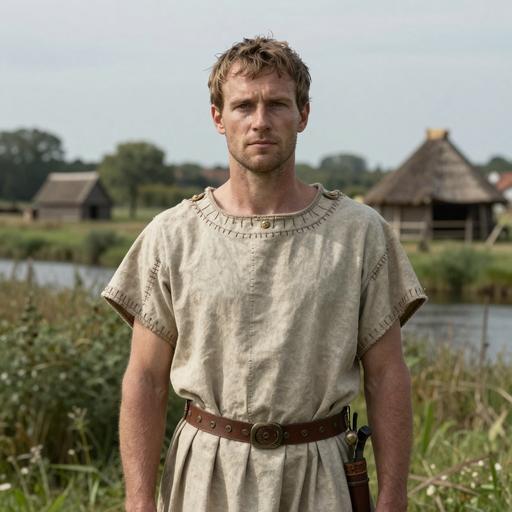
Portrait reconstruction of I11631
Ancient Individual

A man buried in Netherlands in the Iron Age era

I11631
95 BCE - 109 BCE
Male
Early Roman Period Netherlands
Netherlands
Scroll to begin
Chapter I

Identity

The biological and cultural markers that define this ancient individual

Sample ID

I11631

Date Range

95 BCE - 109 BCE

Biological Sex

Male

mtDNA Haplogroup

T2b

Y-DNA Haplogroup

Not available

Cultural Period

Early Roman Period Netherlands

Chapter II

Place

Where this individual was discovered

Country Netherlands
Locality Gelderland. Tiel-Medel-De Reth
Coordinates 51.9180, 5.4510
Chapter III

Time

When this individual lived in the broader context of human history

I11631 95 BCE - 109 BCE
Chapter IV

Story

The narrative of this ancient life

The Early Roman Period in the region now known as the Netherlands was a time of significant cultural, social, and economic transformation that occurred roughly between the 1st century BCE and the early 3rd century CE. During this era, the influence of the Roman Empire began to permeate throughout the region, which was at the northern edge of the Roman Empire. This period was characterized by a blend of Roman and indigenous cultures, resulting in a unique cultural tapestry.

Historical Context

Before Roman influence, the area was inhabited by various Celtic and Germanic tribes, including the Batavians, Frisians, and Cananefates. The Roman conquest began in earnest with campaigns by Julius Caesar in the 50s BCE, though the region wasn't fully integrated into the Roman Empire until later expeditions solidified Roman control. The Rhine River, which cuts through what is now the Netherlands, served as both a critical frontier and a major route for the movement of Roman troops and goods. However, full Romanization was limited due to geographical challenges such as marshlands and the resistance from local tribes.

Economy and Trade

The introduction of Roman infrastructure, including roads and fortifications, significantly impacted the economy. Roman engineering brought the construction of roads and bridges, which improved trade routes within the region and with the wider Roman Empire. The presence of Roman legions and settlements stimulated local economies as they required supplies, creating markets for local goods, including textiles, pottery, and metalwork. Trade with the Roman heartlands introduced new goods such as wine, olives, and luxury items, which were exchanged for regional products like salt, cattle, and leather.

Military and Administration

The area held strategic importance for the Roman military, serving as a frontier zone with numerous forts and camps established along the Rhine, such as those at Noviomagus (modern Nijmegen) and Lugdunum Batavorum (modern Katwijk/Brittenburg). These installations helped enforce Roman control and protected against incursions by northern tribes. To ensure loyalty and maintain security, the Romans formed alliances with local tribes, notably the Batavians, who served as auxiliary soldiers in the Roman army. Roman military presence also accelerated the spread of Roman culture and practices as soldiers settled in the area, often intermarrying with local populations.

Society and Culture

Socially, the Early Roman Period in the Netherlands saw considerable cultural exchange and syncretism. The indigenous tribes began adopting Roman customs, language, and religion. Latin began to influence local dialects, though full Latinization remained limited to certain urban and military areas. The Roman pantheon was introduced, leading to syncretic religious practices where aspects of local deities were merged with Roman gods. Archaeological findings such as altars and votive offerings illustrate this blend of religious practices.

The Roman lifestyle, including housing, clothing, and food, influenced the local populations as Roman villas and bathhouses were erected. Urban centers like Nijmegen developed Roman architectural styles with forums, temples, and administrative buildings, although many inhabitants continued to live in traditional roundhouse settlements.

Legacy and Challenges

Despite these developments, the reach of Roman civilization was uneven throughout the territory. While the south and areas near the Rhine were more Romanized, the northern and more rural regions retained stronger local traditions. Moreover, the geography of the Netherlands, with its rivers and wetlands, posed constant challenges to the Roman administration, particularly in maintaining infrastructure and military control.

As the Roman Empire faced increasing pressure from Germanic tribes in the late 3rd century CE, the military focus shifted, leading to a gradual withdrawal from outlier territories like the Netherlands. However, the Roman legacy persisted long after their departure, influencing the region's development in areas of law, language, and infrastructure.

Overall, the Early Roman Period in the Netherlands was marked by a dynamic interplay between Roman innovation and local tradition, shaping a distinctive regional identity that carried forward elements of both Celtic-Germanic and Roman influences.

Chapter V

Genetics

The genetic ancestry of this ancient individual

Ancient Genetic Admixture

This analysis compares the DNA profile of I11631 with ancient reference populations, showing the genetic composition in terms of prehistoric ancestral groups.

European Hunter-Gatherers 42.7%
Western Steppe Pastoralists 38.0%
Neolithic Farmers 14.5%
Ancient Native Americans 4.8%

Modern Genetic Admixture

This analysis compares the DNA profile with present-day reference populations, showing what percentage of genetic makeup resembles modern populations from different regions.

Europe 100.0%
Northwestern European 67.7%
English 47.7%
Northwestern European 10.1%
Finnish 9.9%
Eastern European 28.7%
Southern European 3.7%
Sardinian 3.7%

Closest Modern Populations

These are the modern populations showing the closest statistical alignment to A man buried in Netherlands in the Iron Age era, ranked by genetic distance. Lower distance values indicate closer statistical similarity.

1
German Hamburg
3.0444
2
Orcadian
3.1564
3
German
3.2710
4
Afrikaner
3.2860
5
Dutch
3.3262
6
German Erlangen
3.3438
7
Scottish
3.3530
8
German East
3.3667
9
Swedish
3.3781
10
Norwegian
3.4000
Chapter VI

Context

Other ancient individuals connected to this sample

Sources

References

Scientific publications and genetic data

Scientific Publication

Large-scale migration into Britain during the Middle to Late Bronze Age

Authors Patterson N, Isakov M, Booth T
Abstract

Present-day people from England and Wales have more ancestry derived from early European farmers (EEF) than did people of the Early Bronze Age1. To understand this, here we generated genome-wide data from 793 individuals, increasing data from the Middle to the Late Bronze Age and Iron Age in Britain by 12-fold, and western and central Europe by 3.5-fold. Between 1000 and 875 BC, EEF ancestry increased in southern Britain (England and Wales) but not northern Britain (Scotland) due to incorporation of migrants who arrived at this time and over previous centuries, and who were genetically most similar to ancient individuals from France. These migrants contributed about half the ancestry of people of England and Wales from the Iron Age, thereby creating a plausible vector for the spread of early Celtic languages into Britain. These patterns are part of a broader trend of EEF ancestry becoming more similar across central and western Europe in the Middle to the Late Bronze Age, coincident with archaeological evidence of intensified cultural exchange2-6. There was comparatively less gene flow from continental Europe during the Iron Age, and the independent genetic trajectory in Britain is also reflected in the rise of the allele conferring lactase persistence to approximately 50% by this time compared to approximately 7% in central Europe where it rose rapidly in frequency only a millennium later. This suggests that dairy products were used in qualitatively different ways in Britain and in central Europe over this period.

G25 Coordinates

The G25 coordinates for sample I11631 can be used for detailed admixture analysis in our G25 Studio tool.

I11631,0.12686204,0.11591008,0.0661978,0.04447482,0.03809688,0.01468018,0.00147112,0.00571432,0.00777904,-1.422E-05,-0.00248944,0.00065894,-0.00642216,-0.00017164,0.00924204,-0.00647642,-0.01862912,0.00126348,-0.00283292,-0.0034768,0.00085286,0.00468048,-0.00431152,0.00420702,0.00150423
Analyze in G25 Studio
Use code for 40% off Expires Feb 27