Menu
Store
Blog
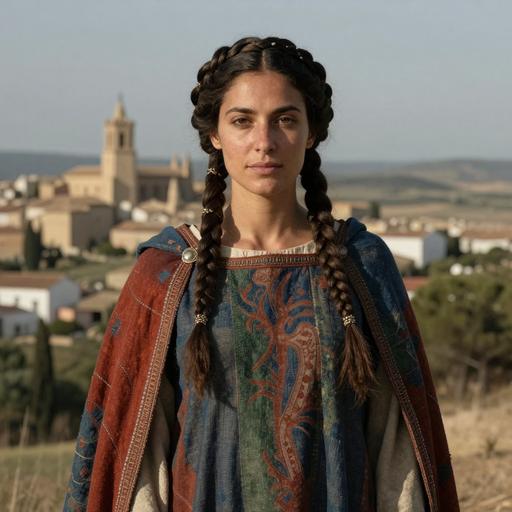
Portrait reconstruction of I12030
Ancient Individual

A woman buried in Spain in the Medieval era

I12030
500 CE - 600 CE
Female
Visigothic Period Girona, Spain
Spain
Scroll to begin
Chapter I

Identity

The biological and cultural markers that define this ancient individual

Sample ID

I12030

Date Range

500 CE - 600 CE

Biological Sex

Female

mtDNA Haplogroup

J1c3g

Cultural Period

Visigothic Period Girona, Spain

Chapter II

Place

Where this individual was discovered

Country Spain
Locality Girona. Pla de l'Horta
Coordinates 42.0166, 2.8149
Chapter III

Time

When this individual lived in the broader context of human history

I12030 500 CE - 600 CE
Chapter IV

Story

The narrative of this ancient life

The Visigothic period in Girona, Spain, is a fascinating chapter in Western European history, reflecting broader trends in the transition from Roman to medieval Europe. The Visigoths, initially a branch of the Germanic tribes, played a pivotal role in this era as they migrated westward and established powerful kingdoms on the Iberian Peninsula after the decline of the Roman Empire.

Historical Context

The Visigothic period in Girona spans approximately from the late 5th century to the early 8th century. It was during this time that the Visigoths consolidated their power in the region. Following the sack of Rome in 410 AD by the Visigoths under King Alaric I, they embarked on a migration that saw them settle first in the region of Aquitania in what is now southwestern France. Eventually, they moved into the Iberian Peninsula, where they established a stronghold with their capital at Toledo.

Political Structure

The Visigothic Kingdom in Spain was characterized by a monarchy, with kings often struggling to maintain authority over various factions of nobles and competing interests. The Visigothic legal code, known as the \Liber Judiciorum" or "Forum Iudicum," was one of their significant contributions. It sought to unify the legal practices of both Roman and Visigothic peoples, indicative of the fusion of cultures that defined the period.

Cultural Synthesis

Girona, as part of the Visigothic Kingdom, was a site of considerable cultural synthesis. While the Visigoths were originally pagan, their conversion to Arian Christianity and subsequently to Catholicism facilitated significant interactions with the existing Romanized Christian populations. This conversion aligned them more closely with local Iberian traditions and the ecclesiastical structures of the time, leading to eventual religious and cultural unity.

Architecture and Art

The Visigoths are known for their distinctive architectural style, which, though not extensively documented in Girona specifically, is evident in multiple sites across Spain. Their architecture featured horseshoe arches and basilica-style church buildings, some of which laid the foundations for the later Romanesque style prominent in Catalonia and elsewhere. Visigothic art and craftsmanship also included intricate metalwork and jewelry, often decorated with garnets and other stones, highlighting their Germanic roots.

Economy and Society

Economically, the Visigothic period in Girona and the broader region was marked by a transition from a Roman urban-centered economy to a more rural, agrarian-based system. This transition was reflective of broader European trends during this time as large villas and estates became the economic hubs rather than cities. Land remained the primary source of wealth, and the social hierarchy was largely feudal, with a significant reliance on serfs and peasants.

Decline and Legacy

The decline of the Visigothic Kingdom came with the Muslim conquests in the early 8th century. In 711, the Moors invaded Spain, and by 722, much of the Visigothic territory, including Girona, had fallen. Despite this rapid decline, the legacy of the Visigoths endured in Spain, particularly in terms of law, language, and cultural practices that continued to influence the region long after their political power had waned.

Girona, like other parts of the Visigothic territories, played an integral role in bridging the ancient world with the medieval era. The cultural and political shifts during the Visigothic period laid foundational stones for the subsequent development of the region, influencing the emergence of distinct Spanish and Catalan identities in the centuries to follow."

Chapter V

Genetics

The genetic ancestry of this ancient individual

Ancient Genetic Admixture

This analysis compares the DNA profile of I12030 with ancient reference populations, showing the genetic composition in terms of prehistoric ancestral groups.

Neolithic Farmers 46.6%
European Hunter-Gatherers 22.7%
Western Steppe Pastoralists 21.4%
Ancient Oceanians 9.3%

Modern Genetic Admixture

This analysis compares the DNA profile with present-day reference populations, showing what percentage of genetic makeup resembles modern populations from different regions.

Europe 59.7%
Northwestern European 49.0%
Southern European 10.7%
Italian 10.7%
Asia 25.8%
Arab, Egyptian & Levantine 16.0%
Arabian 12.4%
Levantine 3.6%
Northern West Asian 9.9%
Cypriot 9.9%
Africa 14.5%
Northern East African 14.5%
Ethiopian 14.5%

Closest Modern Populations

These are the modern populations showing the closest statistical alignment to A woman buried in Spain in the Medieval era, ranked by genetic distance. Lower distance values indicate closer statistical similarity.

1
Spanish Canarias
3.4200
2
Spanish Extremadura
3.7571
3
Belmonte Jew
3.8440
4
Portuguese
3.8746
5
Spanish Murcia
3.8928
6
Spanish Andalucia
3.9376
7
Spanish Eivissa
4.1724
8
Spanish Menorca
4.1853
9
French Corsica
4.2434
10
Sicilian West
4.2512
Chapter VI

Context

Other ancient individuals connected to this sample

Sources

References

Scientific publications and genetic data

Scientific Publication

The genomic history of the Iberian Peninsula over the past 8000 years

Authors Olalde I, Mallick S, Patterson N
Abstract

We assembled genome-wide data from 271 ancient Iberians, of whom 176 are from the largely unsampled period after 2000 BCE, thereby providing a high-resolution time transect of the Iberian Peninsula. We document high genetic substructure between northwestern and southeastern hunter-gatherers before the spread of farming. We reveal sporadic contacts between Iberia and North Africa by ~2500 BCE and, by ~2000 BCE, the replacement of 40% of Iberia's ancestry and nearly 100% of its Y-chromosomes by people with Steppe ancestry. We show that, in the Iron Age, Steppe ancestry had spread not only into Indo-European-speaking regions but also into non-Indo-European-speaking ones, and we reveal that present-day Basques are best described as a typical Iron Age population without the admixture events that later affected the rest of Iberia. Additionally, we document how, beginning at least in the Roman period, the ancestry of the peninsula was transformed by gene flow from North Africa and the eastern Mediterranean.

G25 Coordinates

The G25 coordinates for sample I12030 can be used for detailed admixture analysis in our G25 Studio tool.

I12030,0.09031494,0.1416062,0.0230693,-0.01686128,0.03621504,-0.00860118,-0.00172828,0.00575204,0.02562488,0.02357856,-0.00199288,0.00293282,0.00271124,-0.00495424,-0.00226922,0.00620604,-0.00227138,0.00105458,0.00237692,0.00182514,0.00580632,0.00643572,-0.00598114,-0.0052176,-0.00051914
Analyze in G25 Studio
Use code for 40% off Expires Feb 27