Menu
Store
Blog
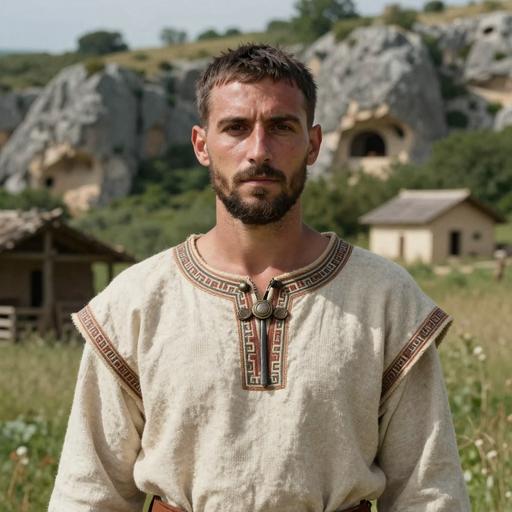
Portrait reconstruction of I26742
Ancient Individual

A man buried in Croatia in the Late Bronze Age to Early Iron Age era

I26742
800 BCE - 600 BCE
Male
The Transition to Iron Age in Croatia
Croatia
Scroll to begin
Chapter I

Identity

The biological and cultural markers that define this ancient individual

Sample ID

I26742

Date Range

800 BCE - 600 BCE

Biological Sex

Male

mtDNA Haplogroup

HV0e

Y-DNA Haplogroup

Not available

Cultural Period

The Transition to Iron Age in Croatia

Chapter II

Place

Where this individual was discovered

Country Croatia
Locality Jazinka Cave
Coordinates 43.7059, 16.5200
Chapter III

Time

When this individual lived in the broader context of human history

I26742 800 BCE - 600 BCE
Chapter IV

Story

The narrative of this ancient life

The transition to the Iron Age in Croatia is marked by the development and influence of the Urnfield culture, a significant archaeological culture in Central Europe during the Late Bronze Age and into the Early Iron Age, roughly spanning from 1300 to 750 BCE. This era is characterized by substantial sociocultural, technological, and economic changes that gradually led to the use of iron for tools and weapons, distinguishing the Iron Age from the preceding Bronze Age.

Geographical Context

Croatia, situated in Southeast Europe along the Adriatic Sea, is a region rich in cultural intersections due to its strategic location between Central Europe, the Mediterranean, and the Balkans. This geographical positioning enabled interactions between various cultural groups, including the Illyrians, Greeks, and later, Romans, which influenced the region's transition into the Iron Age.

The Urnfield Culture

The Urnfield culture is named after the prevalent burial practice of cremating the dead and placing the remains in urns, which were then buried in fields. This funerary custom marks a significant departure from previous burial practices, emphasizing a shift in spiritual and ritualistic behavior.

Settlements and Society

  • Settlements: The Urnfield culture was characterized by increased fortification of settlements, often located on elevated areas or hilltops. These fortified settlements, or hillforts, were indicative of heightened concerns regarding security and defense, possibly due to agricultural surpluses or inter-community competition.

  • Society: The period saw a transition in social structures, with evidence suggesting a more hierarchical society. The emergence of elite classes is indicated by the disparity in burial goods, with some graves containing complex assemblages of pottery, bronze jewelry, and weapons.

Technological and Economic Developments

  • Metalworking: The transition to the Iron Age in Croatia involved the gradual adoption of iron smelting technology. Initially, iron was a rare and precious material primarily used for ornamentation and high-status objects. Over time, as iron working techniques improved, it became more widespread for tools and weapons, eventually surpassing bronze in importance.

  • Agriculture and Trade: The period is marked by advances in agricultural practices, possibly due to the use of iron tools, which enhanced productivity. This increase likely supported population growth and more complex trade networks. Croatia's position along the Adriatic facilitated trade and cultural exchanges with other Mediterranean and European cultures.

Cultural Influences and Trade

The Urnfield culture in Croatia did not exist in isolation; it was part of a broader cultural milieu influenced by neighboring regions. Trade routes extended through the Danube River and the Adriatic Sea, bringing goods such as amber, pottery, and metals. These exchanges introduced new cultural elements and technologies, fostering innovation and cultural diversity in the region.

Art and Material Culture

  • Pottery: The pottery of the Urnfield culture was typically undecorated or simply adorned, characterized by practical forms for everyday use. The lack of elaborate decoration is a notable difference from the preceding cultures, indicating a shift in aesthetic or functional values.

  • Bronze and Iron Artifacts: The transition period saw a combination of bronze and iron being used for tools and decorative items. While bronze continued to be used for detailed work due to its malleability, iron started to take precedence in creating more durable and effective tools and weapons.

Religious and Ritual Practices

The change in burial customs from inhumation to cremation reflects a significant cultural shift, perhaps indicative of changing beliefs about the afterlife. The uniformity in burial practices across a wide geographical area suggests a shared belief system or cultural ideology.

Conclusion

The transition to the Iron Age in Croatia, as part of the broader Urnfield culture, represents a complex period of cultural transformation characterized by technological innovation, changes in social structures, and increased interaction with neighboring regions. The adoption of iron metallurgy, the development of fortified settlements, and evolving burial customs all highlight the dynamic nature of this era, setting the stage for the further cultural developments that would emerge in the ensuing periods, specifically with the rise of the Iapodian, Liburnian, and other historic groups within Illyria. This transition laid important foundations for the Iron Age societies that followed in the Croatian region.

Chapter V

Genetics

The genetic ancestry of this ancient individual

Ancient Genetic Admixture

This analysis compares the DNA profile of I26742 with ancient reference populations, showing the genetic composition in terms of prehistoric ancestral groups.

Neolithic Farmers 45.0%
European Hunter-Gatherers 30.5%
Western Steppe Pastoralists 22.1%
Ancient Asians 2.4%

Modern Genetic Admixture

This analysis compares the DNA profile with present-day reference populations, showing what percentage of genetic makeup resembles modern populations from different regions.

Europe 86.4%
Southern European 59.4%
Italian 31.5%
Balkan 17.2%
Sardinian 5.5%
Iberian 5.3%
Northwestern European 27.0%
Scandinavian 20.6%
Northwestern European 6.5%
Africa 7.8%
North African 7.8%
North African 7.8%
Asia 5.8%
Northern West Asian 5.8%
Cypriot 4.0%
Mesopotamian 1.8%

Closest Modern Populations

These are the modern populations showing the closest statistical alignment to A man buried in Croatia in the Late Bronze Age to Early Iron Age era, ranked by genetic distance. Lower distance values indicate closer statistical similarity.

1
Italian Veneto
1.7687
2
Italian Piedmont
1.8710
3
Italian Trentino Alto Adige
1.9252
4
Spanish Mallorca
2.0061
5
Italian Bergamo
2.0105
6
Swiss Italian
2.1240
7
French Provence
2.1559
8
Spanish Eivissa
2.1850
9
Italian Emilia
2.2228
10
Spanish Menorca
2.2513
Chapter VI

Context

Other ancient individuals connected to this sample

Sources

References

Scientific publications and genetic data

Scientific Publication

Large-scale migration into Britain during the Middle to Late Bronze Age

Authors Patterson N, Isakov M, Booth T
Abstract

Present-day people from England and Wales have more ancestry derived from early European farmers (EEF) than did people of the Early Bronze Age1. To understand this, here we generated genome-wide data from 793 individuals, increasing data from the Middle to the Late Bronze Age and Iron Age in Britain by 12-fold, and western and central Europe by 3.5-fold. Between 1000 and 875 BC, EEF ancestry increased in southern Britain (England and Wales) but not northern Britain (Scotland) due to incorporation of migrants who arrived at this time and over previous centuries, and who were genetically most similar to ancient individuals from France. These migrants contributed about half the ancestry of people of England and Wales from the Iron Age, thereby creating a plausible vector for the spread of early Celtic languages into Britain. These patterns are part of a broader trend of EEF ancestry becoming more similar across central and western Europe in the Middle to the Late Bronze Age, coincident with archaeological evidence of intensified cultural exchange2-6. There was comparatively less gene flow from continental Europe during the Iron Age, and the independent genetic trajectory in Britain is also reflected in the rise of the allele conferring lactase persistence to approximately 50% by this time compared to approximately 7% in central Europe where it rose rapidly in frequency only a millennium later. This suggests that dairy products were used in qualitatively different ways in Britain and in central Europe over this period.

G25 Coordinates

The G25 coordinates for sample I26742 can be used for detailed admixture analysis in our G25 Studio tool.

I26742,0.117588,0.14223982,0.0277679,-0.00550118,0.03196424,0.0005734,-0.00172168,0.00246968,0.01152276,0.02376084,-0.00479986,0.0079308,-0.01255046,-0.0079961,0.00210596,-0.0022444,0.0022749,0.00011922,-0.00034938,5.514E-05,0.00216072,0.00031206,-0.00369696,-0.00413042,0.00065153
Analyze in G25 Studio
Use code for 40% off Expires Feb 27