Menu
Store
Blog
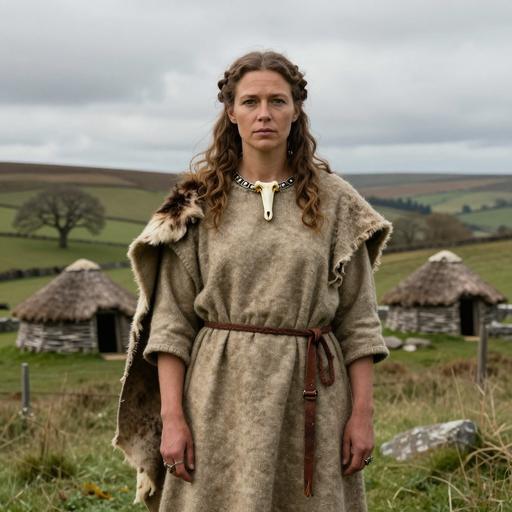
Portrait reconstruction of KD071
Ancient Individual

A woman buried in United Kingdom in the Iron Age era

KD071
750 BCE - 100 CE
Female
Iron Age North Yorkshire, England
United Kingdom
Scroll to begin
Chapter I

Identity

The biological and cultural markers that define this ancient individual

Sample ID

KD071

Date Range

750 BCE - 100 CE

Biological Sex

Female

mtDNA Haplogroup

H1b1+16362

Cultural Period

Iron Age North Yorkshire, England

Chapter II

Place

Where this individual was discovered

Country United Kingdom
Locality England. North Yorkshire. Knapton Wold
Coordinates 54.1596, -0.6418
Chapter III

Time

When this individual lived in the broader context of human history

KD071 750 BCE - 100 CE
Chapter IV

Story

The narrative of this ancient life

The Iron Age in North Yorkshire, England, was a period that spanned from approximately 800 BCE to the Roman invasion in 43 CE. This era, which marked the latter part of the broader Celtic culture across the British Isles, was characterized by significant social, technological, and cultural developments. The people of Iron Age North Yorkshire were part of a broader Celtic network that extended across much of Europe, with shared linguistic, artistic, and religious attributes.

Geography and Settlements

North Yorkshire, with its diverse landscapes, including the Yorkshire Dales, the North York Moors, and fertile lowlands, provided a variety of environments for Iron Age communities. The region's terrain influenced settlement patterns, with tribes often choosing elevated sites for their hillforts, such as Stanwick and Ingleborough, which provided strategic views and natural defenses. These hillforts served not only as military strongholds but also as centers of trade, politics, and community life.

Other settlements were found in the lowlands where the fertile soil allowed for agriculture. Roundhouses built with timber, wattle, and daub, and thatched roofs were the typical dwelling structure, reflecting both practical needs and a connection to the surrounding natural environment.

Economy and Technology

The economy of Iron Age North Yorkshire was primarily agrarian, with the cultivation of wheat, barley, and oats, and the rearing of livestock such as cattle, sheep, and pigs. The introduction of iron tools during this period revolutionized farming, making land clearance and cultivation more efficient and contributing to increased agricultural yields.

Craftsmanship flourished, with local artisans producing pottery, textiles, and metalwork. The use of iron became widespread for the manufacture of tools and weapons, while precious metals were worked into jewelry and ceremonial objects, often featuring intricate Celtic designs such as spirals and knots.

Trade was an important aspect of life, facilitated by the region's rivers and trackways. There was exchange of goods not only within the local tribes but also with continental Europe, evidenced by the discovery of items such as wine amphorae and glass beads.

Social Structure and Tribal Organization

The social structure of Iron Age communities in North Yorkshire was likely hierarchical. Tribal societies were led by chieftains or kings supported by a warrior aristocracy. The Celts are known for their fierce warrior culture, with status often determined by prowess in battle and the accumulation of wealth.

The region was divided among several tribal groups, each with distinct territories. The Brigantes, one of the most powerful tribes in Britain, dominated much of northern England, including North Yorkshire. Their society was complex, with confederations of smaller clans that operated semi-autonomously yet were united under a larger tribal identity.

Religion and Belief Systems

Celtic religion during the Iron Age was polytheistic and deeply connected to nature. The spiritual life of the people in North Yorkshire revolved around the veneration of various deities associated with natural elements like rivers, forests, and mountains. Rituals were often conducted in sacred groves or at natural features, such as springs or hilltops.

Archaeological findings suggest druids played a significant role as religious leaders, believed to possess great wisdom and influence over both spiritual and temporal matters. The reverence for ancestors was also a central aspect of their belief system, with burial practices reflecting a belief in an afterlife.

Art and Culture

Art from the Iron Age in North Yorkshire, as with much of Celtic Britain, was marked by its abstract and flowing designs. Artisans produced decorative items including torcs, brooches, and mirrors, exhibiting distinct La Tène style motifs that included symmetrical patterns, curvilinear designs, and natural forms.

While there are no written records from the Celtic tribes, their oral traditions were rich, featuring storytelling, poetry, and music. The bard played an integral role in these societies, responsible for remembering and performing tales that conveyed the history, laws, and legends of the people.

Legacy

The Iron Age in North Yorkshire laid the foundation for later historical developments, even as the region transitioned into the Roman era. The cultural and technological advancements made during this time had a lasting impact on the socio-economic landscape, leaving behind a wealth of archaeological sites that continue to provide insights into the lives of these ancient peoples.

In summary, Iron Age North Yorkshire was a vibrant and dynamic part of Celtic Britain, characterized by its rich cultural traditions, advanced technological practices, and complex social structures, all of which contributed significantly to the historical tapestry of the region.

Chapter V

Genetics

The genetic ancestry of this ancient individual

Ancient Genetic Admixture

This analysis compares the DNA profile of KD071 with ancient reference populations, showing the genetic composition in terms of prehistoric ancestral groups.

European Hunter-Gatherers 57.8%
Neolithic Farmers 12.7%
Ancient Africans 11.9%
Ancient Oceanians 6.9%
Western Steppe Pastoralists 6.2%
Ancient Asians 4.6%

Modern Genetic Admixture

This analysis compares the DNA profile with present-day reference populations, showing what percentage of genetic makeup resembles modern populations from different regions.

Europe 96.2%
Northwestern European 76.6%
Northwestern European 30.9%
English 27.5%
Finnish 18.3%
Southern European 19.6%
Sardinian 19.6%
Asia 3.8%
Northern West Asian 3.8%
Mesopotamian 3.6%

Closest Modern Populations

These are the modern populations showing the closest statistical alignment to A woman buried in United Kingdom in the Iron Age era, ranked by genetic distance. Lower distance values indicate closer statistical similarity.

1
French Occitanie
2.4466
2
Belgianc
2.5672
3
French Auvergne
2.7044
4
Swiss German
2.8006
5
French Paris
2.8584
6
French Nord
2.9185
7
French Alsace
3.0812
8
Spanish Barcelones
3.0844
9
Spanish Biscay
3.1683
10
Belgiana
3.1932
Chapter VI

Context

Other ancient individuals connected to this sample

Sources

References

Scientific publications and genetic data

Scientific Publication

Ancient DNA at the edge of the world: Continental immigration and the persistence of Neolithic male lineages in Bronze Age Orkney

Authors Dulias K, Foody MGB, Justeau P
Abstract

Orkney was a major cultural center during the Neolithic, 3800 to 2500 BC. Farming flourished, permanent stone settlements and chambered tombs were constructed, and long-range contacts were sustained. From ∼3200 BC, the number, density, and extravagance of settlements increased, and new ceremonial monuments and ceramic styles, possibly originating in Orkney, spread across Britain and Ireland. By ∼2800 BC, this phenomenon was waning, although Neolithic traditions persisted to at least 2500 BC. Unlike elsewhere in Britain, there is little material evidence to suggest a Beaker presence, suggesting that Orkney may have developed along an insular trajectory during the second millennium BC. We tested this by comparing new genomic evidence from 22 Bronze Age and 3 Iron Age burials in northwest Orkney with Neolithic burials from across the archipelago. We identified signals of inward migration on a scale unsuspected from the archaeological record: As elsewhere in Bronze Age Britain, much of the population displayed significant genome-wide ancestry deriving ultimately from the Pontic-Caspian Steppe. However, uniquely in northern and central Europe, most of the male lineages were inherited from the local Neolithic. This suggests that some male descendants of Neolithic Orkney may have remained distinct well into the Bronze Age, although there are signs that this had dwindled by the Iron Age. Furthermore, although the majority of mitochondrial DNA lineages evidently arrived afresh with the Bronze Age, we also find evidence for continuity in the female line of descent from Mesolithic Britain into the Bronze Age and even to the present day.

G25 Coordinates

The G25 coordinates for sample KD071 can be used for detailed admixture analysis in our G25 Studio tool.

KD071,0.1165559,0.13981132,0.05255126,0.0223006,0.0463499,0.00566322,2.31E-05,0.00031228,0.01479538,0.01977772,-0.00849026,0.0109914,-0.01820402,-0.01099318,0.01530038,-0.0078605,-0.01457602,-0.00072874,0.00040488,-0.00251754,0.00647548,0.00226076,-0.0095455,0.00257956,-0.00218062
Analyze in G25 Studio
Use code for 40% off Expires Feb 27