Menu
Store
Blog
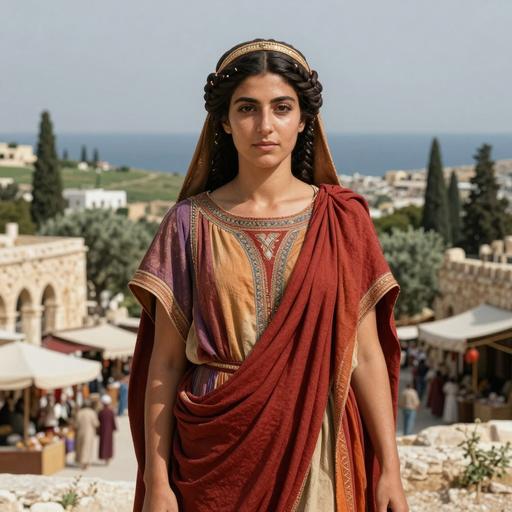
Portrait reconstruction of SFI-33
Ancient Individual

A woman buried in Lebanon in the Iron Age era

SFI-33
31 CE - 235 CE
Female
Early Roman Lebanon
Lebanon
Scroll to begin
Chapter I

Identity

The biological and cultural markers that define this ancient individual

Sample ID

SFI-33

Date Range

31 CE - 235 CE

Biological Sex

Female

mtDNA Haplogroup

T1c*

Cultural Period

Early Roman Lebanon

Chapter II

Place

Where this individual was discovered

Country Lebanon
Locality Beirut
Coordinates 33.8965, 35.5114
Chapter III

Time

When this individual lived in the broader context of human history

SFI-33 31 CE - 235 CE
Chapter IV

Story

The narrative of this ancient life

The period of Roman rule in Lebanon, beginning with the conquest of the region by the Roman Empire, is a fascinating era that highlights the blend of local traditions with Roman administrative and cultural practices. This period, often referred to as \Early Roman Lebanon," spanned several centuries, beginning in 64 BCE when the Roman general Pompey annexed the remnants of the Seleucid Empire and established the Roman province of Syria, which included present-day Lebanon.

Geographic and Strategic Importance

Lebanon, with its diverse geography characterized by the Lebanon and Anti-Lebanon mountain ranges and its Mediterranean coastline, held significant strategic importance for the Romans. The region served as a critical link between the eastern and western parts of the empire. Its ports, such as Tyre, Sidon, and Berytus (modern-day Beirut), were bustling centers of trade and connectivity. These cities facilitated the exchange of goods, ideas, and cultures between the Roman Empire and the eastern world, including regions like Persia and India.

Urban Development and Architecture

Under Roman influence, Lebanese cities experienced significant urban development. Berytus became one of the most notable cities in the region due to its remarkable transformation under Roman rule. It was often referred to as "Colonia Julia Augusta Felix Berytus," reflecting its status as a Roman colony. The city was famed for its law school, considered one of the most prestigious in the Roman Empire, attracting students from all over the empire.

Roman architectural styles flourished in Lebanon, with the construction of temples, theaters, and public baths. The Temple of Jupiter in Baalbek is a prime example of Roman architecture, characterized by its massive columns and intricate design. Baalbek, known as Heliopolis in antiquity, became a major religious site in the Roman Empire and remains one of the best-preserved Roman temple complexes today.

Cultural Synthesis

The Roman period in Lebanon was marked by a rich cultural amalgamation. The Romans imposed their administrative systems and Latin language, but local traditions and languages, such as Phoenician and Aramaic, persisted. This cultural synthesis was evident in the arts, religion, and daily life. Roman religious practices coexisted with local deities, and many temples dedicated to Roman gods also enshrined local gods, reflecting a blend of religious traditions.

In the arts, Roman mosaics and sculptures were prevalent, often featuring themes from Roman mythology while incorporating local artistic styles and motifs. The coexistence of Roman and native elements created a unique regional identity within the broader Roman Empire.

Economic Prosperity

Economically, Roman Lebanon thrived due to its strategic position and natural resources. The region was an important center for the production of commodities like purple dye from murex shells, glass, and timber—all highly valued across the Roman Empire. The fertile Bekaa Valley contributed to the agricultural prosperity with crops like wheat and wine, which were traded extensively.

Infrastructure and Connectivity

Roman infrastructure projects significantly improved connectivity and integration within the region. They built an extensive network of roads that facilitated trade and movement of Roman legions. Aqueducts and improved port facilities enhanced urban life and trade operations. These infrastructural developments played a crucial role in integrating Lebanon into the Roman economic system.

Conclusion

Early Roman Lebanon was a period marked by significant transformation and interaction between local cultures and Roman civilization. The region's strategic location, economic prosperity, and cultural synthesis made it a vibrant part of the Roman Empire. Today, the remnants of Roman architecture, along with historical and cultural records, serve as testament to this rich era of Lebanese history. The blend of Roman and local influences during this period laid foundational aspects of cultural and historical legacy in the region, which continue to influence Lebanese identity and heritage."

Chapter V

Genetics

The genetic ancestry of this ancient individual

Ancient Genetic Admixture

This analysis compares the DNA profile of SFI-33 with ancient reference populations, showing the genetic composition in terms of prehistoric ancestral groups.

Neolithic Farmers 73.4%
European Hunter-Gatherers 23.9%
Western Steppe Pastoralists 2.7%

Modern Genetic Admixture

This analysis compares the DNA profile with present-day reference populations, showing what percentage of genetic makeup resembles modern populations from different regions.

Asia 74.3%
Arab, Egyptian & Levantine 46.0%
Levantine 26.7%
Arabian 19.3%
Northern West Asian 22.2%
Mesopotamian 12.4%
Cypriot 9.1%
Anatolian 0.7%
Central Asian, Northern Indian & Pakistani 6.1%
Indian 6.1%
Europe 24.2%
Southern European 24.2%
Italian 9.2%
Sardinian 7.7%
Balkan 7.3%
Africa 1.6%
North African 1.6%
North African 1.6%

Closest Modern Populations

These are the modern populations showing the closest statistical alignment to A woman buried in Lebanon in the Iron Age era, ranked by genetic distance. Lower distance values indicate closer statistical similarity.

1
Lebanese Christian
1.7835
2
Druze
2.0739
3
Lebanese Druze
2.2224
4
Alawite
2.5810
5
Palestinian Beit Sahour
2.8148
6
Cypriot
2.9446
7
Syrian Jew
3.1970
8
Lebanese Muslim
3.1995
9
Karaite Egypt
3.2798
10
Romaniote Jew
3.7597
Chapter VI

Context

Other ancient individuals connected to this sample

Sources

References

Scientific publications and genetic data

Scientific Publication

A Genetic History of the Near East from an aDNA Time Course Sampling Eight Points in the Past 4,000 Years

Authors Haber M, Nassar J, Almarri MA
Abstract

The Iron and Classical Ages in the Near East were marked by population expansions carrying cultural transformations that shaped human history, but the genetic impact of these events on the people who lived through them is little-known. Here, we sequenced the whole genomes of 19 individuals who each lived during one of four time periods between 800 BCE and 200 CE in Beirut on the Eastern Mediterranean coast at the center of the ancient world's great civilizations. We combined these data with published data to traverse eight archaeological periods and observed any genetic changes as they arose. During the Iron Age (∼1000 BCE), people with Anatolian and South-East European ancestry admixed with people in the Near East. The region was then conquered by the Persians (539 BCE), who facilitated movement exemplified in Beirut by an ancient family with Egyptian-Lebanese admixed members. But the genetic impact at a population level does not appear until the time of Alexander the Great (beginning 330 BCE), when a fusion of Asian and Near Easterner ancestry can be seen, paralleling the cultural fusion that appears in the archaeological records from this period. The Romans then conquered the region (31 BCE) but had little genetic impact over their 600 years of rule. Finally, during the Ottoman rule (beginning 1516 CE), Caucasus-related ancestry penetrated the Near East. Thus, in the past 4,000 years, three limited admixture events detectably impacted the population, complementing the historical records of this culturally complex region dominated by the elite with genetic insights from the general population.

G25 Coordinates

The G25 coordinates for sample SFI-33 can be used for detailed admixture analysis in our G25 Studio tool.

SFI-33,0.09047202,0.14398402,-0.05014416,-0.07437404,-0.00951028,-0.0326483,-0.00162692,-0.01153368,0.00407034,0.01494756,0.00373372,-0.00524068,0.00081348,-0.0003003,-0.01296444,0.01081964,-0.0005449,0.00181704,0.0014363,-0.00415822,0.00127964,0.00556484,0.00043864,-0.00073752,0.00257288
Analyze in G25 Studio
Use code for 40% off Expires Feb 27