Menu
Store
Blog
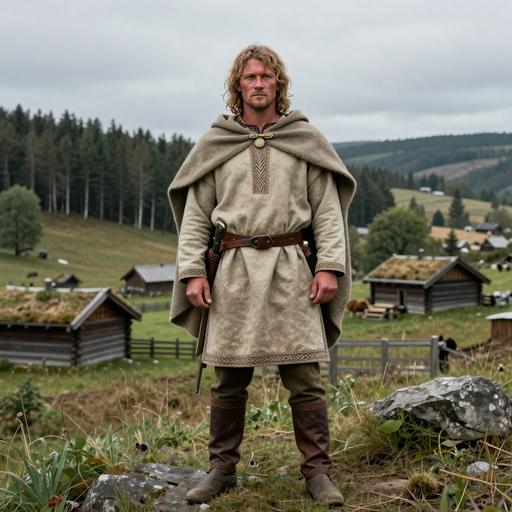
Portrait reconstruction of VK390
Ancient Individual

A man buried in Norway in the Iron Age era

VK390
400 CE - 600 CE
Male
Iron Age Norway
Norway
Scroll to begin
Chapter I

Identity

The biological and cultural markers that define this ancient individual

Sample ID

VK390

Date Range

400 CE - 600 CE

Biological Sex

Male

mtDNA Haplogroup

K2a3*

Y-DNA Haplogroup

R1a1a1b1a3a1

Cultural Period

Iron Age Norway

Chapter II

Place

Where this individual was discovered

Country Norway
Locality Nor South. Telemark
Coordinates 59.2200, 9.5900
Chapter III

Time

When this individual lived in the broader context of human history

VK390 400 CE - 600 CE
Chapter IV

Story

The narrative of this ancient life

The Iron Age in Norway, particularly the Norse culture during this period, is a fascinating era marked by significant social, technological, and cultural changes that laid the groundwork for what would eventually become the Viking Age. This period spans from roughly 500 BCE to 800 CE, encompassing both the early and late Iron Age, characterized by the emergence of new societal structures, technological advances, and complex interactions with neighboring cultures.

Society and Social Structure

Tribal Organization: During the Iron Age, Norwegian society was primarily tribal, with various chieftains or petty kings ruling over different regions. These chieftains wielded significant power, often sustained through loyalty from warrior elites and alliances with other tribes.

Agriculture and Settlement: The Norse people primarily engaged in agriculture, cultivating barley, oats, and rye, along with raising livestock like cattle, sheep, goats, and pigs. Settlements were often small and scattered, consisting of extended family units living in longhouses constructed from wood and turf, reflecting a dispersed and clan-based society.

Technology and Innovation

Metallurgy: A hallmark of the Iron Age is the significant improvement in metallurgy. The Norse refined techniques for iron smelting, leading to the production of more durable tools and weapons, which contributed to agricultural efficiency and military prowess.

Shipbuilding: The latter part of the Iron Age saw advancements in shipbuilding technology, which would later culminate in the iconic longships of the Viking Age. These vessels provided the Norse with greater mobility and facilitated expanded trade and exploration.

Culture and Beliefs

Religion and Mythology: The Iron Age in Norway saw the development of Norse mythology, with a pantheon of gods including Odin, Thor, and Freyja playing central roles in religious practices. Rituals often involved offerings to these deities to ensure prosperity and protection, and sacred sites, like burial mounds and stone circles, formed focal points of spiritual activity.

Art and Craftsmanship: Norse art and craftsmanship began to flourish, with intricate designs and motifs adorning artifacts, from jewelry to weapons. The artistry often featured interwoven patterns and animal forms, infused with symbolic meaning inspired by nature and mythology.

Interaction and Trade

Trade Networks: While Norwegian Iron Age society remained locally focused, trading networks expanded across the North Sea and into the Baltic region. The Norse traded furs, wool, iron, and amber for luxury goods such as silver, silk, and spices, establishing connections that would later enhance their reach during the Viking Age.

Cultural Exchange: Through trade and exploration, there was a significant exchange of cultural practices and technologies with neighboring peoples, including the Celts and Germanic tribes. These interactions occasionally led to conflict but also increased the dissemination of ideas and goods.

Late Iron Age and Transition to the Viking Age

Centralization of Power: As the Iron Age drew to a close, the trend towards larger, more centralized political entities began. This consolidation of power set the stage for the unified kingdoms that would rise during the Viking Age, facilitating larger military campaigns and exploration.

Preparation for Expansion: The technological, social, and cultural developments of the Iron Age prepared the Norse societies for the expansionist ventures typical of the Vikings. With improved ships and weaponry, Norse seafarers were equipped to venture beyond their shores, leading to the Viking expeditions of the subsequent centuries.

In conclusion, Iron Age Norway was a vibrant and complex society undergoing significant transformation. The legacy of this period is evident in the rich tapestry of Norse mythology, advancements in technology and craftsmanship, and the groundwork laid for the Viking Age's exploration and influence.

Chapter V

Genetics

The genetic ancestry of this ancient individual

Ancient Genetic Admixture

This analysis compares the DNA profile of VK390 with ancient reference populations, showing the genetic composition in terms of prehistoric ancestral groups.

European Hunter-Gatherers 41.8%
Western Steppe Pastoralists 37.9%
Neolithic Farmers 15.5%
Ancient Asians 4.8%

Modern Genetic Admixture

This analysis compares the DNA profile with present-day reference populations, showing what percentage of genetic makeup resembles modern populations from different regions.

Europe 99.2%
Northwestern European 98.1%
English 33.5%
Scandinavian 23.5%
Finnish 21.4%
Northwestern European 19.7%
Southern European 1.1%
Iberian 1.1%
Africa 0.6%
West African 0.6%
Ghanaian, Liberian, Sierra Leonean 0.6%

Closest Modern Populations

These are the modern populations showing the closest statistical alignment to A man buried in Norway in the Iron Age era, ranked by genetic distance. Lower distance values indicate closer statistical similarity.

1
Orcadian
1.9408
2
Norwegian
2.0615
3
Scottish
2.0733
4
Icelandic
2.0843
5
Shetlandic
2.1688
6
Danish
2.2361
7
Irish
2.3072
8
Dutch
2.4698
9
English
2.4936
10
Swedish
2.5938
Chapter VI

Context

Other ancient individuals connected to this sample

Sources

References

Scientific publications and genetic data

Scientific Publication

Population genomics of the Viking world

Authors Margaryan A, Lawson DJ, Sikora M
Abstract

The maritime expansion of Scandinavian populations during the Viking Age (about AD 750-1050) was a far-flung transformation in world history1,2. Here we sequenced the genomes of 442 humans from archaeological sites across Europe and Greenland (to a median depth of about 1×) to understand the global influence of this expansion. We find the Viking period involved gene flow into Scandinavia from the south and east. We observe genetic structure within Scandinavia, with diversity hotspots in the south and restricted gene flow within Scandinavia. We find evidence for a major influx of Danish ancestry into England; a Swedish influx into the Baltic; and Norwegian influx into Ireland, Iceland and Greenland. Additionally, we see substantial ancestry from elsewhere in Europe entering Scandinavia during the Viking Age. Our ancient DNA analysis also revealed that a Viking expedition included close family members. By comparing with modern populations, we find that pigmentation-associated loci have undergone strong population differentiation during the past millennium, and trace positively selected loci-including the lactase-persistence allele of LCT and alleles of ANKA that are associated with the immune response-in detail. We conclude that the Viking diaspora was characterized by substantial transregional engagement: distinct populations influenced the genomic makeup of different regions of Europe, and Scandinavia experienced increased contact with the rest of the continent.

G25 Coordinates

The G25 coordinates for sample VK390 can be used for detailed admixture analysis in our G25 Studio tool.

VK390,0.13078704,0.1254446,0.06388562,0.05220168,0.0404256,0.02210916,-0.00044084,0.0063919,0.00590462,-0.00367856,-0.00460704,0.00111684,-0.00890402,-0.0051497,0.0197122,-0.00092432,-0.02008062,0.00377858,-0.00034184,-0.00357054,0.00176946,0.00424074,-0.0011993,0.01519194,0.00273874
Analyze in G25 Studio
Use code for 40% off Expires Feb 26