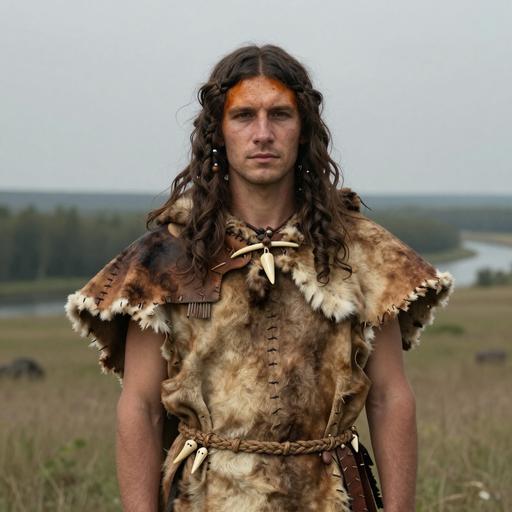
A man buried in Russia in the Pleistocene era

Download PDF creates a visual, rasterized copy. Use Print for selectable text and better assistive-technology support.

Loading Report

Preparing your ancestry journey

Preparing the available report content...

Your report will open automatically.

Skip to main content
Reference library / Sample profile

A man buried in Russia in the Pleistocene era

Explore the recorded context, genetic comparisons and research behind this reference sample.

RussiaKostenki 14 Site, Russia

A reference profile describes this sample. It does not establish a personal or family relationship.

AI portrait reconstruction for A man buried in Russia in the Pleistocene era
AI-generated artistic reconstruction, not a photograph of the individual.
Record

Sample details

Recorded details and available lineage markers.

Individual

Paleolithic individual, Russia

Sample ID: Kostenki14

Date Range

37426 BCE - 34726 BCE

Cultural Period

Kostenki 14 Site, Russia

Biological Sex

Male

mtDNA Haplogroup

U2*

Y-DNA Haplogroup

C-FT409300

Social Role

Hunter (AI estimate, era-typical)

Geography

Location

Where this individual was discovered

Country Russia
Locality Kostenki
Coordinates 51.2300, 39.3000
Chronology

Date range

When this individual lived in the broader context of human history

Paleolithic individual, Russia 37426 BCE - 34726 BCE
Context

Historical context

Background information associated with the reference record.

Kostenki 14, also referred to as Markina Gora, is one of the most important archaeological sites located in the Kostenki region along the Don River in Russia. This area has been vital for understanding the Paleolithic era, particularly the Upper Paleolithic period, which dates back to around 30,000 to 40,000 years ago. Kostenki 14 is renowned for its rich archaeological finds, which provide significant insights into the early humans of the region, their culture, lifestyle, and adaptation strategies during the last Ice Age.

Geographic and Environmental Context

The Kostenki site is situated on a high terrace above the Don River, providing a strategic location that combined access to the river's resources with protection from potential flooding. During the Paleolithic era, this region was part of the mammoth steppe ecosystem, characterized by open grasslands with scattered patches of coniferous forests. Such an environment supported diverse megafauna including mammoths, bison, and reindeer, which were crucial for the subsistence of human groups during this time.

Archaeological Discoveries

Excavations at Kostenki 14 have revealed a wealth of artifacts, including stone tools, personal ornaments, and evidence of human burials. The stone tool assemblages predominantly consist of blades and points, crafted using sophisticated techniques like pressure flaking, highlighting the technological advancements of these early inhabitants.

The site also offered significant finds of personal ornaments such as beads made from bone, ivory, and shells, which suggest not only aesthetic preferences but also social and symbolic practices among the Upper Paleolithic communities.

Human Remains and Burials

One of the most notable discoveries from Kostenki 14 is that of human remains, including an almost complete skeleton known as Kostenki 14 or Markina Gora, which dates back around 30,000 years. The analysis of this skeleton has provided critical insights into the physical anthropology of the period, indicating a well-developed modern human morphology. Genetic studies have further revealed a mixture of European and Asian ancestry, underscoring the complex migratory patterns of early Homo sapiens.

The burial practices observed at Kostenki indicate a level of ritual and symbolic behavior. Graves often included grave goods such as tools and ornaments, suggesting beliefs in an afterlife or the importance of the deceased individual's status or role within the group.

Cultural and Artistic Expression

Kostenki 14 has yielded evidence of early artistic expression. The presence of decorated objects and potentially symbolic use of ochre pigments point towards developing cognitive abilities and cultural complexity. Artistic endeavors such as the creation of figurines or engravings reflect a level of abstract thinking and communication among these early human groups.

Subsistence and Economy

The inhabitants of Kostenki 14 were largely hunter-gatherers, relying on the abundant resources offered by the mammoth steppe. Faunal remains indicate that hunting activities were primarily focused on large herbivores such as mammoths, which provided meat, bones, and hides for various uses. The processing of these animals required coordinated group efforts and knowledge of seasonal animal behavior and migration patterns.

Social Structure and Community Life

Based on the archaeological evidence, it can be inferred that the people of Kostenki lived in small, band-like groups typical of Upper Paleolithic societies. These groups were likely organized around kinship lines or cooperative networks, sharing resources and labor to ensure survival. The presence of elaborate and communal structures, inferred from dwellings and organized camps, suggests a sophisticated social organization capable of sustaining long-term habitation of these regions despite the harsh climatic conditions.

Significance and Impact

The findings at Kostenki 14 have significantly advanced our understanding of early modern humans in Europe. This site underscores the human capacity to adapt to a changing environment during a pivotal time in human evolution. It also highlights the complexity and variability of Upper Paleolithic societies, debunking earlier notions of these communities as being simplistic or uniform in behavior and culture.

In conclusion, Kostenki 14 offers an invaluable window into the lifeways of Upper Paleolithic peoples in Eastern Europe. The diverse and rich archaeological materials from the site illustrate the resilience, creativity, and adaptability of early Homo sapiens, forming a crucial piece of the puzzle in understanding the broader narrative of human history and evolution during the Paleolithic era.

Analysis

Genetic comparisons

These comparisons show genetic similarity, not identity or origin. The populations listed are those whose genomes show statistical alignment to this ancient individual.

Similarity reflects shared history, not shared identity. These are analytical comparisons, not claims about who this person was.

Modern Genetic Admixture

This analysis compares the DNA profile with present-day reference populations, showing statistical similarity to modern reference populations from different regions. The excavation site records where this individual was found, not a fixed modern genetic identity.

Europe 50.0%
Southern European 21.0%
Iberian 18.9%
Sardinian 2.1%
Eastern European 17.9%
Northwestern European 11.1%
English 7.3%
Finnish 2.0%
Northwestern European 1.7%
Asia 29.3%
Central Asian, Northern Indian & Pakistani 25.3%
Indian 23.4%
Pakistan 1.9%
Chinese & Southeast Asian 2.3%
Chinese 2.0%
Arab, Egyptian & Levantine 1.8%
Arabian 1.8%
Africa 10.7%
Northern East African 4.2%
Ethiopian 3.0%
Eastern African 1.2%
African Hunter-Gatherer 2.5%
West African 1.7%
Ghanaian, Liberian, Sierra Leonean 1.7%
North African 1.7%
Egyptian 1.0%
North African 0.6%
Congolese & Southern East African 0.6%
South East African 0.6%
Oceania 5.9%
Melanesian 5.9%
Papuan 5.9%
America 4.2%
America 4.2%
Native American 4.2%

Closest Modern Populations

These are the modern populations showing the closest statistical alignment to A man buried in Russia in the Pleistocene era, ranked by genetic distance. Lower distance values indicate closer statistical similarity. Cross-region similarity can reflect shared ancestry, population movement, continuity, or later admixture.

1
Roma Granada
10.3646
2
Roma Bilbao
10.4782
3
Roma Balkans
10.8631
4
Roma Porto
10.9205
5
Roma Madrid
11.4489
6
Tajik Tajikistan Ayni
11.5472
7
Tajik Tajikistan Hisor
11.6682
8
Pamiri Sarikoli
11.8088
9
Cochin Jew A
11.8217
10
Pamiri Wakhi
11.9590
Context

Related Samples

This individual exists within a broader network of ancient samples. No ancient genome stands alone.

Individual Culture/Period Date Location Action
Paleolithic individual, France Rochedane Site, France 11207 BCE Rochedane, France View
Kostenki UP individual, Russia Kostenki 12 Site, Russia 31300 BCE Kostenki, Russia View
Czechia Gravettian individual, Czech Republic Vestonice 16 Site, Czech Republic 28500 BCE Dolni Vestonice, Czech Republic View
Paleolithic individual, Russia Kostenki 14 Site, Russia 37426 BCE Kostenki, Russia View
Czechia Gravettian individual, Czech Republic Pavlov 1 Site, Czech Republic 29300 BCE Dolni Vestonice, Czech Republic View
UP individual, Romania Peștera Muierii Site, Romania 32228 BCE Muierii 2, Romania View
Czechia Gravettian individual, Czech Republic Vestonice 13 Site, Czech Republic 29200 BCE Dolni Vestonice, Czech Republic View
European Paleolithic individual, Czech Republic Vestonice 15 Site, Czech Republic 29200 BCE Dolni Vestonice, Czech Republic View
Czechia Gravettian individual, Czech Republic Vestonice 43 Site, Czech Republic 28500 BCE Dolni Vestonice, Czech Republic View
Apulia Gravettian individual, Italy Ostuni 2 Hunter-Gatherer, Southern Italy 27546 BCE Apulia. Ostuni, Italy View
Apulia Gravettian individual, Italy Ostuni 1 Hunter-Gatherer, Southern Italy 25860 BCE Apulia. Ostuni, Italy View
Czechia Gravettian individual, Czech Republic Vestonice 14 Site, Czech Republic 29200 BCE Dolni Vestonice, Czech Republic View
Magdalenian individual, Spain El Mirón Cave, Spain 16898 BCE El Miron, Spain View
European Paleolithic individual, Austria Krems-Wachtberg 3 Site, Austria 29500 BCE Krems-Wachtberg, Austria View
Paleolithic Cultures of Siberia individual, Russia Afontova Gora 3 Site, Russia 16257 BCE Afontova Gora, Russia View
Paleolithic individual, Romania Cioclovina Cave, Romania 31343 BCE Cioclovina, Romania View
European Paleolithic individual, Italy Villabruna Hunter-Gatherer, Northern Italy 12268 BCE Veneto. Villabruna, Italy View
Paleolithic European individual, Italy Paglicci 133 Hunter-Gatherer, Southern Italy 33150 BCE Apulia. Paglicci, Italy View
Mediterranean Hunter-Gatherers individual, Italy Southern Italy Hunter-Gatherer 9300 BCE Abruzzo. Grotta de Continenza, Italy View
Paleolithic European individual, Italy Paglicci 108 Hunter-Gatherer, Southern Italy 26700 BCE Apulia. Paglicci, Italy View
Aurignacian individual, Germany Hohle Fels 49 Site, Germany 13771 BCE Swabian Jura. Baden-Wurttemberg. Hohle Fels. Ach Valley, Germany View
Paleolithic individual, Germany Burkhardtshohle Cave, Germany 13127 BCE Swabian Jura. Baden-Wurttemberg. Burkhardtshöhle. Westerheim, Germany View
Western European Hunter-Gatherers individual, Germany Bockstein Cave, Germany 6450 BCE Swabian Jura. Baden-Wurttemberg. Bockstein-Höhle. Lone valley, Germany View
Paleolithic individual, Germany Brillenhohle Cave, Germany 13167 BCE Swabian Jura. Baden-Wurttemberg. Brillenhöhle. Ach Valley, Germany View
Aurignacian individual, Germany Hohle Fels 79 Site, Germany 13101 BCE Swabian Jura. Baden-Wurttemberg. Hohle Fels. Ach Valley, Germany View
European Hunter-Gatherers individual, Germany Ofnet Caves, Germany 6472 BCE Ofnet, Germany View
Western European Hunter-Gatherers individual, France Ranchot 88 Site, France 8290 BCE Ranchot, France View
Western European Hunter-Gatherers individual, France Chaudardes Site, France 6400 BCE Chaudardes, France View
Western European Hunter-Gatherers individual, France Berry-au-Bac Site, France 5368 BCE Berry Au Bac, France View
Paleolithic individual, France Rigney 1 Site, France 13696 BCE Rigney, France View
European Paleolithic individual, France Iboussieres 39 Site, France 9992 BCE Aven des Iboussières à Malataverne. Rhône-Alpes, France View
Western European Hunter-Gatherers individual, France Les Closeaux 13 Site, France 8282 BCE Les Closeaux, France View
European Paleolithic individual, Belgium Upper Paleolithic Goyet Cave Q116-1, Belgium 33678 BCE Troisieme caverne of Goyet cave, Belgium View
European Paleolithic individual, Belgium Upper Paleolithic Goyet Cave Q376-19, Belgium 25771 BCE Troisieme caverne of Goyet cave, Belgium View
European Paleolithic individual, Belgium Upper Paleolithic Goyet Cave Q53-1, Belgium 26440 BCE Troisieme caverne of Goyet cave, Belgium View
European Paleolithic individual, Belgium Upper Paleolithic Goyet Cave Q56-16, Belgium 24847 BCE Troisieme caverne of Goyet cave, Belgium View
Palaeolithic Gravettian individual, Italy 26700 BCE Apulia. Paglicci, Italy View
Palaeolithic Gravettian individual, Belgium 26440 BCE Troisieme caverne of Goyet cave, Belgium View
Palaeolithic Gravettian individual, Belgium 24847 BCE Troisieme caverne of Goyet cave, Belgium View
Palaeolithic Magdalenian individual, France 13696 BCE Rigney, France View
Palaeolithic Magdalenian individual, Germany 13127 BCE Swabian Jura. Baden-Wurttemberg. Burkhardtshöhle. Westerheim, Germany View
Palaeolithic France individual, France 9992 BCE Aven des Iboussières à Malataverne. Rhône-Alpes, France View
Palaeolithic Epigravettian individual, Italy 9300 BCE Abruzzo. Grotta de Continenza, Italy View
Afontovagora individual, Russia 16257 BCE Afontova Gora, Russia View
Palaeolithic Magdalenian individual, Belgium 13305 BCE Troisieme caverne of Goyet cave, Belgium View
Palaeolithic Gravettian individual, Belgium 33678 BCE Troisieme caverne of Goyet cave, Belgium View
Ceu Lm individual, Germany 6472 BCE Ofnet, Germany View
France Hg individual, France 8282 BCE Les Closeaux, France View
Palaeolithic Magdalenian individual, Germany 13101 BCE Swabian Jura. Baden-Wurttemberg. Hohle Fels. Ach Valley, Germany View
Palaeolithic Gravettian individual, Romania 31343 BCE Cioclovina, Romania View
Palaeolithic Magdalenian individual, Germany 13167 BCE Swabian Jura. Baden-Wurttemberg. Brillenhöhle. Ach Valley, Germany View
Ceu Lm individual, Germany 6450 BCE Swabian Jura. Baden-Wurttemberg. Bockstein-Höhle. Lone valley, Germany View
Palaeolithic Gravettian individual, Belgium 25771 BCE Troisieme caverne of Goyet cave, Belgium View
Palaeolithic Magdalenian individual, Germany 13771 BCE Swabian Jura. Baden-Wurttemberg. Hohle Fels. Ach Valley, Germany View
Ceu Hg individual, Germany 7472 BCE Swabian Jura. Baden-Wurttemberg. Falkenstein-Höhle, Germany View
France Hg individual, France 6400 BCE Chaudardes, France View
France Hg individual, France 8290 BCE Ranchot, France View
Ceu Hg individual, Germany 7472 BCE Swabian Jura. Baden-Wurttemberg. Falkenstein-Höhle, Germany View
France Hg individual, France 5368 BCE Berry Au Bac, France View
Palaeolithic Gravettian individual, Belgium 33678 BCE Troisieme caverne of Goyet cave, Belgium View
Italy Hg individual, Italy 33150 BCE Apulia. Paglicci, Italy View
West European Hunter Gatherer individual, France 11207 BCE Rochedane, France View
Europe North East Hg individual, Russia 7050 BCE Karelia. Yuzhnyy Oleni Ostrov, Russia View
Palaeolithic Epigravettian individual, Italy 12268 BCE Veneto. Villabruna, Italy View
Page 1
Individual Culture/Period Date Location Action
Paleolithic individual, Russia Kostenki 14 Site, Russia 37426 BCE Kostenki, Russia View
Page 1
Sources

References

Scientific publications and genetic data that inform this profile.

G25 Coordinates

These coordinates represent a position in genetic space, a tool for comparison, not a conclusion. You can use these to perform custom admixture analysis in G25 Studio.

Kostenki14,0.02804852,0.0173033,-0.01513684,0.05450874,0.01214704,-0.0072133,-0.01578872,-0.00558686,0.02791686,-2.28E-05,-0.0010247,-0.00040814,-0.00314062,-0.00461812,0.00709156,-0.00617192,-0.00366914,0.00015784,-0.0015916,-0.00495076,0.00178046,0.00237118,-0.0057781,0.00551024,-0.00126968
Continue in G25 Studio
Use code for 30% off • Expires Nov 16