A woman buried in Spain in the era

Download PDF creates a visual, rasterized copy. Use Print for selectable text and better assistive-technology support.

Loading Report

Preparing your ancestry journey

Preparing the available report content...

Your report will open automatically.

Skip to main content
Reference library / Sample profile

A woman buried in Spain in the era

Explore the recorded context, genetic comparisons and research behind this reference sample.

SpainBronze Age Iberia

A reference profile describes this sample. It does not establish a personal or family relationship.

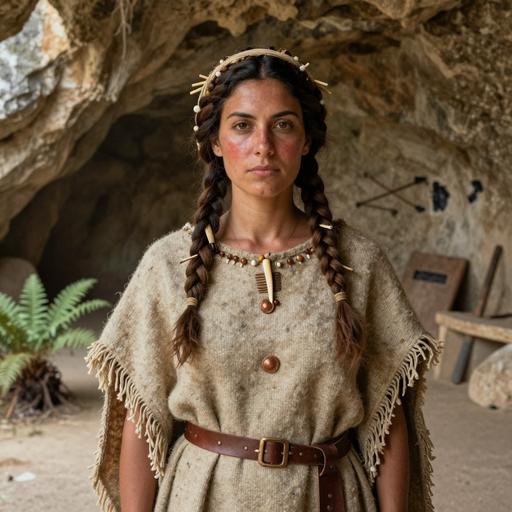
AI portrait reconstruction for A woman buried in Spain in the  era
AI-generated artistic reconstruction, not a photograph of the individual.
Record

Sample details

Recorded details and available lineage markers.

Individual

Iberia Ba individual, Spain

Sample ID: ATP9

Date Range

1863 BCE - 1564 BCE

Cultural Period

Bronze Age Iberia

Biological Sex

Female

mtDNA Haplogroup

U5b1b

Y-DNA Haplogroup

Not available

Social Role

Farmer (AI estimate, era-typical)

Geography

Location

Where this individual was discovered

Country Spain
Locality El Portalon Cave. Sierra de Atapuerca

A location map is not available for this record.

Chronology

Date range

When this individual lived in the broader context of human history

Iberia Ba individual, Spain 1863 BCE - 1564 BCE
Context

Historical context

Background information associated with the reference record.

Overview

Bronze Age Iberia was a period when copper and tin-based metalworking became increasingly important in daily life, craft specialization, and elite display. Across different regions, communities developed distinct burial and settlement traditions, while still participating in wider exchange networks.

Region & Environment

Iberia’s varied geography—mountain ranges, river valleys, fertile plains, and coastal zones—shaped where people lived and how they obtained resources. Access to metals depended on regional geology and transport routes, and agricultural productivity often determined settlement density and surplus production.

Historical Context

The Bronze Age in Iberia followed earlier Neolithic and Chalcolithic lifeways and is associated with intensifying metallurgy and regional differentiation. Interaction across the peninsula and with Mediterranean and Atlantic networks is reflected in similarities of object types and in the presence of non-local materials, though the scale and direction of exchange differed from place to place.

Populations & Lifeways

Populations likely practiced mixed farming and herding, with households producing food while also participating in crafts and seasonal movements. Social organization varied, but burial practices and the distribution of metalwork indicate unequal access to prestige goods and possibly to specialized roles in metal acquisition, casting, and working.

Archaeology & Material Culture

Archaeological signatures include:

  • Bronze tools and weapons, along with casting waste and workshop-related debris where preserved
  • Pottery vessels associated with domestic contexts and funerary settings
  • Grave goods that range from everyday items to more elaborate sets of metal objects Regional differences in cemeteries and monument styles are important for identifying local traditions. Metallurgical evidence—such as typologies of bronzes and technological traits—helps track changing production and external influence.

Culture & Society

Culture and society were shaped by craft knowledge, exchange, and ritualized treatment of the dead. Metal objects and ornaments often served as status markers and in some cases as important components of social identity. Communities also maintained local traditions in architecture, pottery styles, and burial arrangements.

Legacy & Transition

As the Bronze Age waned and the transition to later phases began, material culture changed in ways that reflect shifting trade relationships, evolving settlement patterns, and new technological and social configurations. These transitions are typically recognized through changing assemblages, new burial customs, and different patterns of metallurgical style.

Analysis

Genetic comparisons

These comparisons show genetic similarity, not identity or origin. The populations listed are those whose genomes show statistical alignment to this ancient individual.

Similarity reflects shared history, not shared identity. These are analytical comparisons, not claims about who this person was.

Modern Genetic Admixture

This analysis compares the DNA profile with present-day reference populations, showing statistical similarity to modern reference populations from different regions. The excavation site records where this individual was found, not a fixed modern genetic identity.

Europe 96.7%
Southern European 81.0%
Iberian 57.9%
Sardinian 13.6%
Italian 9.5%
Northwestern European 15.7%
Finnish 11.6%
English 3.3%
Northwestern European 0.8%
Asia 2.8%
Northern West Asian 2.6%
Cypriot 2.6%

Closest Modern Populations

These are the modern populations showing the closest statistical alignment to A woman buried in Spain in the era, ranked by genetic distance. Lower distance values indicate closer statistical similarity. Cross-region similarity can reflect shared ancestry, population movement, continuity, or later admixture.

1
Basque Soule
2.4687
2
Spanish La Rioja
2.7595
3
Basque French
2.8101
4
Spanish Burgos
2.8428
5
Basque Lower Navarre
2.9037
6
Basque Spanish
2.9040
7
Basque Navarre North
2.9112
8
French Bearn
2.9319
9
Basque Navarre Center
2.9367
10
French Bigorre
3.0231
Context

Related Samples

This individual exists within a broader network of ancient samples. No ancient genome stands alone.

Individual Culture/Period Date Location Action
Iberian individual, Spain Bronze Age Spain 1863 BCE El Portalon Cave. Sierra de Atapuerca, Spain View
Iberian Chalcolithic individual, Spain Chalcolithic Spain 3345 BCE El Portalon Cave. Sierra de Atapuerca, Spain View
Iberian Chalcolithic individual, Spain Chalcolithic Spain 3008 BCE El Portalon Cave. Sierra de Atapuerca, Spain View
Iberian Chalcolithic individual, Spain Chalcolithic Spain 3516 BCE El Portalon Cave. Sierra de Atapuerca, Spain View
Iberian Chalcolithic individual, Spain Chalcolithic Spain 2291 BCE El Portalon Cave. Sierra de Atapuerca, Spain View
Iberia Ca individual, Spain 3516 BCE El Portalon Cave. Sierra de Atapuerca, Spain View
Iberia Ca individual, Spain 3345 BCE El Portalon Cave. Sierra de Atapuerca, Spain View
Iberia Ba individual, Spain 1863 BCE El Portalon Cave. Sierra de Atapuerca, Spain View
Iberia Ca individual, Spain 3008 BCE El Portalon Cave. Sierra de Atapuerca, Spain View
Iberia Ca individual, Spain 2291 BCE El Portalon Cave. Sierra de Atapuerca, Spain View
Page 1
Individual Culture/Period Date Location Action
Iberia Ba individual, Spain 1800 BCE Castell. Cabanes. Túmulo Mortorum, Spain View
Iberia Ba individual, Portugal 1728 BCE Monte do Gato de Cima 3, Portugal View
Iberia Ba individual, Portugal 1800 BCE Torre Velha 3, Portugal View
Iberia Ba individual, Portugal 1800 BCE Monte do Vale do Ouro 2, Portugal View
Iberia Ba individual, Spain 1863 BCE El Portalon Cave. Sierra de Atapuerca, Spain View
Iberia Ba individual, Spain 971 BCE Basque Country. Araba/Álava. Laguardia. El Sotillo, Spain View
Iberia Ba individual, Spain 1881 BCE Andalusia. Cádiz. Chiclana de la Frontera. Loma del Puerco, Spain View
Iberia Ba individual, Spain 1300 BCE Castellón. Cabanes. Túmulo Mortorum, Spain View
Iberia Ba individual, Spain 1600 BCE La Rioja. Cueva de los Lagos, Spain View
Iberia Ba individual, Spain 1412 BCE Basque Country. Araba/Álava. Laguardia. El Sotillo, Spain View
Iberia Ba individual, Spain 1800 BCE Castell. Cabanes. Túmulo Mortorum, Spain View
Page 1
Sources

References

Scientific publications and genetic data that inform this profile.

G25 Coordinates

These coordinates represent a position in genetic space, a tool for comparison, not a conclusion. You can use these to perform custom admixture analysis in G25 Studio.

ATP9,0.1213136,0.15786736,0.04622554,-0.00441512,0.055642,-0.0044204,-0.00111366,0.00714906,0.03210314,0.04846752,-0.0084081,0.01365446,-0.02372754,-0.0091182,0.00694528,0.00159894,-0.01116852,-0.00198116,-0.00174016,-0.00174266,0.00596306,0.00681474,-0.01156424,-0.01444154,0.00365313
Continue in G25 Studio
Use code for 30% off • Expires Nov 16