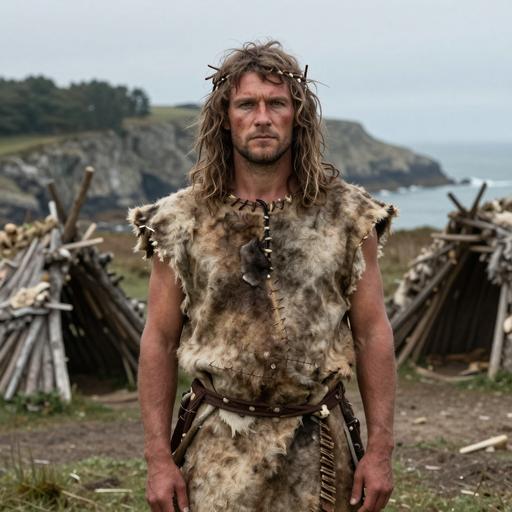
A man buried in France in the Mesolithic era

Download PDF creates a visual, rasterized copy. Use Print for selectable text and better assistive-technology support.

Loading Report

Preparing your ancestry journey

Preparing the available report content...

Your report will open automatically.

Skip to main content
Reference library / Sample profile

A man buried in France in the Mesolithic era

Explore the recorded context, genetic comparisons and research behind this reference sample.

FranceFrance Mesolithic

A reference profile describes this sample. It does not establish a personal or family relationship.

AI portrait reconstruction for A man buried in France in the Mesolithic era
AI-generated artistic reconstruction, not a photograph of the individual.
Record

Sample details

Recorded details and available lineage markers.

Individual

Mesolithic individual, France

Sample ID: hoe002

Date Range

5359 BCE - 5211 BCE

Cultural Period

France Mesolithic

Biological Sex

Male

mtDNA Haplogroup

U5b

Y-DNA Haplogroup

L460

Social Role

Hunter (AI estimate, era-typical)

Geography

Location

Where this individual was discovered

Country France
Locality Hoedic (Bretagne, Morbihan)
Coordinates 47.3390, -2.8790
Chronology

Date range

When this individual lived in the broader context of human history

Mesolithic individual, France 5359 BCE - 5211 BCE
Context

Historical context

Background information associated with the reference record.

Overview

The Mesolithic period in France spans roughly 10,000–6,000 BCE, when postglacial climates stabilized and human groups practiced broadly foraging-based lifeways. Archaeological records emphasize stone tool industries, seasonal site use, and diets shaped by local aquatic and terrestrial resources.

Region & Environment

During the Mesolithic, France’s environments varied from coastal zones to river valleys and inland woodlands. As temperatures improved after the last glacial phases, forests expanded and habitats diversified. People could exploit shifting ecological opportunities—such as fish runs in rivers, shellfish in coastal areas, and game and plant resources in wooded landscapes—often leading to repeated seasonal occupation of favorable locations.

Historical Context

The Mesolithic is best understood as a bridge between Palaeolithic hunter-gatherer systems and later Neolithic farming in parts of Europe. In France, this era precedes the widespread introduction of agriculture and pottery traditions associated with the Neolithic. Instead, technological and subsistence strategies reflect adaptation to rapidly changing postglacial conditions.

Populations & Lifeways

Mesolithic communities were generally mobile to semi-mobile, organizing movement around resource availability and seasonal cycles. Subsistence relied on hunting terrestrial animals and on fishing and gathering plant foods; aquatic resources were especially important in many areas. Social organization is difficult to reconstruct in detail, but evidence from repeated site use and shared manufacturing practices suggests stable networks of interaction.

Archaeology & Material Culture

Archaeology for this period is dominated by lithic remains, including microlithic and other shaped stone tools used for cutting, hunting, and processing food. Settlement traces—often low-density scatters or feature-poor sites—reflect short-term occupation rather than permanent villages. Organic materials usually survive poorly, so technological interpretations commonly rely on stone tool typology, wear, and the spatial organization of finds.

Culture & Society

Mesolithic “cultures” in western Europe are frequently defined by patterns in toolmaking rather than by large-scale architectural remains. Shared approaches to stone-working indicate communication or common traditions across regions. Mobility and seasonal practice also imply flexible social arrangements, with people likely coordinating travel and exchange through networks that varied over time.

Legacy & Transition

The Mesolithic ends as farming communities and associated material practices expand across portions of France in the Neolithic. This transition was not instantaneous everywhere: foraging strategies persisted in some localities while agricultural lifeways became increasingly prominent. Archaeological sequences from Mesolithic to Neolithic help track how ecosystems, mobility patterns, and tool traditions changed as agriculture took hold.

Analysis

Genetic comparisons

These comparisons show genetic similarity, not identity or origin. The populations listed are those whose genomes show statistical alignment to this ancient individual.

Similarity reflects shared history, not shared identity. These are analytical comparisons, not claims about who this person was.

Modern Genetic Admixture

This analysis compares the DNA profile with present-day reference populations, showing statistical similarity to modern reference populations from different regions. The excavation site records where this individual was found, not a fixed modern genetic identity.

Europe 100.0%
Northwestern European 87.6%
Scandinavian 33.9%
English 28.7%
Finnish 24.9%
Eastern European 12.4%

Closest Modern Populations

These are the modern populations showing the closest statistical alignment to A man buried in France in the Mesolithic era, ranked by genetic distance. Lower distance values indicate closer statistical similarity. Cross-region similarity can reflect shared ancestry, population movement, continuity, or later admixture.

1
Icelandic
2.1029
2
Swedish
2.1193
3
Norwegian
2.1560
4
Danish
2.1865
5
German Hamburg
2.3634
6
Shetlandic
2.5066
7
Orcadian
2.5842
8
Scottish
2.6665
9
Dutch
2.7353
10
Irish
2.8180
Context

Related Samples

This individual exists within a broader network of ancient samples. No ancient genome stands alone.

Individual Culture/Period Date Location Action
Mesolithic individual, France Mesolithic France 5375 BCE Hoedic (Bretagne, Morbihan), France View
Mesolithic individual, France Mesolithic France 5359 BCE Hoedic (Bretagne, Morbihan), France View
Mesolithic individual, France Mesolithic France 6100 BCE Hoedic (Bretagne, Morbihan), France View
Mesolithic individual, France Mesolithic France 5375 BCE Hoedic (Bretagne, Morbihan), France View
Mesolithic individual, France Mesolithic France 5474 BCE Hoedic (Bretagne, Morbihan), France View
Pre-civilization individual, France Mesolithic France 6071 BCE Hoedic (Bretagne, Morbihan), France View
Grand Est Mesolithic individual, France Mesolithic France 6351 BCE Mont Saint Pierre (Grand Est, Marne, Champigny), France View
Mesolithic individual, France Mesolithic France 5513 BCE Téviec (Bretagne, Morbihan), France View
Page 1
Individual Culture/Period Date Location Action
Mesolithic individual, France Mesolithic France 5375 BCE Hoedic (Bretagne, Morbihan), France View
Mesolithic individual, France Mesolithic France 5359 BCE Hoedic (Bretagne, Morbihan), France View
Mesolithic individual, France Mesolithic France 6100 BCE Hoedic (Bretagne, Morbihan), France View
Mesolithic individual, France Mesolithic France 5375 BCE Hoedic (Bretagne, Morbihan), France View
Mesolithic individual, France Mesolithic France 5474 BCE Hoedic (Bretagne, Morbihan), France View
Pre-civilization individual, France Mesolithic France 6071 BCE Hoedic (Bretagne, Morbihan), France View
Grand Est Mesolithic individual, France Mesolithic France 6351 BCE Mont Saint Pierre (Grand Est, Marne, Champigny), France View
Mesolithic individual, France Mesolithic France 5513 BCE Téviec (Bretagne, Morbihan), France View
Mesolithic individual, France Mesolithic France 7317 BCE Achères (Île-de-France, Yvelines), France View
Mesolithic individual, France Mesolithic France 8207 BCE Farman (Île-de-France, Paris), France View
Mesolithic individual, France Mesolithic France 9078 BCE Maisons-Alfort (France), France View
Mesolithic individual, France 5590 BCE Téviec (Bretagne, Morbihan), France View
Page 1
Sources

References

Scientific publications and genetic data that inform this profile.

G25 Coordinates

These coordinates represent a position in genetic space, a tool for comparison, not a conclusion. You can use these to perform custom admixture analysis in G25 Studio.

hoe002,0.13773,0.12796,0.06034,0.0562,0.04093,0.0265,0.00376,0.00715,0.0045,-0.00747,-0.00828,0.00689,0.00164,-0.00812,0.01371,0.00093,-0.01004,0.00101,-0.00189,0.00013,0.00649,0.0042,0.00099,0.00952,-0.001437
Continue in G25 Studio
Use code for 30% off • Expires Nov 16