A man buried in Georgia in the Upper Paleolithic era

Download PDF creates a visual, rasterized copy. Use Print for selectable text and better assistive-technology support.

Loading Report

Preparing your ancestry journey

Preparing the available report content...

Your report will open automatically.

Skip to main content
Reference library / Sample profile

A man buried in Georgia in the Upper Paleolithic era

Explore the recorded context, genetic comparisons and research behind this reference sample.

GeorgiaDzudzuana Cave Culture

A reference profile describes this sample. It does not establish a personal or family relationship.

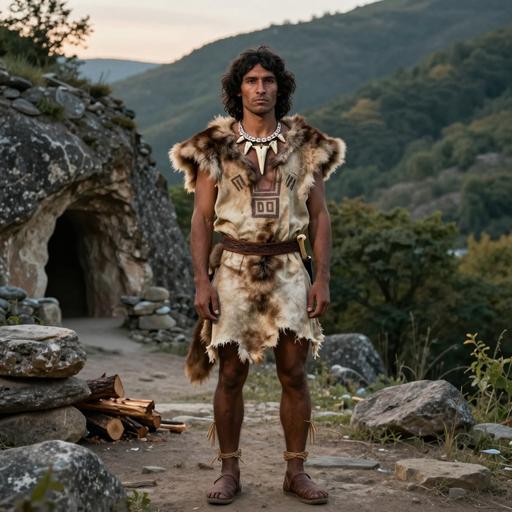
AI portrait reconstruction for A man buried in Georgia in the Upper Paleolithic era
AI-generated artistic reconstruction, not a photograph of the individual.
Record

Sample details

Recorded details and available lineage markers.

Individual

Pre-Agricultural Caucasian individual, Georgia

Sample ID: I11857

Date Range

25550 BCE - 23250 BCE

Cultural Period

Dzudzuana Cave Culture

Biological Sex

Male

mtDNA Haplogroup

N

Y-DNA Haplogroup

K

Social Role

Hunter (AI estimate, era-typical)

Geography

Location

Where this individual was discovered

Country Georgia
Locality Dzudzuana Cave (Imereti, Raion Chiatura, Chiatura)
Coordinates 42.3120, 43.3173
Chronology

Date range

When this individual lived in the broader context of human history

Pre-Agricultural Caucasian individual, Georgia 25550 BCE - 23250 BCE
Context

Historical context

Background information associated with the reference record.

Region & Environment

Georgia sits at the crossroads of mountain and lowland habitats, with access to varied resources. During the early Upper Paleolithic, local climates were cooler and landscapes would have shifted repeatedly, influencing the distribution of game and the availability of plant foods.

Historical Context

Dzudzuana Cave Culture belongs to the early Upper Paleolithic of the Caucasus region. In this period, human groups in the region relied on stone tool technologies and mobile foraging systems, using caves and rock shelters as favorable locations.

Populations & Lifeways

Populations were hunter-gatherers with flexible mobility. Life revolved around procuring wild resources and processing them on-site, with activities organized around tool production, maintenance, and the repeated use of sheltered locations during favorable hunting seasons.

Archaeology & Material Culture

Archaeological work in caves such as Dzudzuana typically yields dense concentrations of lithic artifacts associated with flaking and tool use. The stratified deposits can preserve sequences of occupation, allowing archaeologists to recognize changing toolkits or activity emphases over time. Where organic remains are preserved, they can supplement lithic evidence, though preservation varies.

Culture & Society

Cultural practice is most visible through recurring stone-tool traditions, including characteristic reduction methods and tool forms. These patterns imply learned techniques passed within groups and possibly shared across neighboring populations, reinforcing cultural cohesion in a wider Paleolithic world.

Legacy & Transition

Over time, climatic fluctuation and changing ecosystems influenced how Paleolithic groups used landscapes and shelters. Dzudzuana contributes to the deep archaeological sequence that helps track the long-term development of hunter-gatherer lifeways in the Caucasus before later Mesolithic and Neolithic transitions.

Analysis

Genetic comparisons

These comparisons show genetic similarity, not identity or origin. The populations listed are those whose genomes show statistical alignment to this ancient individual.

Similarity reflects shared history, not shared identity. These are analytical comparisons, not claims about who this person was.

Modern Genetic Admixture

This analysis compares the DNA profile with present-day reference populations, showing statistical similarity to modern reference populations from different regions. The excavation site records where this individual was found, not a fixed modern genetic identity.

Europe 44.2%
Northwestern European 21.1%
Scandinavian 11.0%
Finnish 10.0%
Southern European 18.8%
Italian 18.8%
Eastern European 4.4%
Asia 39.4%
Arab, Egyptian & Levantine 19.2%
Levantine 11.1%
Arabian 8.1%
Central Asian, Northern Indian & Pakistani 9.8%
Pakistan 8.5%
Indian 1.4%
Northern West Asian 9.5%
Mesopotamian 6.2%
Anatolian 3.4%
Chinese & Southeast Asian 0.8%
Tibetan 0.8%
Africa 12.2%
Northern East African 9.1%
Ethiopian 4.9%
Eastern African 4.1%
West African 2.4%
Senegambian & Guinean 1.7%
Nigerian 0.6%
African Hunter-Gatherer 0.8%
Oceania 4.1%
Melanesian 4.1%
Papuan 4.1%

Closest Modern Populations

These are the modern populations showing the closest statistical alignment to A man buried in Georgia in the Upper Paleolithic era, ranked by genetic distance. Lower distance values indicate closer statistical similarity. Cross-region similarity can reflect shared ancestry, population movement, continuity, or later admixture.

1
Roma Granada
7.5915
2
Roma Madrid
7.7458
3
Roma Bilbao
8.0337
4
Roma Porto
8.2699
5
Roma Barcelona
8.7263
6
Turkish Denizli
9.0235
7
Roma Balkans
9.0484
8
Turkish Rumeli
9.1441
9
Turkish Balikesir
9.1537
10
Turkish Aydin
9.2093
Context

Related Samples

This individual exists within a broader network of ancient samples. No ancient genome stands alone.
Individual Culture/Period Date Location Action
Pre-Agricultural Caucasian individual, Georgia Dzudzuana Cave Culture 25550 BCE Dzudzuana Cave (Imereti, Raion Chiatura, Chiatura), Georgia View
Page 1
Individual Culture/Period Date Location Action
Pre-Agricultural Caucasian individual, Georgia Dzudzuana Cave Culture 25550 BCE Dzudzuana Cave (Imereti, Raion Chiatura, Chiatura), Georgia View
Page 1
Sources

References

Scientific publications and genetic data that inform this profile.

G25 Coordinates

These coordinates represent a position in genetic space, a tool for comparison, not a conclusion. You can use these to perform custom admixture analysis in G25 Studio.

I11857,0.03224506,0.07738166,-0.01933786,0.00882144,0.00752594,-0.02533108,-0.00128778,0.00534548,0.01465492,0.00261744,0.00054454,-0.00253422,0.0063148,-0.00220716,-0.00323798,0.00110612,0.00487498,-0.0018466,-0.00117254,0.00147786,0.00071194,-0.0004424,0.00076464,0.00483398,-0.00055182
Continue in G25 Studio
Use code for 30% off • Expires Nov 16