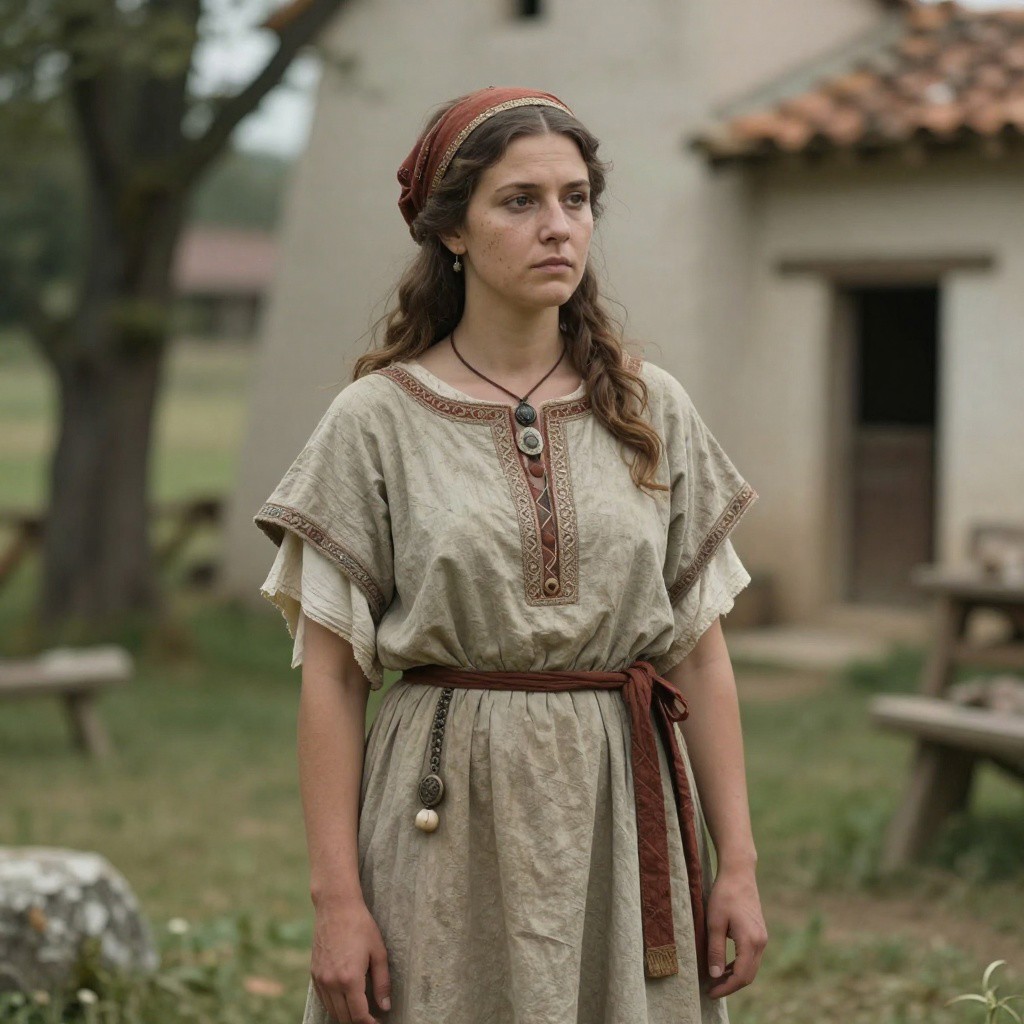
A woman buried in Croatia in the era

Download PDF creates a visual, rasterized copy. Use Print for selectable text and better assistive-technology support.

Loading Report

Preparing your ancestry journey

Preparing the available report content...

Your report will open automatically.

Skip to main content
Reference library / Sample profile

A woman buried in Croatia in the era

Explore the recorded context, genetic comparisons and research behind this reference sample.

CroatiaCroatia EIA

A reference profile describes this sample. It does not establish a personal or family relationship.

AI portrait reconstruction for A woman buried in Croatia in the  era
AI-generated artistic reconstruction, not a photograph of the individual.
Record

Sample details

Recorded details and available lineage markers.

Individual

EIA individual, Croatia

Sample ID: I24343

Date Range

428 CE - 600 CE

Cultural Period

Croatia EIA

Biological Sex

Female

mtDNA Haplogroup

H+73

Y-DNA Haplogroup

Not available

Geography

Location

Where this individual was discovered

Country Croatia
Locality Mala-Metaljka (Sisak-Moslavina County, Grad Glina)
Coordinates 45.1736, 16.1243
Chronology

Date range

When this individual lived in the broader context of human history

EIA individual, Croatia 428 CE - 600 CE
Context

Historical context

Background information associated with the reference record.

Region & Environment

Early Iron Age Croatia lay at a crossroads between the Adriatic coast and interior uplands, with travel and exchange supported by river systems flowing toward the sea. The landscape included coastal zones, karstic plateaus, and fertile plains suitable for mixed farming, with locally available stone, clay, and metal-working materials shaping daily life and craft traditions.

Historical Context

From the 8th to the 6th century BCE, northern Adriatic and inland societies developed within the broader European Iron Age framework often associated with Hallstatt influence. Across much of the region, this period saw growing use of iron and refinements in metalworking, alongside evolving burial customs. Local histories varied, but the era is generally characterized by increased connectivity and changing social display through mortuary practice.

Populations & Lifeways

Communities were likely small to medium-sized and organized around farms and villages, drawing on agriculture, herding, and exploitation of nearby woodland and pasture. Access to waterways and coast would have supported both provisioning and exchange. Social differentiation is most clearly visible in how communities treated the dead, suggesting uneven control of prestige goods and craft products.

Archaeology & Material Culture

Archaeological visibility comes largely from cemeteries and settlement remains. Material culture commonly includes iron tools and ornaments, bronze items in some contexts, and pottery forms typical of the wider Hallstatt horizon. In mortuary assemblages, combinations of weapons, personal ornaments, and other grave goods indicate that burial could act as a stage for identity and status.

Culture & Society

The Hallstatt-associated pattern suggests that ideas about prestige, display, and craftsmanship traveled through networks of exchange and skilled labor. While direct political labels are not always recoverable from material evidence, the period shows how households and local elites used durable goods—especially metalwork and curated items—to communicate social standing.

Legacy & Transition

By the end of this Early Iron Age phase (c. 6th century BCE), regional cultures continued developing toward later Iron Age frameworks that are often linked with Urnfield-to-Hallstatt continuities and subsequent La Tène horizons in the wider region. The transition is visible archaeologically through changing styles in metalwork and the evolution of burial and settlement patterns, rather than a single abrupt replacement.

Analysis

Genetic comparisons

These comparisons show genetic similarity, not identity or origin. The populations listed are those whose genomes show statistical alignment to this ancient individual.

Similarity reflects shared history, not shared identity. These are analytical comparisons, not claims about who this person was.

Modern Genetic Admixture

This analysis compares the DNA profile with present-day reference populations, showing statistical similarity to modern reference populations from different regions. The excavation site records where this individual was found, not a fixed modern genetic identity.

Europe 85.1%
Southern European 85.1%
Iberian 70.0%
Italian 12.8%
Sardinian 2.3%
Asia 12.0%
Northern West Asian 10.3%
Mesopotamian 8.2%
Anatolian 2.1%
Central Asian, Northern Indian & Pakistani 0.9%
Indian 0.9%
Arab, Egyptian & Levantine 0.7%
Arabian 0.7%
Africa 3.0%
North African 3.0%
Egyptian 3.0%

Closest Modern Populations

These are the modern populations showing the closest statistical alignment to A woman buried in Croatia in the era, ranked by genetic distance. Lower distance values indicate closer statistical similarity. Cross-region similarity can reflect shared ancestry, population movement, continuity, or later admixture.

1
Bulgarian
2.9030
2
Swiss Italian
2.9900
3
Italian Northeast
2.9969
4
Romanian
3.1372
5
Gagauz
3.2237
6
Italian Veneto
3.4413
7
Italian Piedmont
3.4858
8
French Provence
3.5140
9
Greek Central Macedonia
3.5212
10
Rumelia East
3.5450
Context

Related Samples

This individual exists within a broader network of ancient samples. No ancient genome stands alone.

Individual Culture/Period Date Location Action
EIA individual, Croatia 428 CE Mala-Metaljka (Sisak-Moslavina County, Grad Glina), Croatia View
Page 1
Individual Culture/Period Date Location Action
EIA individual, Croatia Early Iron Age Croatia 805 BCE Jazinka Cave, Croatia View
EIA individual, Croatia Early Iron Age Croatia 789 BCE Smiljan, Croatia View
EIA individual, Croatia Early Iron Age Croatia 891 BCE Smiljan, Croatia View
EIA individual, Croatia Early Iron Age Croatia 810 BCE Smiljan, Croatia View
EIA individual, Croatia Early Iron Age Croatia 809 BCE Smiljan, Croatia View
EIA individual, Croatia Early Iron Age Croatia 795 BCE Smiljan, Croatia View
EIA individual, Croatia Early Iron Age Croatia 774 BCE Skradnik-Sultanov grob, Croatia View
EIA individual, Croatia Early Iron Age Croatia 774 BCE Mala Metaljka, Croatia View
EIA individual, Croatia Early Iron Age Croatia 850 BCE Osor-St. Peter, Croatia View
EIA individual, Croatia Early Iron Age Croatia 514 BCE Sv. Križ Brdovečki, Croatia View
EIA individual, Croatia Early Iron Age Croatia 382 BCE Sv. Križ Brdovečki, Croatia View
Hallstatt Culture individual, Croatia Early Iron Age Croatia 752 BCE Sv. Križ Brdovečki, Croatia View
EIA individual, Croatia Early Iron Age Croatia 538 BCE Sv. Križ Brdovečki, Croatia View
EIA individual, Croatia Early Iron Age Croatia 765 BCE Sv. Križ Brdovečki, Croatia View
EIA individual, Croatia Early Iron Age Croatia 361 BCE Sv. Križ Brdovečki, Croatia View
Hallstatt Culture individual, Croatia Early Iron Age Croatia 1051 BCE Sv Petar Ludbreski, Croatia View
EIA individual, Croatia 428 CE Mala-Metaljka (Sisak-Moslavina County, Grad Glina), Croatia View
Page 1
Sources

References

Scientific publications and genetic data that inform this profile.

G25 Coordinates

These coordinates represent a position in genetic space, a tool for comparison, not a conclusion. You can use these to perform custom admixture analysis in G25 Studio.

I24343,0.11034864,0.13378662,0.02441858,0.00468152,0.02145816,-0.0008453,-6.462E-05,-0.0036018,0.00664286,0.00832278,0.00092402,0.0021125,-0.00548526,-0.0038175,-0.00494068,0.00447092,0.01041798,-0.00015008,0.00187412,-3.498E-05,0.00041534,0.00260134,-0.00293266,0.0032493,-0.00052202
Continue in G25 Studio
Use code for 30% off • Expires Nov 16