A man buried in Spain in the Upper Paleolithic era

Download PDF creates a visual, rasterized copy. Use Print for selectable text and better assistive-technology support.

Loading Report

Preparing your ancestry journey

Preparing the available report content...

Your report will open automatically.

Skip to main content
Reference library / Sample profile

A man buried in Spain in the Upper Paleolithic era

Explore the recorded context, genetic comparisons and research behind this reference sample.

SpainSpain Solutrean

A reference profile describes this sample. It does not establish a personal or family relationship.

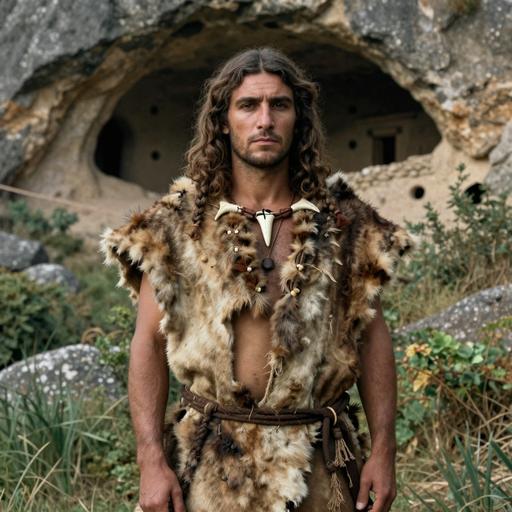
AI portrait reconstruction for A man buried in Spain in the Upper Paleolithic era
AI-generated artistic reconstruction, not a photograph of the individual.
Record

Sample details

Recorded details and available lineage markers.

Individual

Solutrean individual, Spain

Sample ID: MLZ005003

Date Range

21067 BCE - 20676 BCE

Cultural Period

Spain Solutrean

Biological Sex

Male

mtDNA Haplogroup

Not available

Y-DNA Haplogroup

C-Y11591

Social Role

Hunter (AI estimate, era-typical)

Geography

Location

Where this individual was discovered

Country Spain
Locality Cueva del Malalmuerzo (Andalusia, Granada, Moclín)
Coordinates 37.3607, -3.8037
Chronology

Date range

When this individual lived in the broader context of human history

Solutrean individual, Spain 21067 BCE - 20676 BCE
Context

Historical context

Background information associated with the reference record.

Region & Environment

The Solutrean unfolded during the Upper Paleolithic in late glacial conditions across parts of Iberia and the broader western European sphere. Cold climates affected vegetation zones, animal migration patterns, and the availability of raw materials for toolmaking. Populations occupied areas where game and resources could be reliably accessed, often near landscapes offering shelter and hunting opportunities.

Historical Context

Within the broader Upper Paleolithic sequence, the Solutrean is typically placed after earlier Paleolithic phases and before later Upper Paleolithic developments. In this era, communities relied on hunting and the production of advanced lithic technologies rather than farming or herding.

Populations & Lifeways

Solutrean groups were human hunter-gatherers. Their lifeways centered on acquiring and processing animal resources through coordinated hunting and tool-supported butchery and craft activities. Mobility is generally expected in Paleolithic contexts, with seasonal movements shaped by prey behavior and local environmental conditions, though the precise settlement system varies by place.

Archaeology & Material Culture

Archaeology identifies the Solutrean largely through lithic assemblages. Stoneworking includes technologies that produce finely crafted points and cutting tools from high-quality flint or other knappable stones. Toolmaking debris, retouch scars, and standardized shapes at particular sites support the idea of learned techniques and consistent production choices. Organic artifacts are less often preserved, but stone tools indicate repeated task-specific activities such as hunting, hide processing, and tool maintenance.

Culture & Society

The Solutrean technological signature implies shared technical traditions across regions, even if local groups adapted to their immediate environments. Social learning of knapping skills would have been important, given the complexity and careful flaking required for specific tool forms. Evidence for long-distance mobility or exchange is not assured in all cases, so it is best understood as reflecting a connected Upper Paleolithic cultural landscape rather than a single centrally organized society.

Legacy & Transition

As climates and ecosystems changed toward the end of this interval, later Upper Paleolithic traditions followed. The Solutrean’s distinctive stone technologies contribute to understanding how Upper Paleolithic communities responded to late glacial challenges. The transition to subsequent industries reflects both environmental change and evolving technological practices rather than an instantaneous cultural replacement.

Analysis

Genetic comparisons

These comparisons show genetic similarity, not identity or origin. The populations listed are those whose genomes show statistical alignment to this ancient individual.
Similarity reflects shared history, not shared identity. These are analytical comparisons, not claims about who this person was.

Modern Genetic Admixture

This analysis compares the DNA profile with present-day reference populations, showing statistical similarity to modern reference populations from different regions. The excavation site records where this individual was found, not a fixed modern genetic identity.

Europe 66.9%
Northwestern European 36.9%
Scandinavian 18.4%
English 13.0%
Finnish 5.3%
Southern European 30.1%
Iberian 30.1%
Asia 23.6%
Central Asian, Northern Indian & Pakistani 14.4%
Indian 14.4%
Chinese & Southeast Asian 9.1%
Tibetan 3.7%
Indonesian Khmer Thai Myanma 3.6%
Chinese 1.8%
Africa 4.6%
Congolese & Southern East African 2.4%
South East African 2.4%
West African 1.4%
Nigerian 1.4%
Northern East African 0.7%
Eastern African 0.7%
Oceania 3.1%
Melanesian 3.1%
Papuan 3.1%
America 1.8%
America 1.8%
Native American 1.8%

Closest Modern Populations

These are the modern populations showing the closest statistical alignment to A man buried in Spain in the Upper Paleolithic era, ranked by genetic distance. Lower distance values indicate closer statistical similarity. Cross-region similarity can reflect shared ancestry, population movement, continuity, or later admixture.

1
Tatar Mishar
6.8928
2
Roma Barcelona
7.8778
3
Tatar Kazan
8.0994
4
Roma Madrid
8.4457
5
Roma Bilbao
8.5031
6
Erzya
8.5489
7
Mordovian
8.5559
8
Moksha
8.6158
9
Turkish Deliorman
8.8623
10
Russian Krasnoborsky
8.9225
Context

Related Samples

This individual exists within a broader network of ancient samples. No ancient genome stands alone.

Individual Culture/Period Date Location Action
Solutrean individual, Spain Solutrean culture 21067 BCE Cueva del Malalmuerzo (Andalusia, Granada, Moclín), Spain View
Page 1
Individual Culture/Period Date Location Action
Solutrean individual, Spain Solutrean culture 21067 BCE Cueva del Malalmuerzo (Andalusia, Granada, Moclín), Spain View
Pre-Agricultural European individual, Spain Solutrean culture 19061 BCE La Riera (Asturias, llanes, Quintana), Spain View
Page 1
Sources

References

Scientific publications and genetic data that inform this profile.

G25 Coordinates

These coordinates represent a position in genetic space, a tool for comparison, not a conclusion. You can use these to perform custom admixture analysis in G25 Studio.

MLZ005003,0.09358578,0.05438658,0.02148888,0.06072164,0.0184741,0.0225222,0.0022736,0.0024625,0.01512888,0.00365658,0.00287082,0.00020032,0.00055106,-0.00305614,4.18E-05,-0.00039374,0.00262444,-0.00016642,0.00127766,0.0003454,0.00352396,0.00455468,-0.003811,0.00622138,0.0039518
Continue in G25 Studio
Use code for 30% off • Expires Nov 16