A woman buried in Estonia in the Bronze Age era

Download PDF creates a visual, rasterized copy. Use Print for selectable text and better assistive-technology support.

Loading Report

Preparing your ancestry journey

Preparing the available report content...

Your report will open automatically.

Skip to main content
Reference library / Sample profile

A woman buried in Estonia in the Bronze Age era

Explore the recorded context, genetic comparisons and research behind this reference sample.

EstoniaCorded Ware Culture, Estonia

A reference profile describes this sample. It does not establish a personal or family relationship.

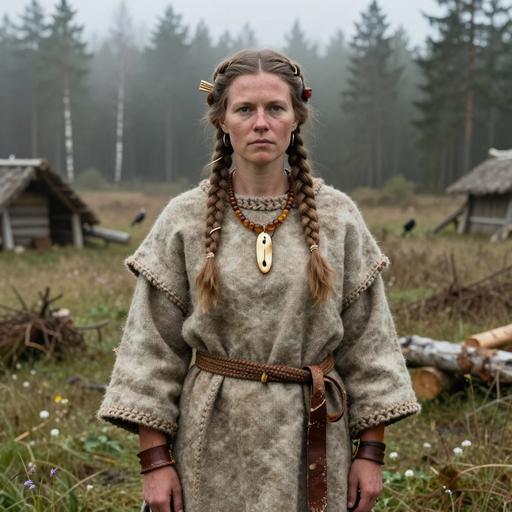
AI portrait reconstruction for A woman buried in Estonia in the Bronze Age era
AI-generated artistic reconstruction, not a photograph of the individual.
Record

Sample details

Recorded details and available lineage markers.

Individual

Proto-Indo-European individual, Estonia

Sample ID: Sope

Date Range

2575 BCE - 2348 BCE

Cultural Period

Corded Ware Culture, Estonia

Biological Sex

Female

mtDNA Haplogroup

H5a1

Y-DNA Haplogroup

Not available

Social Role

Laborer (AI estimate, era-typical)

Geography

Location

Where this individual was discovered

Country Estonia
Locality Jäbara. Ida-Viru. Sope
Coordinates 59.4080, 27.0260
Chronology

Date range

When this individual lived in the broader context of human history

Proto-Indo-European individual, Estonia 2575 BCE - 2348 BCE
Context

Historical context

Background information associated with the reference record.

Overview

The Corded Ware Culture in Estonia belongs to a broader Late Neolithic/early Bronze Age horizon recognized across much of northern and central Europe. Dated to roughly 2900–2300 BCE in Estonia, it is especially visible in distinctive pottery styles and particular burial practices.

Region & Environment

Estonia lies on the Baltic coast and inland is dominated by lowlands, glacial landscapes, extensive forests, and numerous rivers and lakes. These varied water-rich environments supported fishing and hunting, while patches of more productive soils helped sustain farming where conditions allowed. Coastal and lake networks likely facilitated movement of people and goods, even when settlements were dispersed.

Historical Context

In the late 3rd millennium BCE, parts of northern Europe experienced cultural shifts that archaeologists connect with the spread of the Corded Ware phenomenon. Rather than a single event, the horizon reflects changing practices—most clearly in mortuary customs and ceramic design—within communities that were already living in the region.

Populations & Lifeways

Communities in Estonia during this period were organized at the level of households and local groups. Subsistence likely combined cultivation (where soils permitted), pastoral activities, fishing, and hunting in surrounding forests and wetlands. Lifeways would have been seasonal and place-based, with travel and exchange taking advantage of waterways.

Archaeology & Material Culture

Corded Ware assemblages are characterized by ceramics decorated with cord-like impressions and related techniques. Funerary evidence often includes burials that differ from earlier local traditions, providing a key basis for distinguishing this horizon archaeologically. Other material traces—such as stone and bone tools—reflect continuity with earlier Neolithic lifeways, while new styles in pottery and burial stand out as diagnostic.

Culture & Society

The prominence of patterned burial practices suggests shared social norms and ways of marking identity and community memory. Decorative ceramic styles also point to communication across distances, whether through direct contact, migration, or the adoption of widely recognized traditions. Overall, the society implied by the record appears locally rooted yet connected to broader networks across the Baltic and beyond.

Legacy & Transition

After the Corded Ware horizon, Estonian material culture gradually shifts toward later phases of the Bronze Age. The transition is visible archaeologically through changing ceramic styles and evolving mortuary practices, indicating that traditions did not simply disappear but transformed over subsequent generations.

Analysis

Genetic comparisons

These comparisons show genetic similarity, not identity or origin. The populations listed are those whose genomes show statistical alignment to this ancient individual.

Similarity reflects shared history, not shared identity. These are analytical comparisons, not claims about who this person was.

Modern Genetic Admixture

This analysis compares the DNA profile with present-day reference populations, showing statistical similarity to modern reference populations from different regions. The excavation site records where this individual was found, not a fixed modern genetic identity.

Europe 92.7%
Northwestern European 72.1%
English 43.8%
Scandinavian 23.0%
Northwestern European 4.7%
Finnish 0.7%
Eastern European 20.6%
Asia 6.8%
Central Asian, Northern Indian & Pakistani 6.8%
Pakistan 6.5%

Closest Modern Populations

These are the modern populations showing the closest statistical alignment to A woman buried in Estonia in the Bronze Age era, ranked by genetic distance. Lower distance values indicate closer statistical similarity. Cross-region similarity can reflect shared ancestry, population movement, continuity, or later admixture.

1
Swedish
2.2732
2
German Hamburg
2.9205
3
Norwegian
3.0604
4
Danish
3.2207
5
Icelandic
3.3075
6
Czech
3.3794
7
German East
3.5637
8
Dutch
3.7484
9
Shetlandic
3.8136
10
Orcadian
3.8299
Context

Related Samples

This individual exists within a broader network of ancient samples. No ancient genome stands alone.
Individual Culture/Period Date Location Action
Proto-Indo-European individual, Estonia Corded Ware Culture, Estonia 2575 BCE Jäbara. Ida-Viru. Sope, Estonia View
Corded Ware individual, Estonia 2575 BCE Jäbara. Ida-Viru. Sope, Estonia View
Page 1
Individual Culture/Period Date Location Action
Proto-Indo-European individual, Estonia Corded Ware Culture, Estonia 2575 BCE Kursi. Jõgeva, Estonia View
Proto-Indo-European individual, Estonia Corded Ware Culture, Estonia 2575 BCE Jäbara. Ida-Viru. Sope, Estonia View
Proto-Indo-European individual, Estonia Corded Ware Culture, Estonia 2872 BCE Ardu. Harju, Estonia View
Proto-Indo-European individual, Estonia Corded Ware Culture, Estonia 2850 BCE Kursi. Jõgeva, Estonia View
Page 1
Sources

References

Scientific publications and genetic data that inform this profile.

G25 Coordinates

These coordinates represent a position in genetic space, a tool for comparison, not a conclusion. You can use these to perform custom admixture analysis in G25 Studio.

Sope,0.1334209,0.11556216,0.05961666,0.0644787,0.03383406,0.02377478,0.00569226,0.01185094,0.0048948,-0.01016026,-0.00971022,0.00103094,0.00214172,-0.00238166,0.0090863,0.0024515,-0.00493346,0.00185398,0.00049284,0.00371124,0.00261106,0.00264512,0.00018336,0.0102462,-0.00277416
Continue in G25 Studio
Use code for 30% off • Expires Nov 16