
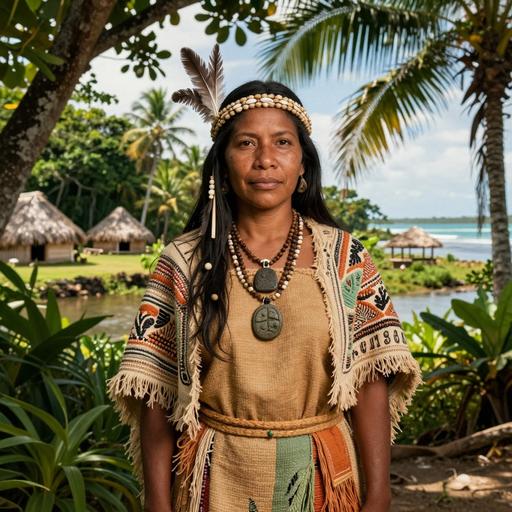
A woman buried in Puerto Rico in the era

Download PDF creates a visual, rasterized copy. Use Print for selectable text and better assistive-technology support.

Loading Report

Preparing your ancestry journey

Preparing the available report content...

Your report will open automatically.

Skip to main content
Reference library / Sample profile

A woman buried in Puerto Rico in the era

Explore the recorded context, genetic comparisons and research behind this reference sample.

Puerto RicoThe First Peoples of the Caribbean

A reference profile describes this sample. It does not establish a personal or family relationship.

AI portrait reconstruction for A woman buried in Puerto Rico in the  era
AI-generated artistic reconstruction, not a photograph of the individual.
Record

Sample details

Recorded details and available lineage markers.

Individual

America Caribbean Ancient individual, Puerto Rico

Sample ID: PDI008

Date Range

1219 CE - 1386 CE

Cultural Period

The First Peoples of the Caribbean

Biological Sex

Female

mtDNA Haplogroup

A2

Y-DNA Haplogroup

Not available

Social Role

Fisher (AI estimate, era-typical)

Geography

Location

Where this individual was discovered

Country Puerto Rico
Locality Vega Baja. Paso del Indio

A location map is not available for this record.

Chronology

Date range

When this individual lived in the broader context of human history

America Caribbean Ancient individual, Puerto Rico 1219 CE - 1386 CE
Context

Historical context

Background information associated with the reference record.

Overview

“The First Peoples of the Caribbean” refers to the earliest phases of human presence in the Caribbean islands and adjacent areas. Archaeological work focuses on earliest dated sites and the lifeways implied by settlement debris, toolkits, and food remains.

Region & Environment

The Caribbean consists of island chains with varied coastlines, wetlands, and inland environments. Island ecologies shaped subsistence possibilities—coastal fishing and shellfishing, along with foraging and gardening or cultivation practices where evidenced.

Historical Context

This era precedes European contact and belongs to the long history of human movement through the Americas. Archaeological sequences indicate that people reached islands via water routes and then developed local routines shaped by available resources.

Populations & Lifeways

Early island communities were typically small and organized around everyday needs: food procurement, tool making, and shelter construction. Lifeways would have depended on the seasonality of resources and local ecological niches, with technologies suited for coastal and inland tasks.

Archaeology & Material Culture

Key archaeological evidence often includes:

  • stone tool traditions used for cutting, scraping, and processing,
  • shell and faunal remains that inform on diet and harvesting strategies,
  • traces of living surfaces and features in coastal settings where preservation favors visibility. Because early chronologies can be challenging, interpretations emphasize broad behavioral patterns rather than precise cultural affiliations.

Culture & Society

While named cultures are not always securely recoverable from the earliest layers, repeated patterns in tool use and site organization can suggest shared technological knowledge and community traditions across regions.

Legacy & Transition

As settlement continued, island societies diversified in material traditions and subsistence strategies over time. Earlier phases provide the foundation for later Caribbean cultural developments documented in progressively richer archaeological sequences.

Analysis

Genetic comparisons

These comparisons show genetic similarity, not identity or origin. The populations listed are those whose genomes show statistical alignment to this ancient individual.

Similarity reflects shared history, not shared identity. These are analytical comparisons, not claims about who this person was.

Modern Genetic Admixture

This analysis compares the DNA profile with present-day reference populations, showing statistical similarity to modern reference populations from different regions. The excavation site records where this individual was found, not a fixed modern genetic identity.

America 91.8%
America 91.8%
Native American 91.8%
Asia 8.2%
Northern Asian 5.4%
Siberian 5.4%
Chinese & Southeast Asian 1.4%
Chinese 1.4%
Central Asian, Northern Indian & Pakistani 1.3%
Indian 1.3%

Closest Modern Populations

These are the modern populations showing the closest statistical alignment to A woman buried in Puerto Rico in the era, ranked by genetic distance. Lower distance values indicate closer statistical similarity. Cross-region similarity can reflect shared ancestry, population movement, continuity, or later admixture.

1
Piapoco
2.0773
2
Aymara
2.1463
3
Yukpa
2.3771
4
Wichi
2.4117
5
Bolivian Lapaz
2.9127
6
Colla
3.3043
7
Karitiana
3.5300
8
Cachi
3.7790
9
Mixe
4.3535
10
Surui
4.5323
Context

Related Samples

This individual exists within a broader network of ancient samples. No ancient genome stands alone.

Individual Culture/Period Date Location Action
Puerto Rico Ceramic individual, Puerto Rico Ceramic Period Paso del Indio, Puerto Rico 994-1,163 CE Puerto Rico. Paso del Indio, Puerto Rico View
America Caribbean Ancient individual, Puerto Rico 1,219-1,386 CE Vega Baja. Paso del Indio, Puerto Rico View
Page 1
Individual Culture/Period Date Location Action
America Caribbean Ancient individual, Puerto Rico 1,219-1,386 CE Vega Baja. Paso del Indio, Puerto Rico View
America Caribbean Ancient individual, Guadeloupe 992-1,034 CE Pointe de Chateaux peninsula. Anse à la Gourde, Guadeloupe View
America Caribbean Ancient individual, Guadeloupe 775-980 CE Pointe de Chateaux peninsula. Anse à la Gourde, Guadeloupe View
America Caribbean Ancient individual, Guadeloupe 1,276-1,384 CE Pointe de Chateaux peninsula. Anse à la Gourde, Guadeloupe View
America Caribbean Ancient individual, Guadeloupe 1,269-1,376 CE Pointe de Chateaux peninsula. Anse à la Gourde, Guadeloupe View
America Caribbean Ancient individual, Cuba 653-874 CE Matanzas City. Canimar Abajo, Cuba View
Page 1
Sources

References

Scientific publications and genetic data that inform this profile.

G25 Coordinates

These coordinates represent a position in genetic space, a tool for comparison, not a conclusion. You can use these to perform custom admixture analysis in G25 Studio.

PDI008,0.0572226,-0.31140278,0.11100998,0.10353708,-0.11442062,-0.01207708,-0.30419008,-0.35751844,-0.01527854,-0.01765576,0.001378,-0.00112632,-0.00067712,0.02478622,-0.0060987,-0.00076974,0.00587758,0.00297276,0.00013518,-0.00221174,-0.00124332,0.00838678,-0.00301424,-0.00536262,-0.00611201
Continue in G25 Studio

Our analyses use reference samples for comparison. A sample’s place, period and source help explain how to interpret a match.

Use code for 35% off • Expires Nov 30