A man buried in Switzerland in the era

Download PDF creates a visual, rasterized copy. Use Print for selectable text and better assistive-technology support.

Loading Report

Preparing your ancestry journey

Preparing the available report content...

Your report will open automatically.

Skip to main content
Reference library / Sample profile

A man buried in Switzerland in the era

Explore the recorded context, genetic comparisons and research behind this reference sample.

SwitzerlandAncient Hunter-Gatherers of Western Europe

A reference profile describes this sample. It does not establish a personal or family relationship.

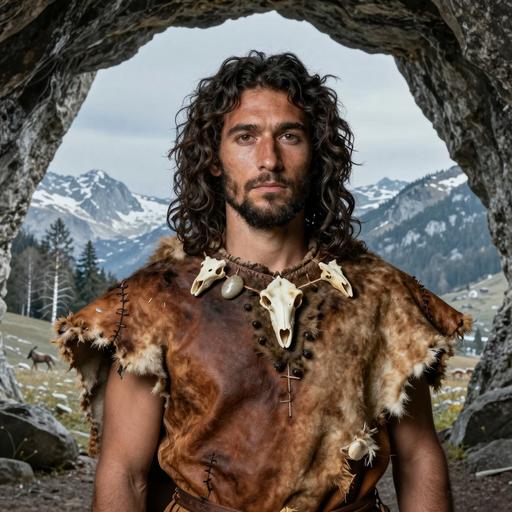
AI portrait reconstruction for A man buried in Switzerland in the  era
AI-generated artistic reconstruction, not a photograph of the individual.
Record

Sample details

Recorded details and available lineage markers.

Individual

West European Hunter Gatherer individual, Switzerland

Sample ID: Bichon

Date Range

11850 BCE - 11579 BCE

Cultural Period

Ancient Hunter-Gatherers of Western Europe

Biological Sex

Male

mtDNA Haplogroup

U5b1-a1*

Y-DNA Haplogroup

I-BY33138

Social Role

Hunter (AI estimate, era-typical)

Geography

Location

Where this individual was discovered

Country Switzerland
Locality Grotte du Bichon

A location map is not available for this record.

Chronology

Date range

When this individual lived in the broader context of human history

West European Hunter Gatherer individual, Switzerland 11850 BCE - 11579 BCE
Context

Historical context

Background information associated with the reference record.

The “Ancient Hunter-Gatherers of Western Europe” category is a broad prehistory interval (here dated from roughly 100,000 to 1,000 years before the present) that encompasses changing climates, environments, and human strategies in western Europe. Because it is defined at a regional and behavioral level rather than by a single named culture, the focus is on general archaeological patterns associated with mobile lifeways.

Region & Environment

Western Europe includes coastal and inland zones with varied ecologies. Over the timeframe implied here, climate instability would have repeatedly altered temperatures, precipitation, and the distribution of plants and animals, affecting where groups could hunt, forage, and camp.

Historical Context

This interval spans much of the late Pleistocene and much of the Holocene, periods in which human populations adjusted to glacial and interglacial conditions and, later, to progressively more stable postglacial environments. Technological and subsistence choices shifted in response to local opportunities rather than to a single coordinated “event.”

Populations & Lifeways

Populations were primarily mobile hunter-gatherers, using seasonal rounds to exploit resources that varied in availability. Settlement likely ranged from short-term camps to repeated use of favored areas, such as river corridors, coasts, and sheltered landscapes.

Archaeology & Material Culture

Archaeological visibility typically centers on lithic (stone) tool technologies, activity debris, and occasional organic traces where conditions preserve them. Toolkits often reflect task-specific strategies—cutting, scraping, hunting-related work, and processing plant and animal materials—while raw-material sourcing can reveal movement and interaction.

Culture & Society

“Culture” in this context is best understood through recurring technological choices and site-use patterns rather than through named states or institutions. Variation between regions likely reflects differences in local ecology, mobility routes, and social networks.

Legacy & Transition

As the Holocene develops, some parts of western Europe eventually see the rise of farming and more complex settlement systems. The hunter-gatherer legacy persists in local traditions of land use, technology, and knowledge of seasonal landscapes that later groups adapted or transformed.

Analysis

Genetic comparisons

These comparisons show genetic similarity, not identity or origin. The populations listed are those whose genomes show statistical alignment to this ancient individual.

Similarity reflects shared history, not shared identity. These are analytical comparisons, not claims about who this person was.

Modern Genetic Admixture

This analysis compares the DNA profile with present-day reference populations, showing statistical similarity to modern reference populations from different regions. The excavation site records where this individual was found, not a fixed modern genetic identity.

Europe 100.0%
Northwestern European 100.0%
Finnish 53.2%
English 26.8%
Northwestern European 18.7%
Scandinavian 1.3%

Closest Modern Populations

These are the modern populations showing the closest statistical alignment to A man buried in Switzerland in the era, ranked by genetic distance. Lower distance values indicate closer statistical similarity. Cross-region similarity can reflect shared ancestry, population movement, continuity, or later admixture.

1
Polish Kashubian
2.0861
2
Polish
2.2922
3
Ukrainian Rivne
2.9751
4
Czech
2.9855
5
Ukrainian Chernihiv
3.0891
6
Russian Smolensk
3.1299
7
Cossack Ukrainian
3.1320
8
Ukrainian Dnipro
3.1372
9
Russian Kursk
3.1392
10
Ukrainian Zhytomyr
3.1411
Context

Related Samples

This individual exists within a broader network of ancient samples. No ancient genome stands alone.

Individual Culture/Period Date Location Action
Caucasian Hunter-Gatherers individual, Georgia Kotias Period Georgia 7940 BCE Kotias Klde, Georgia View
Paleolithic individual, Georgia Satsurblia Period Georgia 11461 BCE Satsurblia, Georgia View
Paleolithic individual, Switzerland Bichon Cave, Switzerland 11850 BCE Grotte du Bichon, Switzerland View
West European Hunter Gatherer individual, Switzerland 11850 BCE Grotte du Bichon, Switzerland View
Caucasus Hg individual, Georgia 7940 BCE Kotias Klde, Georgia View
Palaeolithic Epigravettian individual, Georgia 11461 BCE Satsurblia, Georgia View
Page 1
Individual Culture/Period Date Location Action
West European Hunter Gatherer individual, Luxembourg 6221 BCE Echternach, Luxembourg View
West European Hunter Gatherer individual, France 11207 BCE Rochedane, France View
West European Hunter Gatherer individual, France 10050 BCE Aven des Iboussières à Malataverne. Rhône-Alpes, France View
West European Hunter Gatherer individual, Luxembourg 6221 BCE Echternach, Luxembourg View
West European Hunter Gatherer individual, Switzerland 11850 BCE Grotte du Bichon, Switzerland View
Page 1
Sources

References

Scientific publications and genetic data that inform this profile.

G25 Coordinates

These coordinates represent a position in genetic space, a tool for comparison, not a conclusion. You can use these to perform custom admixture analysis in G25 Studio.

Bichon,0.13760706,0.12671552,0.0705191,0.0662134,0.04141944,0.02959374,0.00747284,0.01102378,0.00211098,-0.0176243,-0.00870522,-0.0007823,0.01157628,0.0114056,0.00163548,0.00424202,-0.00433972,0.00012846,0.002191,0.001411,0.0033065,7.688E-05,0.00605098,0.00341996,-0.00194584
Continue in G25 Studio
Use code for 30% off • Expires Nov 16