


| Individual | Culture/Period | Date | Location | Action |
|---|---|---|---|---|
| Pre-Celtic individual, Luxembourg | Mesolithic Luxembourg | 6221 BCE | Loschbour (Echternach), Luxembourg | View |
Page 1

A man buried in Luxembourg in the Mesolithic era
Download PDF creates a visual, rasterized copy. Use Print for selectable text and better assistive-technology support.
Preparing your ancestry journey
Preparing the available report content...
Your report will open automatically.
Explore the recorded context, genetic comparisons and research behind this reference sample.
A reference profile describes this sample. It does not establish a personal or family relationship.
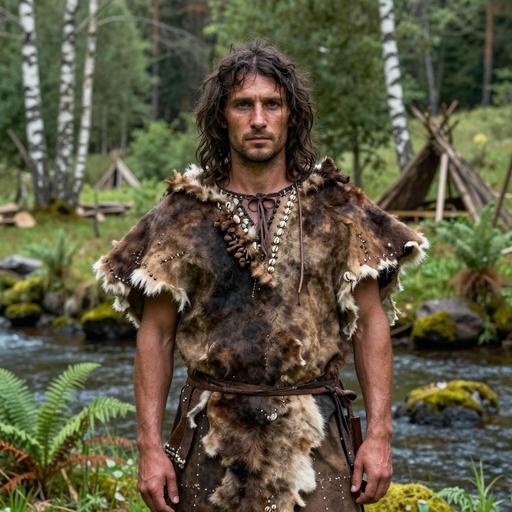
Recorded details and available lineage markers.
Pre-Celtic individual, Luxembourg
Sample ID: Loschbour_snpAD
6221 BCE - 5986 BCE
Mesolithic Luxembourg
Male
U5b1a
Not available
Hunter (AI estimate, era-typical)
Where this individual was discovered
A location map is not available for this record.
When this individual lived in the broader context of human history
Background information associated with the reference record.
Mesolithic Luxembourg refers to Mesolithic hunter-gatherer activity in the territory of present-day Luxembourg between about the ninth and fifth millennia BCE. Rather than a single “culture” with a uniform set of traits everywhere, the archaeological record reflects regional adaptation to local environments and to long-term shifts in climate and ecosystems.
The Luxembourg region lies within a temperate European landscape where forests, river valleys, and wetlands formed the main ecological zones for foraging. Over the Mesolithic, postglacial climate stability and increasing woodland coverage changed the distribution of game and the productivity of waterways. People repeatedly exploited environments that offered predictable seasonal resources.
Mesolithic communities in western Europe preceded the broad adoption of farming in the region. Their lifeways were therefore organized around hunting, fishing, and gathering rather than agriculture. Connections across western Europe are visible in the general similarity of tool-making traditions, even when local assemblages differ.
Hunter-gatherer groups likely formed small, mobile or semi-mobile communities, visiting productive areas multiple times across the year. Activities such as hunting, fishing, and processing wild plant foods required coordinated effort and knowledge of seasonal cycles. Settlement evidence often reflects short-term use of favorable locations, though some places may have been revisited repeatedly.
Archaeological signatures typically include stone tool industries suited to cutting, scraping, and woodworking tasks connected to hunting and daily life. Lithic production debris indicates on-site tool maintenance and manufacture. Organic materials are usually less well preserved, so the stone tool record and associated features (such as hearth-related deposits, where present) play a major role in interpretation.
While detailed social organization is not accessible directly, repeated patterns in tool types and knapping approaches suggest shared learning traditions and regional cultural practice. Different site assemblages can reflect activity variation—such as specialized hunting stations versus general residential areas—or differences in seasonal timing. Such variability fits a subsistence economy based on flexible use of a range of habitats.
Mesolithic lifeways in Luxembourg provided the local baseline for later prehistoric developments. As Neolithic practices spread into parts of western Europe, communities reorganized food production, settlement behavior, and material culture. The Mesolithic-to-Neolithic transition is therefore best viewed as a change in subsistence and social-economic strategies rather than a simple replacement of people.
These comparisons show genetic similarity, not identity or origin. The populations listed are those whose genomes show statistical alignment to this ancient individual.
Similarity reflects shared history, not shared identity. These are analytical comparisons, not claims about who this person was.
This analysis compares the DNA profile with present-day reference populations, showing statistical similarity to modern reference populations from different regions. The excavation site records where this individual was found, not a fixed modern genetic identity.
These are the modern populations showing the closest statistical alignment to A man buried in Luxembourg in the Mesolithic era, ranked by genetic distance. Lower distance values indicate closer statistical similarity. Cross-region similarity can reflect shared ancestry, population movement, continuity, or later admixture.
This individual exists within a broader network of ancient samples. No ancient genome stands alone.
| Individual | Culture/Period | Date | Location | Action |
|---|---|---|---|---|
| Pre-Celtic individual, Luxembourg | Mesolithic Luxembourg | 6221 BCE | Loschbour (Echternach), Luxembourg | View |
Scientific publications and genetic data that inform this profile.
These coordinates represent a position in genetic space, a tool for comparison, not a conclusion. You can use these to perform custom admixture analysis in G25 Studio.
Loschbour_snpAD,0.13773,0.12725762,0.0666026,0.06245914,0.04124832,0.02842722,0.00611972,0.00954778,0.00301566,-0.01377758,-0.00867444,0.00207022,0.00796488,0.00430832,0.00600804,0.00308558,-0.0064762,0.00048408,0.00067732,0.00095002,0.00445898,0.00163268,0.00435658,0.0055583,-0.00180999