A man buried in Belgium in the era

Download PDF creates a visual, rasterized copy. Use Print for selectable text and better assistive-technology support.

Loading Report

Preparing your ancestry journey

Preparing the available report content...

Your report will open automatically.

Skip to main content
Reference library / Sample profile

A man buried in Belgium in the era

Explore the recorded context, genetic comparisons and research behind this reference sample.

BelgiumMagdalenian Paleolithic

A reference profile describes this sample. It does not establish a personal or family relationship.

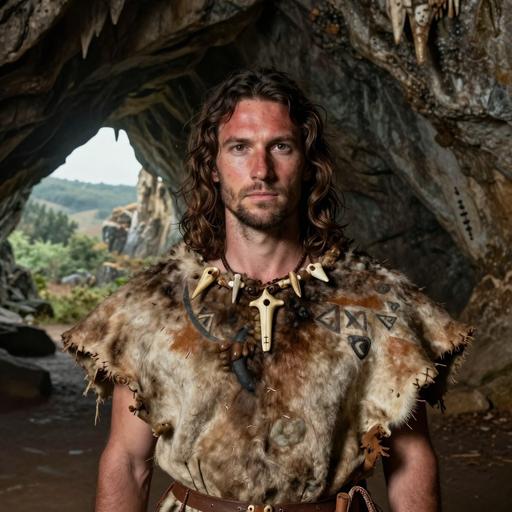
AI portrait reconstruction for A man buried in Belgium in the  era
AI-generated artistic reconstruction, not a photograph of the individual.
Record

Sample details

Recorded details and available lineage markers.

Individual

Palaeolithic Magdalenian individual, Belgium

Sample ID: GoyetQ-2

Date Range

13305 BCE - 12976 BCE

Cultural Period

Magdalenian Paleolithic

Biological Sex

Male

mtDNA Haplogroup

U8a

Y-DNA Haplogroup

I-M170

Social Role

Hunter (AI estimate, era-typical)

Geography

Location

Where this individual was discovered

Country Belgium
Locality Troisieme caverne of Goyet cave

A location map is not available for this record.

Chronology

Date range

When this individual lived in the broader context of human history

Palaeolithic Magdalenian individual, Belgium 13305 BCE - 12976 BCE
Context

Historical context

Background information associated with the reference record.

Overview

The Magdalenian is a late Upper Paleolithic archaeological tradition associated with hunter-gatherers in parts of western and central Europe. It is identified by recurring patterns in lithic and organic technologies and by site evidence for intensive use of particular landscapes.

Region & Environment

The Magdalenian occurs during the Late Pleistocene, when climatic conditions were dynamic as glaciers retreated and environments shifted. People would have been sensitive to changes in habitat and animal distributions. River valleys, resource-rich plains, and other productive zones would have supported hunting and foraging, with site use varying by season.

Historical Context

Within the Upper Paleolithic sequence, the Magdalenian follows earlier traditions and is distinguished through changes in technology and artifact assemblage composition. Its regional expression is not uniform, but common patterns in tool industries help archaeologists recognize it across multiple sites.

Populations & Lifeways

Magdalenian communities were hunter-gatherers who organized mobility around resource cycles. Archaeological patterns suggest repeated occupation of some areas and more complex planning than in earlier periods, particularly where there is evidence for specialized tool manufacture and on-site processing.

Archaeology & Material Culture

The Magdalenian material record includes a strong emphasis on chipped stone tools as well as worked bone/antler. Tool production reflects careful planning of blanks and tool forms, and some assemblages include items suited for specialized tasks associated with hunting, clothing/gear production, and processing animal products. Where preserved, activity areas, hearths, and spatial organization at sites support interpretations of longer or more intensively used occupations.

Culture & Society

The Magdalenian is often discussed in terms of shared technological conventions and the social transmission of craft knowledge. The presence of worked organic artifacts and, in some contexts, decorative or symbolic items suggests social communication and group identity expressed through material culture. However, the specific meanings of such objects remain interpretive, and only their material presence can be stated confidently.

Legacy & Transition

As the Pleistocene ended and post-glacial environments emerged, Late Paleolithic traditions gave way to new toolkits and settlement strategies suited to warmer, more rapidly changing ecosystems. In the archaeological record, transitions are visible through changes in artifact styles and the reorganization of resource use rather than a single abrupt break.

Context

Related Samples

This individual exists within a broader network of ancient samples. No ancient genome stands alone.

Individual Culture/Period Date Location Action
European Paleolithic individual, Belgium Upper Paleolithic Magdalenian Culture, Belgium 13305 BCE Troisieme caverne of Goyet cave, Belgium View
Palaeolithic Magdalenian individual, Belgium 13305 BCE Troisieme caverne of Goyet cave, Belgium View
Page 1
Individual Culture/Period Date Location Action
Palaeolithic Magdalenian individual, France 13696 BCE Rigney, France View
Palaeolithic Magdalenian individual, Germany 13127 BCE Swabian Jura. Baden-Wurttemberg. Burkhardtshöhle. Westerheim, Germany View
Palaeolithic Magdalenian individual, Belgium 13305 BCE Troisieme caverne of Goyet cave, Belgium View
Palaeolithic Magdalenian individual, Germany 13101 BCE Swabian Jura. Baden-Wurttemberg. Hohle Fels. Ach Valley, Germany View
Palaeolithic Magdalenian individual, Germany 13167 BCE Swabian Jura. Baden-Wurttemberg. Brillenhöhle. Ach Valley, Germany View
Palaeolithic Magdalenian individual, Germany 13771 BCE Swabian Jura. Baden-Wurttemberg. Hohle Fels. Ach Valley, Germany View
Palaeolithic Magdalenian individual, Belgium 13305 BCE Troisieme caverne of Goyet cave, Belgium View
Page 1
Use code for 30% off • Expires Nov 16