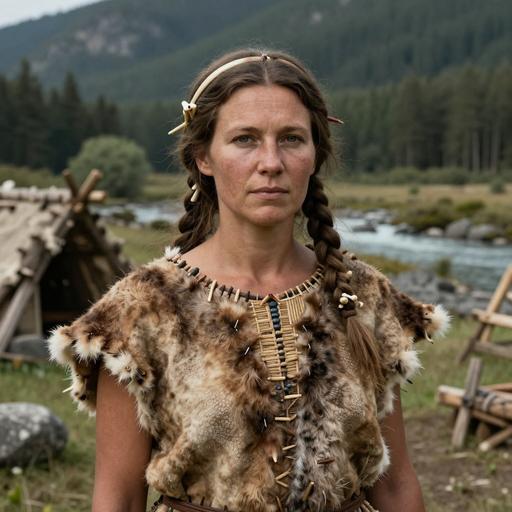
A woman buried in Russia in the Neolithic era

Download PDF creates a visual, rasterized copy. Use Print for selectable text and better assistive-technology support.

Loading Report

Preparing your ancestry journey

Preparing the available report content...

Your report will open automatically.

Skip to main content
Reference library / Sample profile

A woman buried in Russia in the Neolithic era

Explore the recorded context, genetic comparisons and research behind this reference sample.

RussiaNeolithic Devil's Cave, Russia

A reference profile describes this sample. It does not establish a personal or family relationship.

AI portrait reconstruction for A woman buried in Russia in the Neolithic era
AI-generated artistic reconstruction, not a photograph of the individual.
Record

Sample details

Recorded details and available lineage markers.

Individual

Proto-Indo-European individual, Russia

Sample ID: DevilsGate_merge

Date Range

5721 BCE - 5626 BCE

Cultural Period

Neolithic Devil's Cave, Russia

Biological Sex

Female

mtDNA Haplogroup

D4

Y-DNA Haplogroup

Not available

Social Role

Gatherer (AI estimate, era-typical)

Geography

Location

Where this individual was discovered

Country Russia
Locality Devil's-Gate-Cave (Primorsky Krai, Dalnegorsk municipality, Dalnegorsk Village)
Chronology

Date range

When this individual lived in the broader context of human history

Proto-Indo-European individual, Russia 5721 BCE - 5626 BCE
Context

Historical context

Background information associated with the reference record.

Region & Environment

The Russian Far East encompasses diverse environments, including coastal zones and uplands affected by cold seasons and marine productivity. In Neolithic contexts linked to Devil’s Cave, the surrounding landscape would have provided both aquatic and terrestrial resources, with seasonal variation shaping access.

Historical Context

Between roughly 6000 and 2000 BCE, Neolithic developments in the region involved continued refinement of subsistence strategies and increasing use of ceramic technology. These centuries reflect gradual local changes rather than a single, uniform event across the Far East.

Populations & Lifeways

Communities likely relied heavily on aquatic resources such as fish and shellfish where available, supplemented by terrestrial hunting and gathering. Seasonal rounds would have been important for taking advantage of predictable cycles in animal behavior and resource availability.

Archaeology & Material Culture

The Devil’s Cave Neolithic is commonly discussed through tool and pottery assemblages that indicate a maritime-oriented Neolithic lifestyle. Stone tools would have been used for cutting, scraping, and processing food and materials, while ceramics suggest cooking and storage needs. Where preservation allows, archaeologists may also identify manufacturing debris and features indicating repeated activity at or near the site.

Culture & Society

Cultural patterns are inferred from recurring associations of pottery traits and lithic technology, which can reflect shared traditions within local communities. Such patterns also suggest that knowledge about processing aquatic resources and producing everyday tools was transmitted over generations.

Legacy & Transition

Over time, the Neolithic lifeways of the Far East continued to evolve as regional climates and broader technological horizons changed. The Devil’s Cave sequence contributes to understanding how maritime Neolithic economies could persist and gradually transform toward later prehistoric phases.

Analysis

Genetic comparisons

These comparisons show genetic similarity, not identity or origin. The populations listed are those whose genomes show statistical alignment to this ancient individual.

Similarity reflects shared history, not shared identity. These are analytical comparisons, not claims about who this person was.

Modern Genetic Admixture

This analysis compares the DNA profile with present-day reference populations, showing statistical similarity to modern reference populations from different regions. The excavation site records where this individual was found, not a fixed modern genetic identity.

Asia 97.5%
Japanese & Korean 54.5%
Japanese 54.5%
Northern Asian 29.3%
Siberian 21.0%
Mongolian 8.4%
Chinese & Southeast Asian 13.7%
Chinese 13.4%
America 1.2%
America 1.2%
Native American 1.2%
Oceania 0.8%
Melanesian 0.8%
Papuan 0.8%

Closest Modern Populations

These are the modern populations showing the closest statistical alignment to A woman buried in Russia in the Neolithic era, ranked by genetic distance. Lower distance values indicate closer statistical similarity. Cross-region similarity can reflect shared ancestry, population movement, continuity, or later admixture.

1
Oroqen
1.7278
2
Hezhen
4.6341
3
Nanai
4.7558
4
Ulchi
4.9425
5
Daur
5.1698
6
Nivkh
5.7681
7
Negidal
6.6793
8
Khamnegan
7.3260
9
Mongol IMAR
7.5074
10
Xibo
8.1215
Context

Related Samples

This individual exists within a broader network of ancient samples. No ancient genome stands alone.

Individual Culture/Period Date Location Action
Proto-Indo-European individual, Russia Neolithic Devil's Cave, Russia 5721 BCE Devil's-Gate-Cave (Primorsky Krai, Dalnegorsk municipality, Dalnegorsk Village), Russia View
Page 1
Individual Culture/Period Date Location Action
Proto-Indo-European individual, Russia Neolithic Devil's Cave, Russia 5625 BCE Devil's Gate Cave, Russia View
Proto-Indo-European individual, Russia Neolithic Devil's Cave, Russia 5830 BCE Devil's Gate Cave, Russia View
Proto-Indo-European individual, Russia Neolithic Devil's Cave, Russia 5802 BCE Devil's Gate Cave, Russia View
Proto-Indo-European individual, Russia Neolithic Devil's Cave, Russia 5712 BCE Devil's Gate Cave, Russia View
Proto-Indo-European individual, Russia Neolithic Devil's Cave, Russia 5721 BCE Devil's Gate Cave, Russia View
Proto-Indo-European individual, Russia Neolithic Devil's Cave, Russia 5707 BCE Devil's Gate Cave, Russia View
Proto-Indo-European individual, Russia Neolithic Devil's Cave, Russia 5721 BCE Devil's-Gate-Cave (Primorsky Krai, Dalnegorsk municipality, Dalnegorsk Village), Russia View
Page 1
Sources

References

Scientific publications and genetic data that inform this profile.

G25 Coordinates

These coordinates represent a position in genetic space, a tool for comparison, not a conclusion. You can use these to perform custom admixture analysis in G25 Studio.

DevilsGate_merge,0.02511706,-0.43203128,0.06955764,-0.04087538,-0.04332692,-0.030193,0.01485056,0.01951098,0.00580882,0.0125206,-0.02026356,-0.00019856,0.00139988,0.00378212,-0.00793094,-0.00973112,-0.00502508,0.00704312,0.01038138,0.00581126,0.0153366,-0.01431972,-0.00014456,0.00118072,0.00963946
Continue in G25 Studio
Use code for 30% off • Expires Nov 16