A man buried in Austria in the era

Download PDF creates a visual, rasterized copy. Use Print for selectable text and better assistive-technology support.

Loading Report

Preparing your ancestry journey

Preparing the available report content...

Your report will open automatically.

Skip to main content
Reference library / Sample profile

A man buried in Austria in the era

Explore the recorded context, genetic comparisons and research behind this reference sample.

AustriaThe Linear Pottery Culture

A reference profile describes this sample. It does not establish a personal or family relationship.

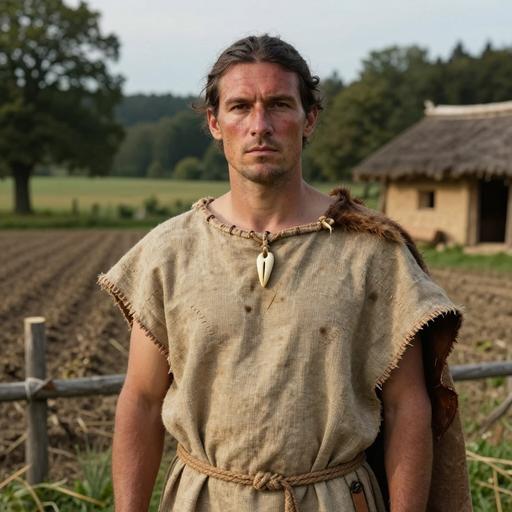
AI portrait reconstruction for A man buried in Austria in the  era
AI-generated artistic reconstruction, not a photograph of the individual.
Record

Sample details

Recorded details and available lineage markers.

Individual

Lbk individual, Austria

Sample ID: I6912

Date Range

5500 BCE - 4775 BCE

Cultural Period

The Linear Pottery Culture

Biological Sex

Male

mtDNA Haplogroup

J1

Y-DNA Haplogroup

R-M343

Social Role

Farmer (AI estimate, era-typical)

Geography

Location

Where this individual was discovered

Country Austria
Locality Brunn Wolfholz

A location map is not available for this record.

Chronology

Date range

When this individual lived in the broader context of human history

Lbk individual, Austria 5500 BCE - 4775 BCE
Context

Historical context

Background information associated with the reference record.

Region & Environment

The LBK is primarily associated with parts of Central Europe where loess soils and favorable farmland supported early agriculture. Landscapes included river valleys and open plains, which helped sustain crop cultivation and grazing.

Historical Context

LBK settlements belong to the Neolithic, when farming communities increasingly replaced or supplemented older foraging strategies in many regions. Chronologically, LBK is notable for the early establishment of large-scale village networks and for continuity in ceramic and tool traditions that allow archaeologists to trace movement and interaction.

Populations & Lifeways

LBK populations were largely sedentary agriculturalists. Their subsistence relied on domesticated cereals and livestock, supported by organized food production at the household and village scale. Settlements often show repeated use of similar spatial patterns, suggesting stable community routines over multiple generations.

Archaeology & Material Culture

Material culture is strongly diagnostic in pottery. LBK vessels commonly feature incised linear decoration, alongside plain and functional forms used for everyday tasks such as storage and serving. Toolkits included ground-stone implements (including axes/adzes) and standardized flaked stone tools, consistent with woodworking, farming, and food-processing activities.

Culture & Society

Social organization can be inferred through settlement clustering, repeated architectural choices, and consistent craft traditions. The patterned appearance of LBK ceramics across a wide area suggests shared practices and communication networks. Differences between local assemblages also point to regional variation rather than a single uniform society.

Legacy & Transition

LBK communities form an important baseline for understanding the spread and development of Neolithic lifeways in Central Europe. Over time, regional sequences change as newer ceramic and technological traditions emerge, reflecting shifting population histories, local adaptation, and interaction among farming communities and neighbors.

Analysis

Genetic comparisons

These comparisons show genetic similarity, not identity or origin. The populations listed are those whose genomes show statistical alignment to this ancient individual.

Similarity reflects shared history, not shared identity. These are analytical comparisons, not claims about who this person was.

Modern Genetic Admixture

This analysis compares the DNA profile with present-day reference populations, showing statistical similarity to modern reference populations from different regions. The excavation site records where this individual was found, not a fixed modern genetic identity.

Europe 89.3%
Southern European 51.3%
Italian 41.9%
Sardinian 9.4%
Northwestern European 30.8%
Scandinavian 21.2%
English 9.6%
Eastern European 7.2%
Asia 8.7%
Northern West Asian 8.7%
Cypriot 8.7%
Africa 2.0%
West African 2.0%
Senegambian & Guinean 1.5%
Ghanaian, Liberian, Sierra Leonean 0.5%

Closest Modern Populations

These are the modern populations showing the closest statistical alignment to A man buried in Austria in the era, ranked by genetic distance. Lower distance values indicate closer statistical similarity. Cross-region similarity can reflect shared ancestry, population movement, continuity, or later admixture.

1
Spanish Camp De Tarragona
1.5863
2
Spanish Barcelones
1.5863
3
Spanish Penedes
1.6582
4
French Auvergne
1.6824
5
Spanish Lleida
1.7000
6
Spanish Peri Barcelona
1.7535
7
Spanish Mallorca
1.8016
8
Spanish Girona
1.8229
9
Spanish Valencia
1.8401
10
Spanish Terres De L'ebre
1.8801
Context

Related Samples

This individual exists within a broader network of ancient samples. No ancient genome stands alone.

Individual Culture/Period Date Location Action
European Neolithic individual, Austria Neolithic Linear Pottery Culture, Austria 5500 BCE Brunn Wolfholz, Austria View
European Neolithic individual, Austria Neolithic Hunter-Gatherer and Linear Pottery Culture, Austria 5604 BCE Brunn Wolfholz, Austria View
Lbk individual, Austria 5604 BCE Brunn Wolfholz, Austria View
Lbk individual, Austria 5500 BCE Brunn Wolfholz, Austria View
Page 1
Individual Culture/Period Date Location Action
Lbk individual, Germany 5307 BCE Baden-Württemberg. Stuttgart-Mühlhausen. Viesenhaeuser Hof, Germany View
Lbk individual, Hungary 5211 BCE Apc-Berekalya I, Hungary View
Lbk individual, Hungary 5300 BCE Enese elkerülő. Kóny. Proletár-dülö. M85. Site 2, Hungary View
Lbk individual, Germany 5307 BCE Baden-Württemberg. Stuttgart-Mühlhausen. Viesenhaeuser Hof, Germany View
Lbk individual, Austria 5209 BCE Asparn Schletz, Austria View
Lbk individual, Austria 5500 BCE Asparn Schletz, Austria View
Lbk individual, Austria 5100 BCE Asparn Schletz, Austria View
Lbk individual, Austria 5604 BCE Brunn Wolfholz, Austria View
Lbk individual, Austria 5500 BCE Brunn Wolfholz, Austria View
Lbk individual, Hungary 5307 BCE Alsónyék-Bátaszék. site 11, Hungary View
Lbk individual, Germany 5211 BCE Halberstadt-Sonntagsfeld, Germany View
Lbk individual, Germany 5210 BCE Halberstadt-Sonntagsfeld, Germany View
Lbk individual, Germany 5500 BCE Halberstadt-Sonntagsfeld, Germany View
Lbk individual, Germany 5205 BCE Halberstadt-Sonntagsfeld, Germany View
Lbk individual, Germany 5215 BCE Halberstadt-Sonntagsfeld, Germany View
Lbk individual, Germany 5299 BCE Halberstadt-Sonntagsfeld, Germany View
Lbk individual, Germany 5211 BCE Halberstadt-Sonntagsfeld, Germany View
Lbk individual, Germany 5500 BCE Halberstadt-Sonntagsfeld, Germany View
Lbk individual, Germany 5299 BCE Halberstadt-Sonntagsfeld, Germany View
Lbk individual, Germany 5500 BCE Halberstadt-Sonntagsfeld, Germany View
Lbk individual, Germany 5210 BCE Halberstadt-Sonntagsfeld, Germany View
Lbk individual, Germany 5350 BCE Halberstadt-Sonntagsfeld, Germany View
Lbk individual, Gernamy 5209 BCE Saxony-Anhalt. Mittelelbe-Saaleregion. Derenburg-MeerenstiegII, Gernamy View
Page 1
Sources

References

Scientific publications and genetic data that inform this profile.

G25 Coordinates

These coordinates represent a position in genetic space, a tool for comparison, not a conclusion. You can use these to perform custom admixture analysis in G25 Studio.

I6912,0.12062964,0.13872266,0.04269322,0.00597198,0.04400948,0.00029092,-0.0015554,0.00367612,0.0205295,0.0251625,-0.00347042,0.00582458,-0.0136769,-0.00961054,0.00754642,-0.00059968,-0.0076564,0.00179524,-0.00043106,-0.00285976,0.00223234,0.00389444,-0.00717322,0.00195678,0.00142166
Continue in G25 Studio
Use code for 30% off • Expires Nov 16