Menu
Store
Blog
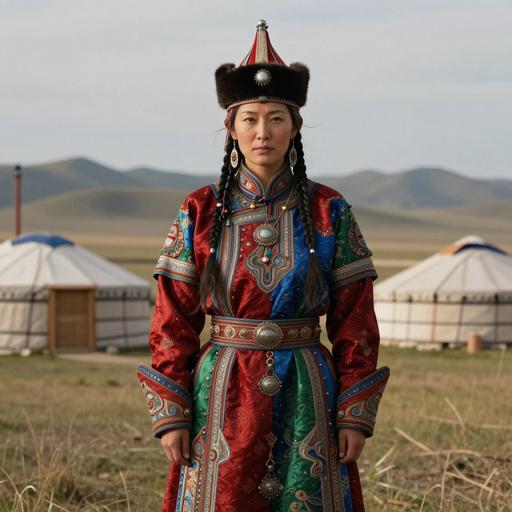
Portrait reconstruction of DEE001
Ancient Individual

A woman buried in Mongolia in the Early Medieval era

DEE001
1328 CE - 1436 CE
Female
Late Medieval Mongolia
Mongolia
Scroll to begin
Chapter I

Identity

The biological and cultural markers that define this ancient individual

Sample ID

DEE001

Date Range

1328 CE - 1436 CE

Biological Sex

Female

mtDNA Haplogroup

B4d1'2'3

Cultural Period

Late Medieval Mongolia

Chapter II

Place

Where this individual was discovered

Country Mongolia
Locality Arkhangai. Delen Tolgoi. Melkhii Chuluu
Chapter III

Time

When this individual lived in the broader context of human history

DEE001 1328 CE - 1436 CE
Chapter IV

Story

The narrative of this ancient life

The Late Medieval period in Mongolia, specifically in the region of Arkhangai and under the broader expanse of the Mongol Empire, is an era marked by significant political, cultural, and economic transformations. This period roughly spans the 14th to 16th centuries, a time when the vast Mongol Empire, initially united under Genghis Khan in the early 13th century, began to fracture into various khanates and entities.

Political Context

During the late medieval era, the Mongol Empire had reached its zenith and subsequently entered a phase of fragmentation. The divisions among Genghis Khan's descendants led to the establishment of separate khanates, such as the Yuan Dynasty in China, the Ilkhanate in Persia, the Chagatai Khanate in Central Asia, and the Golden Horde in Russia. Mongolia itself was often caught between these shifting powers, influencing and being influenced by the political tides in the surrounding regions.

In Arkhangai, as in the rest of Mongolia, local powers often had to navigate the complex web of allegiances and conflicts among the major khanates. This period saw various local khans and leaders vying for power and influence, often shifting allegiances to larger khanates such as the Yuan or the rising Ming Dynasty after the fall of the Yuan in China.

Culture and Society

Despite the political fragmentation, the late medieval period was rich in cultural exchanges and developments. The Pax Mongolica, a result of the relative stability under Mongol rule, continued to facilitate trade and the movement of people, ideas, and technologies across the vast territory from Europe to Asia. This era was characterized by a syncretism of cultural elements, where Mongolian traditions blended with those of the other civilizations they interacted with, particularly the Chinese, Persians, and Europeans.

The Mongols in Arkhangai, similar to other regions, maintained a nomadic pastoral lifestyle, where herding animals such as horses, cattle, sheep, and camels was central to their economy and way of life. Their society was organized into kinship-based groups, and they held a deep connection to their ancestral land, which was reflected in their spiritual beliefs that combined shamanism with Buddhist influences, the latter having gained prominence through contacts with Tibet and China.

Economic Activity

Economically, late medieval Mongolia saw the continued importance of overland trade networks that connected the East and West. The famous Silk Road trade routes facilitated not just the exchange of goods, but also of technologies, art, and scientific knowledge. Arkhangai, being more interior, may have been less directly involved in this trade compared to areas closer to border regions. However, it still experienced indirect economic benefits and cultural influences as goods and ideas trickled in through trade caravans passing through the Mongol Empire’s expansive territory.

Art and Religion

Artistic expression during this period often featured the unique blend of Mongolian motifs with imports from other regions, resulting in exquisite craftsmanship in textiles, metalwork, and ceramics. Buddhism saw a resurgence post-Yuan Dynasty, blending with enduring shamanistic traditions, as monasteries became more prevalent and played crucial roles in communities, not just as spiritual centers but also as centers of learning and cultural preservation.

Conclusion

The late medieval period in Mongolia, particularly within the Arkhangai region, is emblematic of a time of transition—a microcosm of the larger transformations affecting the Mongol Empire and its remnants. This era is a tapestry of political intrigue, cultural syncretism, and economic adaptability, highlighting the resilience and adaptability of the Mongolian people amidst a backdrop of significant historical change.

Chapter V

Genetics

The genetic ancestry of this ancient individual

Ancient Genetic Admixture

This analysis compares the DNA profile of DEE001 with ancient reference populations, showing the genetic composition in terms of prehistoric ancestral groups.

Ancient Asians 57.3%
European Hunter-Gatherers 15.6%
Western Steppe Pastoralists 13.8%
Neolithic Farmers 13.3%

Modern Genetic Admixture

This analysis compares the DNA profile with present-day reference populations, showing what percentage of genetic makeup resembles modern populations from different regions.

Asia 88.6%
Chinese & Southeast Asian 27.3%
Chinese 24.0%
Indonesian Khmer Thai Myanma 3.2%
Central Asian, Northern Indian & Pakistani 23.6%
Central Asian 21.9%
Pakistan 1.7%
Northern West Asian 20.5%
Caucasian 13.5%
Anatolian 4.4%
Mesopotamian 2.6%
Northern Asian 14.3%
Mongolian 9.1%
Siberian 5.2%
Japanese & Korean 3.0%
Japanese 3.0%
Europe 10.6%
Southern European 5.5%
Italian 5.5%
Eastern European 4.6%
Northwestern European 0.6%
Africa 0.8%

Closest Modern Populations

These are the modern populations showing the closest statistical alignment to A woman buried in Mongolia in the Early Medieval era, ranked by genetic distance. Lower distance values indicate closer statistical similarity.

1
Karakalpak
5.6430
2
Uygur
5.6855
3
Hazara
5.7064
4
Kazakh
6.2019
5
Nogai
6.2551
6
Kirghiz Tajikistan Pamir
7.2098
7
Kazakh Xinjiang
7.2520
8
Kirghiz China
8.4006
9
Kirghiz
8.4166
10
Altaian Kizhi O
9.4317
Chapter VI

Context

Other ancient individuals connected to this sample

Sources

References

Scientific publications and genetic data

Scientific Publication

A Dynamic 6,000-Year Genetic History of Eurasia's Eastern Steppe

Authors Jeong C, Wang K, Wilkin S
Abstract

The Eastern Eurasian Steppe was home to historic empires of nomadic pastoralists, including the Xiongnu and the Mongols. However, little is known about the region's population history. Here, we reveal its dynamic genetic history by analyzing new genome-wide data for 214 ancient individuals spanning 6,000 years. We identify a pastoralist expansion into Mongolia ca. 3000 BCE, and by the Late Bronze Age, Mongolian populations were biogeographically structured into three distinct groups, all practicing dairy pastoralism regardless of ancestry. The Xiongnu emerged from the mixing of these populations and those from surrounding regions. By comparison, the Mongols exhibit much higher eastern Eurasian ancestry, resembling present-day Mongolic-speaking populations. Our results illuminate the complex interplay between genetic, sociopolitical, and cultural changes on the Eastern Steppe.

G25 Coordinates

The G25 coordinates for sample DEE001 can be used for detailed admixture analysis in our G25 Studio tool.

DEE001,0.05848276,-0.19857132,0.0158323,-0.03176596,-0.00798984,-0.00239534,0.00616188,0.00604048,-0.01571416,-0.00372794,-0.02714848,-0.00377838,0.0025879,-0.00283972,-0.0054624,-0.00569212,-0.00174878,-0.0029347,0.00419494,0.0087269,0.0073155,-0.0031457,-0.00301886,0.0033752,-0.00018306
Analyze in G25 Studio
Use code for 40% off Expires Feb 27