Menu
Store
Blog
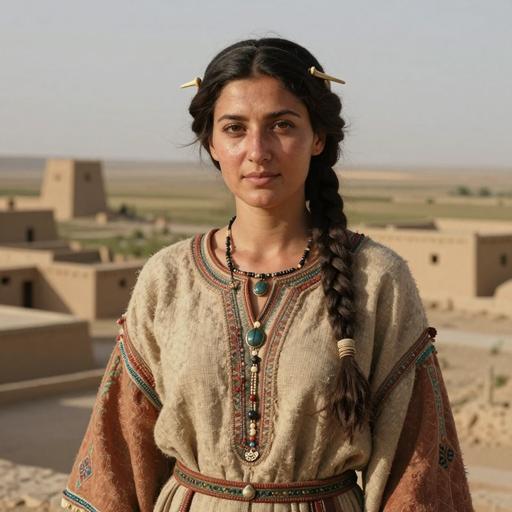
Portrait reconstruction of L8671
Ancient Individual

A woman buried in Uzbekistan in the Iron Age era

L8671
150 BCE - 50 CE
Female
Iron Age Serkharakat Culture of Surkhandaryo
Uzbekistan
Scroll to begin
Chapter I

Identity

The biological and cultural markers that define this ancient individual

Sample ID

L8671

Date Range

150 BCE - 50 CE

Biological Sex

Female

mtDNA Haplogroup

M5a

Cultural Period

Iron Age Serkharakat Culture of Surkhandaryo

Chapter II

Place

Where this individual was discovered

Country Uzbekistan
Locality Serkharakat (Surxondaryo Region, Uzun)
Coordinates 38.2610, 68.0580
Chapter III

Time

When this individual lived in the broader context of human history

L8671 150 BCE - 50 CE
Chapter IV

Story

The narrative of this ancient life

The Iron Age Serkharakat Culture of the Surkhandaryo region in Bactria represents a fascinating intersection of historical development, cultural sophistication, and geographical significance. This society can be placed within a broader context of Central Asian cultures, characterized by its adaptation to the unique environmental and social challenges of the time.

Geographical Context: The Surkhandaryo region, located in present-day southern Uzbekistan, is a geographically diverse area, encompassing mountains, river valleys, and steppes. This environment provided the Serkharakat people access to fertile lands for agriculture, as well as resources such as minerals and metals essential for iron production and crafting.

Historical Background: Emerging in the late second millennium BCE and flourishing in the early first millennium BCE, the Serkharakat culture belongs to the broader historical framework of the Iron Age in Central Asia. This period marked significant technological advances, particularly in metallurgy, which allowed more efficient production of tools and weapons. Developments in iron smelting and forging technologies were likely influenced by interactions with neighboring cultures and earlier Bronze Age societies.

Society and Economy: The Serkharakat society was largely agrarian, with a strong emphasis on agriculture, animal husbandry, and trade. The cultivation of wheat, barley, and other cereals was prominent, supplemented by the rearing of livestock such as sheep, goats, and cattle. The region's geography facilitated trade through caravan routes, linking Bactria with distant lands, promoting cultural exchange, and introducing new technologies and ideas.

The economy was also deeply influenced by iron metallurgy. The ability to produce iron tools and weapons symbolized economic power and technological prowess, providing the Serkharakat people with an advantage over communities still reliant on bronze or stone tools. Iron production sites and artifacts discovered in archaeological excavations reveal the sophistication of their metallurgical practices.

Cultural Aspects: Culturally, the Serkharakat society was characterized by a rich tradition of craftsmanship, evident in ceramics, textiles, and metalwork. Pottery from this era exhibits intricate designs and motifs, suggesting both aesthetic values and symbolic meanings. Textile remains, albeit scarce, indicate advanced weaving techniques and the usage of natural dyes.

Religion and spiritual beliefs were likely integral to their culture, as suggested by archaeological findings such as burial sites and religious artifacts. These suggest a belief in an afterlife and the use of rites and rituals to honor deities or ancestors.

Socially, the structure of the Serkharakat culture likely consisted of stratified layers, with leaders or chieftains at the top, possibly augmented by a class of skilled artisans and metalworkers. The presence of fortifications and settlement patterns hints at organized societal structures and suggests the importance of defense and community organization.

Intercultural Relations: The Serkharakat people engaged with neighboring cultures through trade, conflict, and cultural exchange. As part of the broader Bactrian region, they were influenced by and contributed to the cultural and technological milieu of Central Asia. Their interactions with other cultures, such as those in the Iranian Plateau, the Indus Valley, and the steppes, likely facilitated the exchange of ideas and goods.

Legacy and Influence: The Serkharakat culture left a lasting legacy in the historical and cultural landscape of Bactria. Their advances in iron technology set a foundation for subsequent cultures in the region. The diffusion of their metallurgical knowledge and cultural practices contributed to the broader cultural evolution of Central Asia.

In conclusion, the Iron Age Serkharakat Culture of Surkhandaryo in Bactria exemplified a dynamic and sophisticated society adept at harnessing the technologies of their time. Through agriculture, trade, metallurgy, and rich cultural traditions, they played a vital role in the historical development of the region.

Chapter V

Context

Other ancient individuals connected to this sample

Sources

References

Scientific publications and genetic data

Scientific Publication

Genetic Continuity of Bronze Age Ancestry with Increased Steppe-Related Ancestry in Late Iron Age Uzbekistan

Authors Kumar V, Bennett EA, Zhao D
Abstract

Although Uzbekistan and Central Asia are known for the well-studied Bronze Age civilization of the Bactria-Margiana Archaeological Complex (BMAC), the lesser-known Iron Age was also a dynamic period that resulted in increased interaction and admixture among different cultures from this region. To broaden our understanding of events that impacted the demography and population structure of this region, we generated 27 genome-wide single-nucleotide polymorphism capture data sets of Late Iron Age individuals around the Historical Kushan time period (∼2100-1500 BP) from three sites in South Uzbekistan. Overall, Bronze Age ancestry persists into the Iron Age in Uzbekistan, with no major replacements of populations with Steppe-related ancestry. However, these individuals suggest diverse ancestries related to Iranian farmers, Anatolian farmers, and Steppe herders, with a small amount of West European Hunter Gatherer, East Asian, and South Asian Hunter Gatherer ancestry as well. Genetic affinity toward the Late Bronze Age Steppe herders and a higher Steppe-related ancestry than that found in BMAC populations suggest an increased mobility and interaction of individuals from the Northern Steppe in a Southward direction. In addition, a decrease of Iranian and an increase of Anatolian farmer-like ancestry in Uzbekistan Iron Age individuals were observed compared with the BMAC populations from Uzbekistan. Thus, despite continuity from the Bronze Age, increased admixture played a major role in the shift from the Bronze to the Iron Age in southern Uzbekistan. This mixed ancestry is also observed in other parts of the Steppe and Central Asia, suggesting more widespread admixture among local populations.

Use code for 40% off Expires Mar 01