Menu
Store
Blog
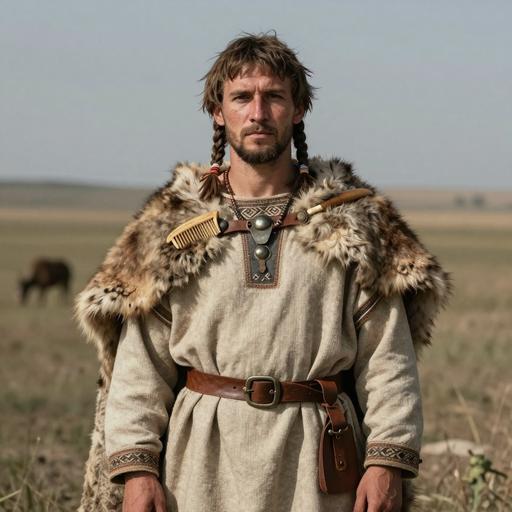
Portrait reconstruction of RISE553
Ancient Individual

A man buried in Russia in the Late Bronze Age era

RISE553
927 BCE - 812 BCE
Male
Late Bronze Age 1 Russia
Russia
Scroll to begin
Chapter I

Identity

The biological and cultural markers that define this ancient individual

Sample ID

RISE553

Date Range

927 BCE - 812 BCE

Biological Sex

Male

mtDNA Haplogroup

F1b

Y-DNA Haplogroup

R-M198

Cultural Period

Late Bronze Age 1 Russia

Chapter II

Place

Where this individual was discovered

Country Russia
Locality Afontova Gora
Coordinates 56.0160, 92.8660
Chapter III

Time

When this individual lived in the broader context of human history

RISE553 927 BCE - 812 BCE
Chapter IV

Story

The narrative of this ancient life

The Late Bronze Age 1 period in what is today Russia is a fascinating era that is often linked with the spread of the Proto-Indo-European (PIE) culture. This time period, roughly spanning from 1600 to 1200 BCE, marks a significant phase in the development of societies in the Eurasian steppe region, influencing broad swathes of Europe and Asia.

Geography and Environment

The geography of the area we now call Russia during the Late Bronze Age was characterized by vast steppes, forests, and rivers that provided both challenges and resources for the proto-Indo-European communities. These vast open plains were ideal for the grazing of livestock, which played a crucial role in the subsistence and economy of these societies. The environment also facilitated movement and trade, which were essential for the spread of cultural and technological innovations.

Socio-Economic Structure

The social structure during this period was likely tribal, with a focus on kinship and clan-based systems. The economy was primarily pastoral, with communities relying heavily on livestock such as cattle, sheep, and goats, which were central to their livelihoods. The domestication of horses, which had started earlier, played an increasingly important role, particularly in terms of mobility, trade, and warfare.

Trade routes extended across the steppes, linking the communities of the region with those further afield, and facilitating the exchange of goods, ideas, and techniques. Metalworking, particularly with bronze, was a significant technological advancement during this period, leading to improvements in tools and weaponry.

Language and Culture

Linguistically, this era is crucial as it is believed to be a significant phase in the evolution and spread of Proto-Indo-European languages. The PIE people are thought to have a common linguistic ancestry that would later diverge into the various Indo-European languages spoken across Europe and parts of Asia today. Language was a key cultural element, accompanied by shared myths, religious practices, and possibly the early stages of a loose pantheon that would leave traces in various later Indo-European religions.

Art and Religion

Cultural expressions during this time included the production of jewelry, ceramics, and other forms of artistic work. Ornamentation often featured animal motifs, which might have held symbolic or religious significance. Burial practices provide insights into their spiritual world; kurgans or burial mounds reveal complex ritual practices, suggesting a belief in an afterlife and possibly ancestor worship.

Technology and Warfare

The Late Bronze Age was marked by significant technological advancements, primarily in metalworking. Bronze tools, weapons, and implements improved efficiency in both daily life and military endeavors. The introduction and refinement of chariots are noteworthy, revolutionizing warfare and facilitating quicker movement across vast distances.

Expansion and Influence

The period saw movements and migrations that are considered pivotal in the spread of Proto-Indo-European languages and culture. These movements were not merely the exploration of new territories but the establishment of routes that allowed cultural, technological, and genetic exchanges across diverse regions. This dissemination would lay the groundwork for the rise of historical cultures and civilizations influenced by or descended from Proto-Indo-European tongues and traditions.

In conclusion, the Late Bronze Age 1 in Russia represents a transformational era, marked by dynamic socio-economic, technological, and cultural developments. These changes played a critical role in shaping the future of Eurasian cultures and the dissemination of Proto-Indo-European language and culture across a vast geographic area. Understanding this period aids in grasping the complex legacies that have influenced numerous later societies.

Chapter V

Genetics

The genetic ancestry of this ancient individual

Ancient Genetic Admixture

This analysis compares the DNA profile of RISE553 with ancient reference populations, showing the genetic composition in terms of prehistoric ancestral groups.

Western Steppe Pastoralists 33.9%
European Hunter-Gatherers 33.1%
Ancient Asians 26.5%
Neolithic Farmers 3.4%
Ancient Oceanians 3.2%

Modern Genetic Admixture

This analysis compares the DNA profile with present-day reference populations, showing what percentage of genetic makeup resembles modern populations from different regions.

Europe 62.9%
Northwestern European 42.1%
English 23.0%
Scandinavian 11.1%
Finnish 7.5%
Eastern European 20.8%
Asia 25.4%
Central Asian, Northern Indian & Pakistani 17.4%
Central Asian 17.4%
Northern West Asian 8.1%
Caucasian 8.1%
America 7.5%
America 7.5%
Native American 7.5%
Oceania 3.0%
Melanesian 3.0%
Papuan 3.0%
Africa 1.2%
African Hunter-Gatherer 1.2%

Closest Modern Populations

These are the modern populations showing the closest statistical alignment to A man buried in Russia in the Late Bronze Age era, ranked by genetic distance. Lower distance values indicate closer statistical similarity.

1
Tatar Kazan
4.8921
2
Tatar Mishar
5.3831
3
Komi A
5.8510
4
Besermyan
5.9802
5
Russian Leshukonsky
7.1192
6
Saami Kola
7.3139
7
Udmurt
7.6066
8
Chuvash
7.6833
9
Russian Pinezhsky
8.3724
10
Tatar Lipka
8.4470
Chapter VI

Context

Other ancient individuals connected to this sample

Sources

References

Scientific publications and genetic data

Scientific Publication

Population genomics of Bronze Age Eurasia

Authors Allentoft ME, Sikora M, Sjögren KG
Abstract

The Bronze Age of Eurasia (around 3000-1000 BC) was a period of major cultural changes. However, there is debate about whether these changes resulted from the circulation of ideas or from human migrations, potentially also facilitating the spread of languages and certain phenotypic traits. We investigated this by using new, improved methods to sequence low-coverage genomes from 101 ancient humans from across Eurasia. We show that the Bronze Age was a highly dynamic period involving large-scale population migrations and replacements, responsible for shaping major parts of present-day demographic structure in both Europe and Asia. Our findings are consistent with the hypothesized spread of Indo-European languages during the Early Bronze Age. We also demonstrate that light skin pigmentation in Europeans was already present at high frequency in the Bronze Age, but not lactose tolerance, indicating a more recent onset of positive selection on lactose tolerance than previously thought.

G25 Coordinates

The G25 coordinates for sample RISE553 can be used for detailed admixture analysis in our G25 Studio tool.

RISE553,0.1053344,0.02606486,0.06985192,0.05231274,0.00199468,0.01152584,-0.01338644,-0.01096026,-0.00465476,-0.01838566,0.00901788,-0.00439784,0.00596864,-0.01546304,0.0001444,-0.01049542,-0.01503646,-0.00106626,-0.0141947,-0.01421196,0.00577086,0.00466998,-0.01559218,0.0117504,-0.00034795
Analyze in G25 Studio
Use code for 40% off Expires Feb 26