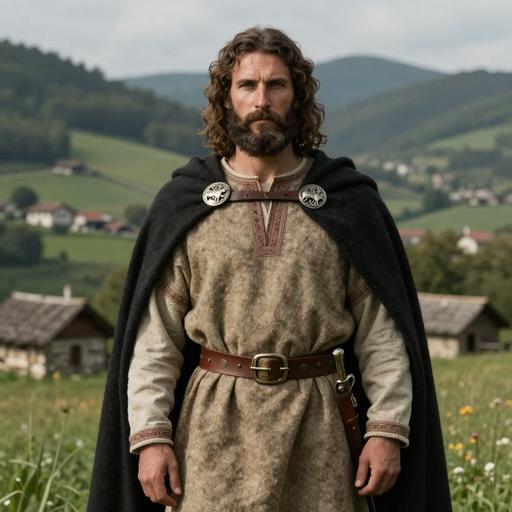
The Early Medieval Langobards, also known as Lombards, were a Germanic people who played a significant role in the transformation of Northern Italy during the early medieval period. Their era, spanning from the late 6th to the late 8th century, is marked by a blend of Germanic traditions and Roman cultural influences, setting the stage for the development of medieval Europe. Here is an extensive and detailed description of this fascinating era and culture:
Historical Background
The Langobards originally migrated from Scandinavia, journeying through Central and Eastern Europe before eventually settling in Italy. Their migration began in earnest around the 4th century, driven by various pressures and opportunities that led them southwards. By the late 6th century, under the leadership of King Alboin, they invaded Northern Italy, which was then under Byzantine control. In 568 AD, the Langobards established a kingdom that significantly altered the political landscape of the Italian peninsula.
Political Structure
Once established in Northern Italy, the Langobards instituted a unique political structure that blended their tribal customs with adaptations suitable for maintaining control over a conquered Roman populace. The Kingdom of the Langobards was initially divided into numerous duchies, each ruled by a duke who owed allegiance to the king. However, the power of these dukes often shifted between loyalty and autonomy, depending on the strength and political acumen of the reigning monarch.
Society and Culture
Langobard society was structured around a warrior elite, with social stratification evident in their laws and customs. The king and dukes were at the top of the hierarchy, followed by a warrior class, freemen, and serfs or slaves. Langobard law, as recorded in the Edictum Rothari (643 AD), offers insights into their Germanic roots, emphasizing kinship, honor, and retribution.
Culturally, the Langobards began to adopt many aspects of Roman and Christian practices. Initially adherents of their native paganism, they gradually converted to Arian Christianity and later to Nicene Christianity, as political alliances and cultural integration encouraged religious adaptation. This transition also had a profound effect on art and architecture, leading to an architectural style that mixed Germanic and Byzantine elements, seen in the construction of significant religious and civic buildings.
Economics and Trade
The Langobard economy was largely agrarian, with subsistence farming forming the backbone of their sustenance. However, they also participated in trading activities with neighboring regions, capitalizing on their strategic location between the Mediterranean and the rest of Europe. The presence of Roman roads and cities facilitated trade and cultural exchange, allowing for a certain degree of economic continuity despite the political upheavals.
Linguistic and Literary Contributions
The Langobards spoke a Germanic language, but over time they adopted Latin, the lingua franca of their new homeland, for administrative and religious functions. This early linguistic blend laid the groundwork for the development of the Italian language. While the Langobards left fewer literary texts compared to other groups, their influence is nonetheless evident in medieval Italian literature and legal documents.
Legacy
The reign of the Langobards in Northern Italy ended in 774 AD when Charlemagne, the Frankish king, conquered their kingdom, integrating it into the Carolingian Empire. Despite their eventual defeat, the Langobards left an indelible mark on Italy's cultural and political fabric. Their integration of Roman and Germanic traditions helped shape the identity of the region and influenced subsequent developments in European history.
In conclusion, the Early Medieval Langobards in Northern Italy represent a critical period in the transition from antiquity to the Middle Ages. Their unique synthesis of Germanic warrior culture with Roman tradition laid the foundation for the cultural and political evolution of medieval Europe, illustrating the dynamic interplay of conquest, adaptation, and integration.