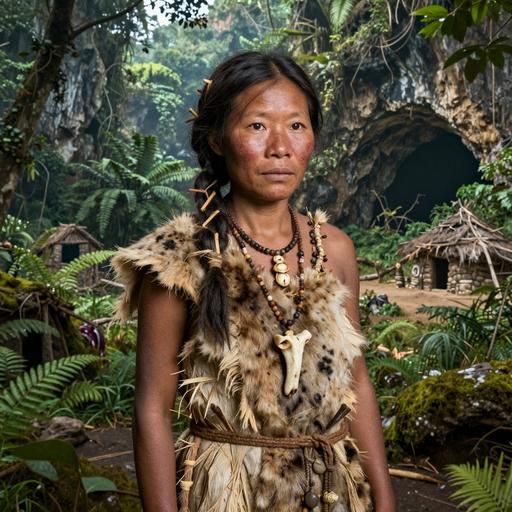
The Red Deer Cave People, a group of prehistoric humans, hold a fascinating and pivotal position in our understanding of human evolution. Discovered in southern China, their remains were found in two sites: the Maludong (Red Deer Cave) near the city of Mengzi, and Longlin Cave in Guangxi Zhuang Autonomous Region. These findings have intrigued anthropologists and paleontologists, sparking discussions about human diversity, adaptation, and migration during the Late Pleistocene era.
Timeline and Environment
The Red Deer Cave People are believed to have lived approximately 14,500 to 11,500 years ago, placing them in the Late Pleistocene to early Holocene epoch. This period was characterized by significant climatic changes, including the end of the last Ice Age, which resulted in rising global temperatures, melting glaciers, and the expansion of forests and grasslands. In Southern China, the environment would have included a mix of subtropical forests and open woodlands, rich with flora and fauna, providing a resource-abundant setting for human habitation.
Anthropological Significance
The Red Deer Cave People possess a unique combination of archaic and modern anatomical features, making them a subject of keen interest in the realm of anthropology. Their skeletal remains exhibit a blend of primitive traits more commonly associated with much older human species, like Homo habilis or Homo erectus, alongside more derived features typical of modern humans (Homo sapiens). For instance, they had thick skull bones, prominent brow ridges, and a flat face, but with a relatively modern dentition and low, rounded braincases which suggest a cranial capacity slightly larger than early humans but smaller than contemporary Homo sapiens.
Their existence overlaps with modern human populations in Asia, prompting questions about their potential interactions, interbreeding, and cultural exchange. The Red Deer Cave People could represent a distinct human lineage that either survived in isolation or interbred with other human populations.
Cultural Aspects
Little direct evidence of the cultural practices of the Red Deer Cave People exists, primarily because no artifacts like tools or artworks were found with their remains. However, extrapolations can be made based on the environmental context and comparison with contemporary human cultures.
Subsistence Strategies:
The name \Red Deer Cave" hints at their dietary habits. It is likely these people hunted large game such as the now-extinct red deer. The protein-rich diet would have been supplemented by gathering edible plants, fruits, nuts, and possibly fishing, reflecting a foraging lifestyle common among prehistoric human groups.
Tool Use and Technology:
Although direct evidence of their tools has not been found, it is plausible they used stone tools similar to those of other late Pleistocene humans. These might include simple hand axes, cutting tools, and perhaps basic implements for processing animal hides and plant materials.
Habitation and Social Structure:
Caves provided natural shelter, offering protection from the elements and predators. The Red Deer Cave People likely lived in small, kinship-based groups, with social structures revolving around cooperative hunting and gathering. Seasonal movements and campsite patterns would have been influenced by the availability of resources and environmental conditions.
Symbolism and Rituals:
While speculative, symbolic behavior such as burial practices, use of personal adornments, or ritualistic behavior cannot be entirely ruled out. Red ochre and other natural pigments might have been used for body painting or other symbolic purposes, as seen in other contemporary human cultures.
Genetic and Evolutionary Implications
Genetically, the Red Deer Cave People pose intriguing questions. Their unique morphological traits suggest either a previously unknown wave of human migration into Asia or a prolonged period of isolation that allowed for distinctive evolutionary development. DNA analysis, if achievable, could reveal crucial insights into their relationship with other human populations, such as Denisovans, Neanderthals, and modern East Asian populations.
Conclusion
The Red Deer Cave People represent an enigmatic chapter in human history, embodying the diversity and adaptability of human species during the Late Pleistocene. Their discovery challenges our understanding of human evolution, suggesting a more intricate web of human lineages and interactions. Continued research and technological advancements, such as improved dating techniques and genetic analysis, hold the promise of unraveling more about these mysterious people and their place in the broader narrative of human ancestry."