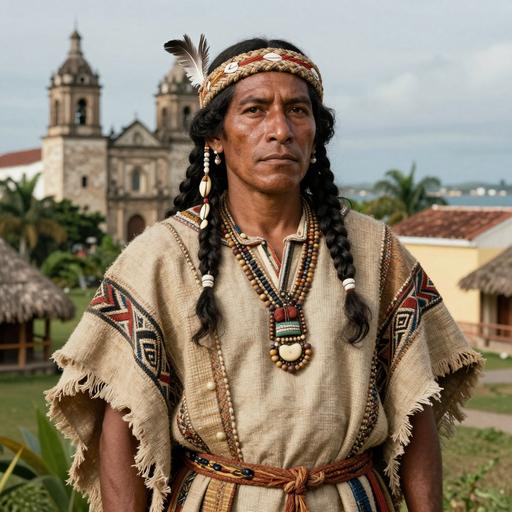
The Colonial Period in the Isthmo-Colombian region of Panama is a fascinating chapter in the history of Mesoamerican civilizations, marked by significant cultural transformations, encounters, and exchanges. This era roughly spans from the early 16th century, with the arrival of the Spanish conquistadors, to Panama’s independence from Spain in 1821.
Historical Context
Pre-Colonial Background
Before the colonial period, the Isthmo-Colombian region, particularly today’s Panama, was not prominently part of the Mesoamerican sphere but instead formed a cultural and geographical transition zone between Central and South America. It was inhabited by diverse indigenous groups, including the Cueva, Ngäbe, Buglé, and Kuna (or Guna) peoples. These groups had developed sophisticated societies with rich spiritual and artistic traditions. They were engaged in trade networks that extended as far as the Andean cultures to the south and Mesoamerican civilizations to the north.
Arrival of European Colonizers
Spanish Expeditions
The Spanish incursion began with Rodrigo de Bastidas (1501) and Vasco Núñez de Balboa’s expedition (1513), who established the first permanent European settlement on the mainland of the Americas, Santa María la Antigua del Darién. The crossing of the Isthmus by Balboa marked the first sighting of the Pacific Ocean by Europeans, opening a new chapter for European colonization efforts.
Colonial Exploitation and Settlement
In 1519, Pedro Arias Dávila founded Panama City, which became the first European city on the Pacific coast. Panama quickly rose in importance due to its strategic location as a transit point for Peruvian gold and silver bound for Spain. This geographical significance intensified Spanish interest and resulted in the construction of the famous Camino Real and Camino de Cruces, overland routes facilitating the movement of wealth.
Cultural Transformations
Indigenous-European Relations
The arrival of Europeans had profound effects on the indigenous populations. There was widespread disruption due to warfare, enslavement, and diseases such as smallpox, which dramatically reduced indigenous populations. The Spanish imposed the encomienda system, forcing indigenous people to work on Spanish estates and in gold mines, which further decimated their numbers and eroded traditional social structures.
Syncretism and Resistance
Despite these pressures, indigenous cultures exhibited resilience, adopting and adapting to Spanish influences. This period saw significant syncretism, with indigenous beliefs and practices interwoven with Catholic Christianity. Resistance to colonial rule was also significant, with uprisings and demonstrations of rebellion, although many were violently suppressed.
Architectural and Cultural Developments
Spanish colonization introduced European architectural styles, most notably seen in the construction of fortifications, churches, and cathedrals in cities like Panama City and Portobelo. The colonial administration and Catholic Church played crucial roles in shaping the economic, educational, and religious life of the colony. Art and music were vital cultural aspects, with Spanish, African, and indigenous influences creating unique hybrid forms.
Economic and Strategic Importance
Trade and Commerce
Panama’s role as a transit hub made it economically vital throughout the colonial period. The isthmus was a crucial part of Spain’s logistical chain in transferring goods from the Americas to Europe. This role was highlighted by the annual Spanish treasure fleets that would stop in Panama to refuel and resupply.
Defense and Piracy
The wealth passing through Panama attracted pirates and privateers, leading to significant battles and fortifications, most notably the pirate Henry Morgan’s infamous sacking of Panama City in 1671. This event prompted the Spanish crown to relocate the city to a more defensible site, leading to the construction of what is now known as Casco Viejo, a World Heritage site.
Transition to Independence
Social Changes
The late colonial period saw the growth of a mestizo population, with mixed European, African, and indigenous ancestry. This diverse demographic landscape set the stage for unique social dynamics and tensions that would influence Panama’s path toward independence.
Independence Movements
Influenced by the wider Latin American movements for independence and growing discontent with colonial rule, Panama proclaimed its independence from Spain on November 28, 1821, joining Gran Colombia under Simón Bolívar. This transition marked the end of colonial rule but set the stage for new political dynamics and challenges in the post-colonial era.
Legacy
The Colonial Period in Panama's Isthmo-Colombian region left a lasting imprint on the culture, architecture, and demographics of the modern nation. It is a period characterized by confluence and conflict, transformation and continuity, which deeply influenced Panama's national identity and cultural tapestry. Today, Panama's complex blend of indigenous, African, and European heritage can be seen in its vibrant culture, festivals, and societal structures, echoing the historical legacies of its colonial past.