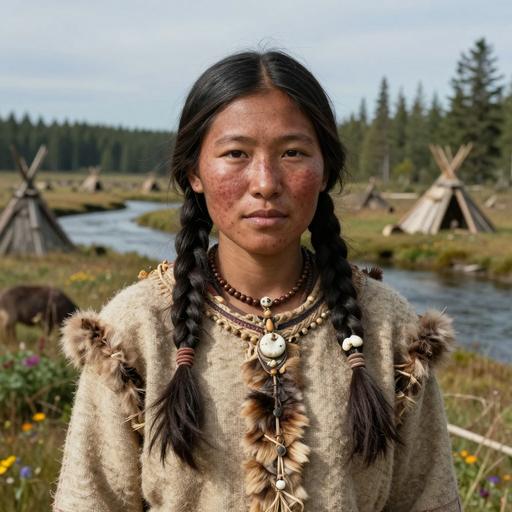
The Ancient Beringian era refers to a significant period in the prehistory of North America, shedding light on the early human inhabitants of the region, commonly known as Paleo-Indians. This era is particularly centered around the people who lived in the Beringia land bridge region, which connected Asia and North America during the last Ice Age. The melting of glaciers and subsequent rising sea levels eventually submerged this land bridge, leaving behind the modern Bering Strait and compelling the Ancient Beringians, along with other Paleo-Indians, to adapt and spread across the Americas.
Timeline and Environment
The Ancient Beringian era encompasses a time roughly between 15,000 and 10,000 years ago, during the Late Pleistocene epoch. This was a time characterized by glaciated landscapes, vast woolly mammoth steppes, and harsh climatic conditions. Beringia itself, during this period, was a treeless tundra stretching from the Yukon to eastern Siberia, featuring cold and windy environments but with rich biological diversity, prompting the flourishing of mega fauna like mammoths, bison, and saber-toothed tigers.
Migration and Settlement
The people of the Ancient Beringian era are believed to have migrated from Asia, following herds of large animals for sustenance. Genetic studies have suggested that the ancestors of these populations might have lived in Beringia for thousands of years, evolving distinct genetic traits. The initial migration likely occurred in waves, with small groups tracking wildlife and settling in niches across the expansive Beringian landscape.
Culture and Lifestyle
The Ancient Beringians, like other Paleo-Indians, were predominantly hunter-gatherers. They relied heavily on hunting mega fauna, which they pursued with sophisticated stone tools. Clovis-style projectile points, which are among the earliest widespread archaeological artifacts throughout North America, demonstrate their technological prowess. These spear points were used for hunting and were often crafted from materials traded over considerable distances, suggesting a complex network of social interactions and exchanges.
The social structure likely consisted of small, familial bands that were highly mobile, moving seasonally to exploit different resources. Evidence suggests these groups had extensive knowledge of their environment, understanding animal migration patterns and the seasonal availability of plant foods.
Archaeological Significance
Investigations into Ancient Beringian sites provide a window into the life ways of these early inhabitants. The Denali Complex sites in Alaska and the Bluefish Caves in the Yukon offer archaeological evidence of prolonged human occupation. Artifacts such as micro blades, burins, and bifacial tools help archaeologists reconstruct aspects of their daily life, subsistence strategies, and migration routes.
Genetic Studies
Recent advances in genomic research have deepened understanding of the Ancient Beringians. In particular, the DNA evidence suggests that they are distinct from both East Asian populations and later Native American groups, highlighting a unique evolutionary trajectory during their isolation in Beringia.
In 2018, the discovery of remains at the Upward Sun River site in Alaska, though only partially attributed to the Ancient Beringians, provided direct genetic evidence of this group's unique lineage, distinct from both earlier Siberian and later Native American populations, suggesting a long period of isolation before movement onwards into the Americas.
Legacy
The Ancient Beringian era is crucial to understanding the peopling of the Americas. It marks a formative phase in human history where adaptability, resilience, and innovation became key responses to climatic challenges and environmental transformations. The people of this era laid the groundwork for subsequent indigenous cultures that would spread across North and South America, influencing a diverse array of societies encountered by Europeans many millennia later.