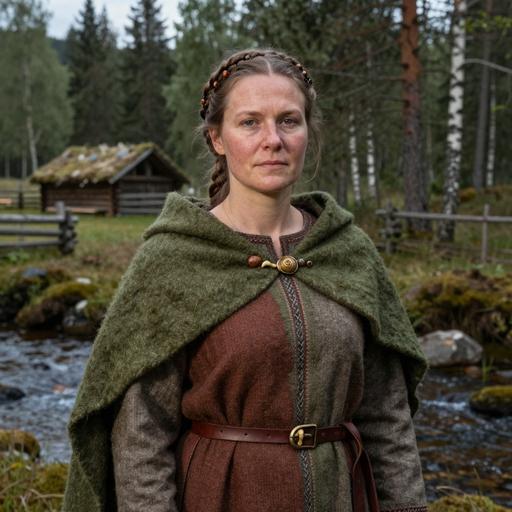
An individual buried in Finland in the Bronze Age era

Download PDF creates a visual, rasterized copy. Use Print for selectable text and better assistive-technology support.

Loading Report

Preparing your ancestry journey

Preparing the available report content...

Your report will open automatically.

Skip to main content
Reference library / Sample profile

An individual buried in Finland in the Bronze Age era

Explore the recorded context, genetic comparisons and research behind this reference sample.

FinlandLevanluhta B

A reference profile describes this sample. It does not establish a personal or family relationship.

AI portrait reconstruction for An individual buried in Finland in the Bronze Age era
AI-generated artistic reconstruction, not a photograph of the individual.
Record

Sample details

Recorded details and available lineage markers.

Individual

Nordic Bronze Age individual, Finland

Sample ID: JK2066

Date Range

300 CE - 800 CE

Cultural Period

Levanluhta B

Biological Sex

Not known

mtDNA Haplogroup

U5b2a5*

Y-DNA Haplogroup

Not available

Social Role

Farmer (AI estimate, era-typical)

Geography

Location

Where this individual was discovered

Country Finland
Locality Isokyro. Levanluhta
Coordinates 62.9487, 22.4101
Chronology

Date range

When this individual lived in the broader context of human history

Nordic Bronze Age individual, Finland 300 CE - 800 CE
Context

Historical context

Background information associated with the reference record.

The Levanluhta B phase for Finland (c. 300–800 CE) refers to an archaeological subdivision used to describe materials and contexts from the Levanluhta site. This broad span falls in centuries when technologies and regional contacts across Northern Europe changed gradually.

Region & Environment

Finland’s environment is dominated by forests and extensive lake systems. Settlements and travel commonly relied on waterways, supporting fishing and other aquatic resource use, while land-based resources supported hunting, foraging, and local agriculture.

Historical Context

Between the late Roman and early medieval periods, Northern European societies experienced changing patterns of movement and trade. In Finland, archaeological evidence typically indicates that external influence was selective and mixed with local development, rather than uniformly transforming local lifeways.

Populations & Lifeways

People likely lived in community and household arrangements oriented toward water access. Mixed subsistence strategies would have included fishing and hunting, with cultivation and livestock adding stability where the environment permitted.

Archaeology & Material Culture

As a site phase, Levanluhta B is interpreted through its associated artifact assemblages and contextual features. Finds commonly include iron objects (where preserved), ceramics, and other domestic materials, which together illustrate tool use, food preparation, and everyday household activities.

Culture & Society

The distribution and character of artifacts can indicate craft skill, household organization, and the practical adoption of new materials. Social interpretations should remain cautious, but material patterns can suggest variability in access to items arriving through exchange.

Legacy & Transition

The end of this broad period leads toward later Iron Age and early medieval shifts in settlement and material culture across Finland. Levanluhta B provides evidence for how earlier practices endured and adapted, supporting broader reconstructions of continuity into subsequent centuries.

Analysis

Genetic comparisons

These comparisons show genetic similarity, not identity or origin. The populations listed are those whose genomes show statistical alignment to this ancient individual.

Similarity reflects shared history, not shared identity. These are analytical comparisons, not claims about who this person was.

Modern Genetic Admixture

This analysis compares the DNA profile with present-day reference populations, showing statistical similarity to modern reference populations from different regions. The excavation site records where this individual was found, not a fixed modern genetic identity.

Europe 83.7%
Northwestern European 61.3%
Finnish 41.6%
Northwestern European 19.7%
Eastern European 22.4%
Asia 16.3%
Northern Asian 11.6%
Siberian 11.6%
Chinese & Southeast Asian 4.8%
Vietnamese 4.8%

Closest Modern Populations

These are the modern populations showing the closest statistical alignment to An individual buried in Finland in the Bronze Age era, ranked by genetic distance. Lower distance values indicate closer statistical similarity. Cross-region similarity can reflect shared ancestry, population movement, continuity, or later admixture.

1
Roma Barcelona
8.7071
2
Turkish Deliorman
9.2629
3
Spanish Castilla Y Leon
9.3169
4
Spanish Valencia
9.3633
5
Spanish Murcia
9.3946
6
Turkish Rumeli
9.4047
7
Spanish Camp De Tarragona
9.4590
8
Spanish Asturias
9.4914
9
Spanish Andalucia
9.5095
10
Spanish Cantabria
9.5333
Context

Related Samples

This individual exists within a broader network of ancient samples. No ancient genome stands alone.

Individual Culture/Period Date Location Action
Arctic Cultures individual, Russia Bolshoy Oleni Ostrov Site, Russia 2024 BCE Murmansk. Bolshoy Oleniy Ostrov, Russia View
Murmansk MBA individual, Russia Bolshoy Oleni Ostrov Site, Russia 2050 BCE Murmansk. Bolshoy Oleniy Ostrov, Russia View
Arctic Cultures individual, Russia Bolshoy Oleni Ostrov Site, Russia 2050 BCE Murmansk. Bolshoy Oleniy Ostrov, Russia View
Nordic Bronze Age individual, Finland Levanluhta Site, Finland 300 CE Isokyro. Levanluhta, Finland View
Nordic Bronze Age individual, Finland Levanluhta B 300 CE Isokyro. Levanluhta, Finland View
Nordic Bronze Age individual, Finland Levanluhta Site, Finland 300 CE Isokyro. Levanluhta, Finland View
Nordic Bronze Age individual, Finland Levanluhta B 300 CE Isokyro. Levanluhta, Finland View
Finland Mia individual, Finland 300 CE Isokyro. Levanluhta, Finland View
Finland Eia individual, Finland 300 CE Isokyro. Levanluhta, Finland View
Finland Mia individual, Finland 300 CE Isokyro. Levanluhta, Finland View
Page 1
Individual Culture/Period Date Location Action
Nordic Bronze Age individual, Finland Levanluhta B 300 CE Isokyro. Levanluhta, Finland View
Page 1
Sources

References

Scientific publications and genetic data that inform this profile.

G25 Coordinates

These coordinates represent a position in genetic space, a tool for comparison, not a conclusion. You can use these to perform custom admixture analysis in G25 Studio.

JK2066,0.10559178,0.05512492,0.0423024,0.0009441,0.0564408,0.00877134,0.00035464,0.00672474,0.02035598,0.02850208,-0.00478482,0.0093945,-0.01470824,-0.01014004,0.00696384,-0.00131234,-0.01433688,-0.00325586,-0.00531116,-0.0053045,0.00913776,0.00804846,-0.00988442,-0.00918622,0.00314182
Continue in G25 Studio
Use code for 30% off • Expires Nov 16