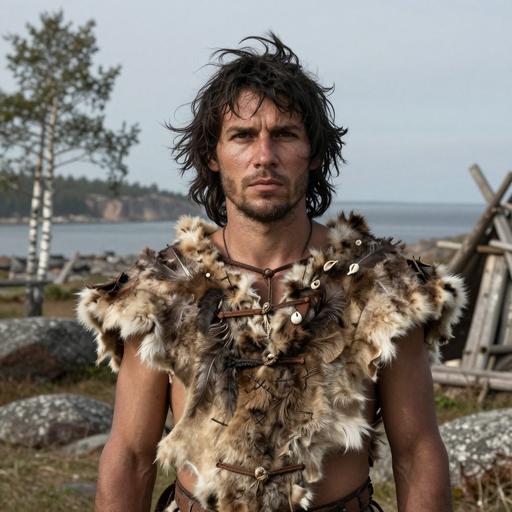
A man buried in Sweden in the era

Download PDF creates a visual, rasterized copy. Use Print for selectable text and better assistive-technology support.

Loading Report

Preparing your ancestry journey

Preparing the available report content...

Your report will open automatically.

Skip to main content
Reference library / Sample profile

A man buried in Sweden in the era

Explore the recorded context, genetic comparisons and research behind this reference sample.

SwedenAncient Hunter-Gatherers

A reference profile describes this sample. It does not establish a personal or family relationship.

AI portrait reconstruction for A man buried in Sweden in the  era
AI-generated artistic reconstruction, not a photograph of the individual.
Record

Sample details

Recorded details and available lineage markers.

Individual

Hunter Gatherers individual, Sweden

Sample ID: StoraForvar11

Date Range

5557 BCE - 5230 BCE

Cultural Period

Ancient Hunter-Gatherers

Biological Sex

Male

mtDNA Haplogroup

Not available

Y-DNA Haplogroup

Not available

Social Role

Hunter (AI estimate, era-typical)

Geography

Location

Where this individual was discovered

Country Sweden
Locality Gotland. Stora Karlsö

A location map is not available for this record.

Chronology

Date range

When this individual lived in the broader context of human history

Hunter Gatherers individual, Sweden 5557 BCE - 5230 BCE
Context

Historical context

Background information associated with the reference record.

Overview

“Ancient Hunter-Gatherers” is a broad category for foraging societies that relied on wild resources rather than domesticated agriculture. Over centuries and millennia, these groups developed region-specific strategies—shaped by climate, water availability, and landscape—while maintaining flexible mobility and knowledge of seasonal resources.

Region & Environment

Because this era is not tied to a single named region in the provided data, the environmental discussion remains general. Hunter-gatherers typically lived in habitats where wild foods could be reliably harvested: river valleys, lakeshores, coasts, wetlands, grasslands, and forested zones. Seasonal changes strongly influenced where people camped, what they hunted or gathered, and when they moved.

Historical Context

In the Mesolithic timeframe (as given), many areas were experiencing ecological shifts compared with earlier glacial conditions. Communities responded through changes in toolkits and subsistence planning rather than through the institutional changes associated with early farming. Rather than “events,” the historical record often shows gradual adaptation to changing landscapes.

Populations & Lifeways

Populations were organized around kin-based cooperation and repeated seasonal rounds. Diets commonly combined hunted animals, fishing where available, and gathered plant foods; many groups practiced task specialization by age and sex, though the details vary by region. Mobility ranged from short-distance movements to longer seasonal relocations, depending on resource distribution.

Archaeology & Material Culture

Stone tools are the most common archaeological signature for hunter-gatherers in many regions. Typical material patterns include:

  • Retouched blades, points, scrapers, and other flaked-stone implements
  • Portable hearths or activity areas indicated by charcoal and heat-altered stones
  • Less durable perishable items inferred indirectly (e.g., from tool types that suit woodworking or hide processing) Because organic materials rarely preserve equally, archaeological interpretations must remain cautious and focus on robust traces.

Culture & Society

Social life likely involved cooperation, knowledge transmission, and shared traditions expressed in tool-making practices and activity organization. While complex social stratification is not a necessary assumption for hunter-gatherer lifeways, variation in site reuse, tool investment, and spatial organization can indicate differing practices across landscapes and communities.

Legacy & Transition

The legacy of ancient hunter-gatherers lies in deep ecological knowledge and long-term technological traditions that many later societies inherited. Transitions to agricultural or other subsistence regimes occurred at different times in different places; the archaeological transition is usually best identified by the appearance of cultivation-related evidence and changing settlement patterns rather than by a single universal event.

Analysis

Genetic comparisons

These comparisons show genetic similarity, not identity or origin. The populations listed are those whose genomes show statistical alignment to this ancient individual.

Similarity reflects shared history, not shared identity. These are analytical comparisons, not claims about who this person was.

Modern Genetic Admixture

This analysis compares the DNA profile with present-day reference populations, showing statistical similarity to modern reference populations from different regions. The excavation site records where this individual was found, not a fixed modern genetic identity.

Europe 98.4%
Northwestern European 60.9%
Scandinavian 24.0%
English 21.6%
Finnish 12.7%
Northwestern European 2.6%
Eastern European 35.4%
Southern European 2.2%
Balkan 2.2%
Africa 1.6%
West African 1.6%
Senegambian & Guinean 1.6%

Closest Modern Populations

These are the modern populations showing the closest statistical alignment to A man buried in Sweden in the era, ranked by genetic distance. Lower distance values indicate closer statistical similarity. Cross-region similarity can reflect shared ancestry, population movement, continuity, or later admixture.

1
Estonian
2.3944
2
Ingrian
2.9159
3
Finnish Central
3.0251
4
Russian Yaroslavl
3.0442
5
Russian Pskov
3.2496
6
Russian Tver
3.2627
7
Finnish Southwest
3.3190
8
Russian Kostroma
3.3281
9
Russian Kaluga
3.4166
10
Finnish Southeast
3.5294
Context

Related Samples

This individual exists within a broader network of ancient samples. No ancient genome stands alone.

Individual Culture/Period Date Location Action
Nordic Bronze Age individual, Sweden Pitted Ware Culture, Sweden 2900 BCE Gotland. Stora Karlsö, Sweden View
Proto-Indo-European individual, Sweden Middle Neolithic Funnel Beaker Culture, Sweden 3086 BCE Gökhem. Västergötland, Sweden View
Nordic Bronze Age individual, Sweden Pitted Ware Culture, Sweden 2900 BCE Gotland. Stora Karlsö, Sweden View
Western European Hunter-Gatherers individual, Sweden Hunter-Gatherer Sweden 5557 BCE Gotland. Stora Karlsö, Sweden View
Nordic Bronze Age individual, Sweden Pitted Ware Culture, Sweden 3100 BCE Gotland. Stora Karlsö, Sweden View
Proto-Indo-European individual, Sweden Middle Neolithic Funnel Beaker Culture, Sweden 3092 BCE Gökhem. Västergötland, Sweden View
Nordic Bronze Age individual, Sweden Pitted Ware Culture, Sweden 2900 BCE Gotland. Stora Karlsö, Sweden View
Proto-Indo-European individual, Sweden Middle Neolithic Funnel Beaker Culture, Sweden 3331 BCE Gökhem. Västergötland, Sweden View
Proto-Indo-European individual, Sweden Middle Neolithic Funnel Beaker Culture, Sweden 2921 BCE Gökhem. Västergötland, Sweden View
Nordic Bronze Age individual, Sweden Pitted Ware Culture, Sweden 2900 BCE Gotland. Stora Karlsö, Sweden View
Hunter Gatherers individual, Sweden 5557 BCE Gotland. Stora Karlsö, Sweden View
Pitted Ware individual, Sweden 2900 BCE Gotland. Stora Karlsö, Sweden View
Nordic Mn individual, Sweden 3086 BCE Gökhem. Västergötland, Sweden View
Nordic Mn individual, Sweden 3092 BCE Gökhem. Västergötland, Sweden View
Nordic Mn individual, Sweden 3331 BCE Gökhem. Västergötland, Sweden View
Nordic Mn individual, Sweden 2921 BCE Gökhem. Västergötland, Sweden View
Pitted Ware individual, Sweden 3100 BCE Gotland. Stora Karlsö, Sweden View
Page 1
Individual Culture/Period Date Location Action
Hunter Gatherers individual, Sweden 5557 BCE Gotland. Stora Karlsö, Sweden View
Page 1
Sources

References

Scientific publications and genetic data that inform this profile.

G25 Coordinates

These coordinates represent a position in genetic space, a tool for comparison, not a conclusion. You can use these to perform custom admixture analysis in G25 Studio.

StoraForvar11,0.12970646,0.10842646,0.08931054,0.0761428,0.03623602,0.03086312,0.00902306,0.0173336,-0.00185262,-0.03244054,0.00282302,-0.00766356,0.01384108,0.01162876,-0.00111368,-0.00143864,5.8E-05,-0.00296612,0.00314554,-0.0001821,0.00278858,-0.00398662,-0.00683616,0.0084394,0.00136165
Continue in G25 Studio
Use code for 30% off • Expires Nov 16