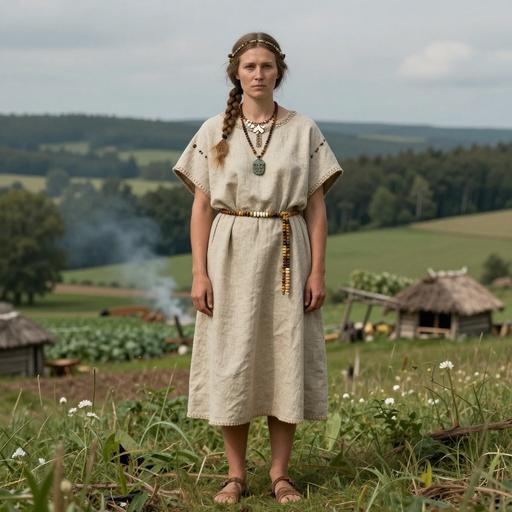
A woman buried in Sweden in the Middle Neolithic era

Download PDF creates a visual, rasterized copy. Use Print for selectable text and better assistive-technology support.

Loading Report

Preparing your ancestry journey

Preparing the available report content...

Your report will open automatically.

Skip to main content
Reference library / Sample profile

A woman buried in Sweden in the Middle Neolithic era

Explore the recorded context, genetic comparisons and research behind this reference sample.

SwedenMiddle Neolithic Funnel Beaker Culture, Sweden

A reference profile describes this sample. It does not establish a personal or family relationship.

AI portrait reconstruction for A woman buried in Sweden in the Middle Neolithic era
AI-generated artistic reconstruction, not a photograph of the individual.
Record

Sample details

Recorded details and available lineage markers.

Individual

Proto-Indo-European individual, Sweden

Sample ID: Gokhem2

Date Range

3086 BCE - 2907 BCE

Cultural Period

Middle Neolithic Funnel Beaker Culture, Sweden

Biological Sex

Female

mtDNA Haplogroup

Not available

Y-DNA Haplogroup

Not available

Social Role

Farmer (AI estimate, era-typical)

Geography

Location

Where this individual was discovered

Country Sweden
Locality Gökhem. Västergötland
Coordinates 58.1740, 13.4080
Chronology

Date range

When this individual lived in the broader context of human history

Proto-Indo-European individual, Sweden 3086 BCE - 2907 BCE
Context

Historical context

Background information associated with the reference record.

Region & Environment

Neolithic Sweden featured forests, rivers, and coastlines, with varying amounts of arable land. These environments made it possible to combine cultivation with hunting and fishing, particularly through access to waterways. Settlement placement would have been influenced by both land suitability and resource diversity.

Historical Context

The Middle Neolithic (c. 4000–2800 BCE) is associated here with Funnel Beaker culture and the TRB complex. Across northern and central Europe, Funnel Beaker-related traditions are known for spreading farming practices and shared ceramic styles. In Sweden, this period reflects participation in those wider Neolithic networks while also maintaining local trajectories.

Populations & Lifeways

Communities increasingly relied on farming and herding, supported by the management of fields and the processing of plant products. Even as agriculture expanded, foraging likely continued as a complementary strategy, especially in forest-rich and coastal landscapes. Lifeways would have included pottery production, craft activities, and the building or reuse of settlement areas over time.

Archaeology & Material Culture

The most characteristic material feature is pottery decorated in Funnel Beaker-related styles. Stone tools suited to agricultural tasks and woodworking appear alongside domestic debris from settlements. Archaeological patterns in settlements and graves help distinguish local expressions of TRB-related traditions from neighboring regions.

Culture & Society

The spread of Funnel Beaker ceramic forms and related practices implies social connection between communities across large areas. Shared styles in material culture can reflect communication, marriage ties, or participation in ritual traditions. At the same time, local differences in assemblage composition and settlement organization suggest that communities were not uniform and likely retained regional identities.

Legacy & Transition

The Middle Neolithic lays groundwork for later Neolithic and subsequent Bronze Age developments in Sweden. As communities changed their subsistence strategies and networks expanded, these earlier TRB/Funnel Beaker traditions contributed to the long-term evolution of settlement patterns, technologies, and cultural expression.

Analysis

Genetic comparisons

These comparisons show genetic similarity, not identity or origin. The populations listed are those whose genomes show statistical alignment to this ancient individual.

Similarity reflects shared history, not shared identity. These are analytical comparisons, not claims about who this person was.

Modern Genetic Admixture

This analysis compares the DNA profile with present-day reference populations, showing statistical similarity to modern reference populations from different regions. The excavation site records where this individual was found, not a fixed modern genetic identity.

Europe 96.5%
Southern European 88.2%
Iberian 26.9%
Italian 26.9%
Sardinian 23.7%
Balkan 10.7%
Northwestern European 8.3%
Asia 3.5%
Arab, Egyptian & Levantine 3.5%
Arabian 3.5%

Closest Modern Populations

These are the modern populations showing the closest statistical alignment to A woman buried in Sweden in the Middle Neolithic era, ranked by genetic distance. Lower distance values indicate closer statistical similarity. Cross-region similarity can reflect shared ancestry, population movement, continuity, or later admixture.

1
Sardinian
3.8197
2
Spanish La Rioja
4.8704
3
French Corsica
4.8993
4
Spanish Castilla La Mancha
5.1759
5
Spanish Castello
5.2194
6
Spanish Pirineu
5.2517
7
Spanish Aragon
5.2806
8
Spanish Cantabria
5.3002
9
Spanish Menorca
5.3043
10
Spanish Navarra
5.3320
Context

Related Samples

This individual exists within a broader network of ancient samples. No ancient genome stands alone.

Individual Culture/Period Date Location Action
Nordic Bronze Age individual, Sweden Pitted Ware Culture, Sweden 2900 BCE Gotland. Stora Karlsö, Sweden View
Proto-Indo-European individual, Sweden Middle Neolithic Funnel Beaker Culture, Sweden 3086 BCE Gökhem. Västergötland, Sweden View
Nordic Bronze Age individual, Sweden Pitted Ware Culture, Sweden 2900 BCE Gotland. Stora Karlsö, Sweden View
Western European Hunter-Gatherers individual, Sweden Hunter-Gatherer Sweden 5557 BCE Gotland. Stora Karlsö, Sweden View
Nordic Bronze Age individual, Sweden Pitted Ware Culture, Sweden 3100 BCE Gotland. Stora Karlsö, Sweden View
Proto-Indo-European individual, Sweden Middle Neolithic Funnel Beaker Culture, Sweden 3092 BCE Gökhem. Västergötland, Sweden View
Nordic Bronze Age individual, Sweden Pitted Ware Culture, Sweden 2900 BCE Gotland. Stora Karlsö, Sweden View
Proto-Indo-European individual, Sweden Middle Neolithic Funnel Beaker Culture, Sweden 3331 BCE Gökhem. Västergötland, Sweden View
Proto-Indo-European individual, Sweden Middle Neolithic Funnel Beaker Culture, Sweden 2921 BCE Gökhem. Västergötland, Sweden View
Nordic Bronze Age individual, Sweden Pitted Ware Culture, Sweden 2900 BCE Gotland. Stora Karlsö, Sweden View
Hunter Gatherers individual, Sweden 5557 BCE Gotland. Stora Karlsö, Sweden View
Pitted Ware individual, Sweden 2900 BCE Gotland. Stora Karlsö, Sweden View
Nordic Mn individual, Sweden 3086 BCE Gökhem. Västergötland, Sweden View
Nordic Mn individual, Sweden 3092 BCE Gökhem. Västergötland, Sweden View
Nordic Mn individual, Sweden 3331 BCE Gökhem. Västergötland, Sweden View
Nordic Mn individual, Sweden 2921 BCE Gökhem. Västergötland, Sweden View
Pitted Ware individual, Sweden 3100 BCE Gotland. Stora Karlsö, Sweden View
Page 1
Individual Culture/Period Date Location Action
MN individual, Sweden Middle Neolithic Funnel Beaker Culture, Sweden 3945 BCE Kvärlöv. Saxtorp. Skåne, Sweden View
Proto-Indo-European individual, Sweden Middle Neolithic Funnel Beaker Culture, Sweden 3086 BCE Gökhem. Västergötland, Sweden View
Proto-Indo-European individual, Sweden Middle Neolithic Funnel Beaker Culture, Sweden 3092 BCE Gökhem. Västergötland, Sweden View
Proto-Indo-European individual, Sweden Middle Neolithic Funnel Beaker Culture, Sweden 3331 BCE Gökhem. Västergötland, Sweden View
Proto-Indo-European individual, Sweden Middle Neolithic Funnel Beaker Culture, Sweden 2921 BCE Gökhem. Västergötland, Sweden View
Page 1
Sources

References

Scientific publications and genetic data that inform this profile.

G25 Coordinates

These coordinates represent a position in genetic space, a tool for comparison, not a conclusion. You can use these to perform custom admixture analysis in G25 Studio.

Gokhem2,0.12060434,0.15827416,0.0322964,-0.0273573,0.05620722,-0.01466126,-0.00169088,0.00521862,0.03499262,0.06030512,-0.00546876,0.01419866,-0.025041,-0.01297238,-0.00414902,0.00263892,0.00499416,-0.00057132,-0.00053124,-0.0033671,0.00175376,0.00466508,-0.01189354,-0.01571154,0.00346122
Continue in G25 Studio
Use code for 30% off • Expires Nov 16