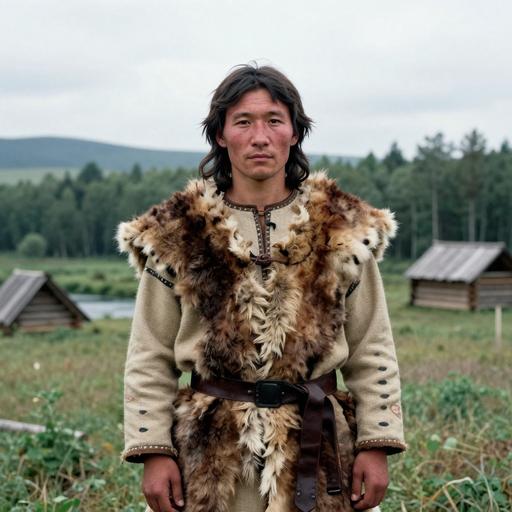
A man buried in Russia in the Neolithic era

Download PDF creates a visual, rasterized copy. Use Print for selectable text and better assistive-technology support.

Loading Report

Preparing your ancestry journey

Preparing the available report content...

Your report will open automatically.

Skip to main content
Reference library / Sample profile

A man buried in Russia in the Neolithic era

Explore the recorded context, genetic comparisons and research behind this reference sample.

RussiaNorthern West Siberian

A reference profile describes this sample. It does not establish a personal or family relationship.

AI portrait reconstruction for A man buried in Russia in the Neolithic era
AI-generated artistic reconstruction, not a photograph of the individual.
Record

Sample details

Recorded details and available lineage markers.

Individual

Forest Neolithic individual, Russia

Sample ID: I1965

Date Range

4037 BCE - 3797 BCE

Cultural Period

Northern West Siberian

Biological Sex

Male

mtDNA Haplogroup

Z1

Y-DNA Haplogroup

C-F1699

Social Role

Hunter (AI estimate, era-typical)

Geography

Location

Where this individual was discovered

Country Russia
Locality Ust'-Isha (Altai Krai, Krasnogorsky District, Ust'-Isha Village)
Coordinates 52.1639, 85.9604
Chronology

Date range

When this individual lived in the broader context of human history

Forest Neolithic individual, Russia 4037 BCE - 3797 BCE
Context

Historical context

Background information associated with the reference record.

Region & Environment

Western Siberia (especially forest-zone river valleys) supported wide seasonal landscapes of taiga forest, wetlands, and major waterways. Abundant aquatic resources and forest game made fishing and hunting central activities, while local soils and clearings could support plant use.

Historical Context

Between roughly 6000 and 3000 BCE, this broad region was part of the wider Neolithic transformation seen across northern Eurasia, marked by more durable technologies and changes in how communities organized work and mobility. The period reflects regional traditions developing in relative interaction with neighboring Neolithic groups rather than a single uniform “culture.”

Populations & Lifeways

People in the northern West Siberian zone relied heavily on hunting and fishing, with seasonal movements that likely varied by locale and resource availability. Settlements were typically focused on productive riverine and lake environments, where groups could exploit fisheries and gather plant foods when conditions allowed.

Archaeology & Material Culture

Archaeological assemblages commonly emphasize stone technologies suited to woodworking, hunting, and processing wild resources. Pottery traditions characteristic of forest Neolithic contexts are often represented, though the exact details vary by named local cultures. Settlement patterns are inferred from the distribution of lithic scatters and occupation deposits along waterways.

Culture & Society

Across the forest zone, community life would have centered on cooperative food procurement, craft work, and the sharing of knowledge about seasonal resource cycles. Material culture suggests practical networks for producing and maintaining tools and vessels, with styles that help archaeologists distinguish regional traditions.

Legacy & Transition

As the late 4th and 3rd millennia BCE approached, northern West Siberian lifeways continued to adapt to ecological opportunities and shifting regional contacts. The broader transition toward later archaeological phases involves changes in technology and settlement intensity rather than an abrupt replacement.

Analysis

Genetic comparisons

These comparisons show genetic similarity, not identity or origin. The populations listed are those whose genomes show statistical alignment to this ancient individual.

Similarity reflects shared history, not shared identity. These are analytical comparisons, not claims about who this person was.

Modern Genetic Admixture

This analysis compares the DNA profile with present-day reference populations, showing statistical similarity to modern reference populations from different regions. The excavation site records where this individual was found, not a fixed modern genetic identity.

Asia 73.4%
Northern Asian 43.9%
Siberian 35.8%
Mongolian 8.1%
Central Asian, Northern Indian & Pakistani 27.7%
Central Asian 27.7%
Japanese & Korean 1.8%
Japanese 1.8%
America 17.4%
America 17.4%
Native American 17.4%
Europe 9.3%
Northwestern European 9.3%
Finnish 9.3%

Closest Modern Populations

These are the modern populations showing the closest statistical alignment to A man buried in Russia in the Neolithic era, ranked by genetic distance. Lower distance values indicate closer statistical similarity. Cross-region similarity can reflect shared ancestry, population movement, continuity, or later admixture.

1
Greenlander East
12.3365
2
Eskimo Sireniki
13.0534
3
Chukchi
13.1494
4
Eskimo Chaplin
13.4643
5
Eskimo
13.6149
6
Eskimo Naukan
13.6196
7
Khakass Kachins
13.6384
8
Teleut O
13.6714
9
Altaian
13.7207
10
Altaian Kizhi
13.7277
Context

Related Samples

This individual exists within a broader network of ancient samples. No ancient genome stands alone.

Individual Culture/Period Date Location Action
Pre-Agricultural Caucasian individual, Georgia Dzudzuana Cave Culture 25550 BCE Dzudzuana Cave (Imereti, Raion Chiatura, Chiatura), Georgia View
Siberian individual, Russia Northern Irkutsk 4239 BCE Sosnovy-Mys (Irkutsk Oblast, Ust-Ilimsky District, Kata, Sosnovy Island), Russia View
Forest Neolithic individual, Russia Northern West Siberian 4037 BCE Ust'-Isha (Altai Krai, Krasnogorsky District, Ust'-Isha Village), Russia View
Siberian individual, Russia Northern Irkutsk 4239 BCE Sosnovy-Mys (Irkutsk Oblast, Ust-Ilimsky District, Kata, Sosnovy Island), Russia View
Forest Neolithic individual, Russia Northern West Siberian 4037 BCE Ust'-Isha (Altai Krai, Krasnogorsky District, Ust'-Isha Village), Russia View
Page 1
Individual Culture/Period Date Location Action
Forest Neolithic individual, Russia Northern West Siberian 4037 BCE Ust'-Isha (Altai Krai, Krasnogorsky District, Ust'-Isha Village), Russia View
Page 1
Sources

References

Scientific publications and genetic data that inform this profile.

G25 Coordinates

These coordinates represent a position in genetic space, a tool for comparison, not a conclusion. You can use these to perform custom admixture analysis in G25 Studio.

I1965,0.05276066,-0.3229665,0.0794695,0.01767244,-0.0570487,-0.01584258,-0.06346044,-0.07567024,-0.00356564,-0.0072266,0.00433876,-0.00077056,0.00374732,-0.00426836,-0.01430928,-0.0075634,0.00024866,0.0044835,0.00680954,0.00376064,0.01199408,-0.01199486,0.00123938,0.006732,0.00842639
Continue in G25 Studio
Use code for 30% off • Expires Nov 16