A man buried in Spain in the Mesolithic era

Download PDF creates a visual, rasterized copy. Use Print for selectable text and better assistive-technology support.

Loading Report

Preparing your ancestry journey

Preparing the available report content...

Your report will open automatically.

Skip to main content
Reference library / Sample profile

A man buried in Spain in the Mesolithic era

Explore the recorded context, genetic comparisons and research behind this reference sample.

SpainUpper Paleolithic Azilian Culture, Spain

A reference profile describes this sample. It does not establish a personal or family relationship.

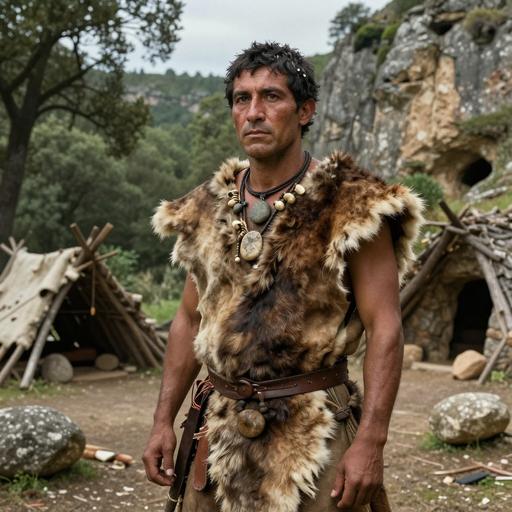
AI portrait reconstruction for A man buried in Spain in the Mesolithic era
AI-generated artistic reconstruction, not a photograph of the individual.
Record

Sample details

Recorded details and available lineage markers.

Individual

Azilian individual, Spain

Sample ID: BAL003

Date Range

10727 BCE - 9272 BCE

Cultural Period

Upper Paleolithic Azilian Culture, Spain

Biological Sex

Male

mtDNA Haplogroup

U2'3'4'7'8'9

Y-DNA Haplogroup

C1a1a

Social Role

Hunter (AI estimate, era-typical)

Geography

Location

Where this individual was discovered

Country Spain
Locality Balma Guilanya
Coordinates 42.0853, 1.6017
Chronology

Date range

When this individual lived in the broader context of human history

Azilian individual, Spain 10727 BCE - 9272 BCE
Context

Historical context

Background information associated with the reference record.

The Upper Paleolithic Azilian culture, named after the site of Mas d’Azil in the French Pyrenees but extending into parts of Spain, represents a fascinating and complex era of European prehistory associated with the later stages of the Paleolithic period, approximately 12,000 to 9,500 years ago. This culture is situated in a transitional phase that links the Paleolithic hunter-gatherer societies to the more settled, agrarian Neolithic communities.

Environmental Context

During the Azilian period, Europe was undergoing significant climatic changes. This era followed the Last Glacial Maximum and coincided with a warming climate and the retreat of ice sheets. As the environment became more temperate, the landscapes of Spain transformed significantly. Forests of pine and birch started to dominate areas previously covered by tundra, creating rich ecosystems potentially brimming with wildlife, such as deer, wild boars, and smaller mammals, as well as a variety of plant resources.

Cultural Characteristics

The Azilian culture marks the tail end of the Upper Paleolithic and the beginning of the Mesolithic in some regions, characterized by adaptation to post-glacial environments. It is distinguished by its simplified tool technology compared to the preceding Magdalenian culture. Typical Azilian artifacts include:

  • Microliths: Small, often geometric microliths are a hallmark of this culture. These were used as barbs and points for arrows or spears, reflecting advancements in hunting tools.
  • Bone and Antler Tools: Though these became less elaborate than those of the Magdalenian era, bone implements, including awls and spatulas, continued in use.
  • Painted Pebbles: Perhaps one of the most iconic aspects of Azilian culture is the presence of painted pebbles. These small stones, usually with simple geometric or linear patterns drawn in red pigment, suggest symbolic or artistic expression, though their exact purpose remains a subject of debate.

Social Organization and Lifestyle

As hunter-gatherers, the Azilians were presumably organized in small, mobile bands. With the changing climate, they likely followed seasonal migrations of game and adjusted their subsistence strategies to incorporate a broader spectrum of resources, including fishing and foraging for plant foods.

The Azilian sites in Spain, including areas like northern Iberia and the Cantabrian region, often reveal evidence of open-air camps and rock shelters rather than the deep cave habitation seen in earlier periods. These settlements could indicate a degree of sedentism, as the stable climates and resource-rich environments permitted longer stays in favorable locations.

Artistic and Symbolic Expression

While the iconic cave paintings of earlier periods, such as those at Altamira, became less frequent during the Azilian era, art did not vanish. The painted pebbles indicate a continuity of symbolic thought and possibly communication or social cohesion expressions. Additionally, these artifacts could have been included in ritualistic or communal activities.

Burial Practices

Evidence for Azilian burial customs is scant, but it suggests less elaborate burials than in some earlier cultures, with few grave goods. However, this might indicate a change in belief systems or social structures.

Technological and Cultural Legacy

The Azilian culture represents a bridge between the Paleolithic and Mesolithic ways of life. As an adaptation to post-glacial environments, it laid down patterns that would inform subsequent European cultures' social and technological developments. This era encompasses the last expressions of a society reliant on hunting, gathering, and fishing before the dawn of agriculture that characterized the Neolithic Revolution.

In summary, the Azilian culture in Spain characterizes a people adept at adapting to a rapidly changing world, carrying forward the legacy of artistic expression, yet simplifying their technological toolkit in response to a new climate and ecological context. Their mark on the archaeological record, though less grandiose than some predecessors, provides critical insight into the resilience and creativity of human societies transitioning through dramatic environmental transformations.

Analysis

Genetic comparisons

These comparisons show genetic similarity, not identity or origin. The populations listed are those whose genomes show statistical alignment to this ancient individual.

Similarity reflects shared history, not shared identity. These are analytical comparisons, not claims about who this person was.

Modern Genetic Admixture

This analysis compares the DNA profile with present-day reference populations, showing statistical similarity to modern reference populations from different regions. The excavation site records where this individual was found, not a fixed modern genetic identity.

Europe 87.7%
Northwestern European 87.7%
Scandinavian 38.5%
Northwestern European 29.3%
English 10.3%
Finnish 9.5%
Oceania 7.6%
Melanesian 7.6%
Papuan 7.6%
Asia 4.2%
Chinese & Southeast Asian 4.2%
Chinese 4.2%
Africa 0.6%
African Hunter-Gatherer 0.6%

Closest Modern Populations

These are the modern populations showing the closest statistical alignment to A man buried in Spain in the Mesolithic era, ranked by genetic distance. Lower distance values indicate closer statistical similarity. Cross-region similarity can reflect shared ancestry, population movement, continuity, or later admixture.

1
Afrikaner
3.7463
2
Dutch
4.5886
3
Orcadian
4.6796
4
Scottish
4.7488
5
Norwegian
4.8105
6
Irish
4.9283
7
Danish
4.9500
8
Icelandic
5.0014
9
Shetlandic
5.0111
10
English
5.0502
Context

Related Samples

This individual exists within a broader network of ancient samples. No ancient genome stands alone.
Individual Culture/Period Date Location Action
Azilian individual, Spain Upper Paleolithic Azilian Culture, Spain 10727 BCE Balma Guilanya, Spain View
European Hunter-Gatherers individual, Spain Upper Paleolithic Azilian Culture, Spain 11446 BCE Balma Guilanya, Spain View
EN individual, Spain Early Neolithic Spain 5308 BCE Cueva de Chaves, Spain View
EN individual, Spain Early Neolithic Spain 5302 BCE Cueva de Chaves, Spain View
EN individual, Spain Early Neolithic Spain 4545 BCE Cueva de Chaves, Spain View
Mesolithic individual, Portugal Geometric Mesolithic Portugal 6238 BCE Moita do Sebastiao, Portugal View
MLN individual, Spain Middle to Late Neolithic Spain 3941 BCE Cova de Els Trocs, Spain View
MLN individual, Spain Middle to Late Neolithic Spain 3949 BCE Cova de Els Trocs, Spain View
EN individual, Spain Early Neolithic Spain 5209 BCE Fuente Celada, Spain View
Page 1
Individual Culture/Period Date Location Action
Azilian individual, Spain Upper Paleolithic Azilian Culture, Spain 10727 BCE Balma Guilanya, Spain View
European Hunter-Gatherers individual, Spain Upper Paleolithic Azilian Culture, Spain 11446 BCE Balma Guilanya, Spain View
Page 1
Sources

References

Scientific publications and genetic data that inform this profile.

G25 Coordinates

These coordinates represent a position in genetic space, a tool for comparison, not a conclusion. You can use these to perform custom admixture analysis in G25 Studio.

BAL003,0.09266594,0.11280372,0.05247926,0.0555263,0.04032264,0.0136688,0.00131344,0.00406446,0.00271382,-0.00106852,-0.00410562,0.0066212,-0.00767196,-0.0105837,0.0233104,-0.00119256,-0.01426538,0.0049969,0.00056786,0.00107768,0.00466948,-0.00097676,0.00138228,0.01309244,0.00114969
Continue in G25 Studio
Use code for 30% off • Expires Nov 16