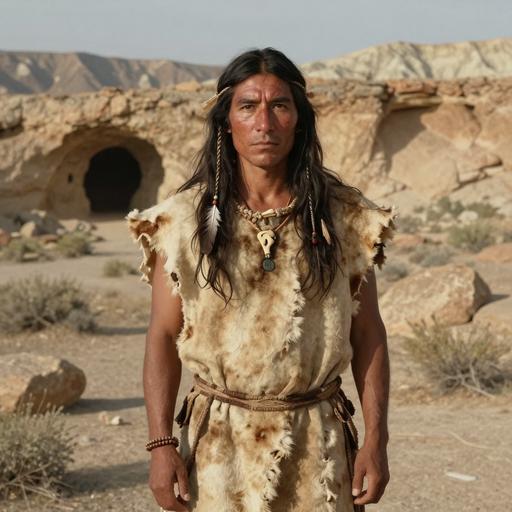
A man buried in USA in the Pre-Columbian North America era

Download PDF creates a visual, rasterized copy. Use Print for selectable text and better assistive-technology support.

Loading Report

Preparing your ancestry journey

Preparing the available report content...

Your report will open automatically.

Skip to main content
Reference library / Sample profile

A man buried in USA in the Pre-Columbian North America era

Explore the recorded context, genetic comparisons and research behind this reference sample.

USALovelock Cave, Nevada, USA 1,850 Years Ago

A reference profile describes this sample. It does not establish a personal or family relationship.

AI portrait reconstruction for A man buried in USA in the Pre-Columbian North America era
AI-generated artistic reconstruction, not a photograph of the individual.
Record

Sample details

Recorded details and available lineage markers.

Individual

Ancient Puebloan individual, USA

Sample ID: Lovelock4

Date Range

126 CE - 313 CE

Cultural Period

Lovelock Cave, Nevada, USA 1,850 Years Ago

Biological Sex

Male

mtDNA Haplogroup

D1

Y-DNA Haplogroup

Q-YP3966

Social Role

Hunter (AI estimate, era-typical)

Geography

Location

Where this individual was discovered

Country USA
Locality Lovelock Cave. Nevada. US
Chronology

Date range

When this individual lived in the broader context of human history

Ancient Puebloan individual, USA 126 CE - 313 CE
Context

Historical context

Background information associated with the reference record.

Overview

Lovelock Cave in western Nevada is a major archaeological sequence for understanding long-term Great Basin lifeways. Dated here to around 1,850 years ago (about 100 CE), this snapshot reflects how people used shelter in arid landscapes while continuing Great Basin adaptations.

Region & Environment

Western Nevada’s Great Basin environment includes dry basins, mountain ranges, and seasonal water availability. Caves and rock shelters would have offered more stable microclimates than open landscapes and acted as focal points for repeated visits. Resource procurement across the wider region would have been shaped by drought cycles and seasonal plant growth.

Historical Context

Great Basin histories are commonly described in terms of long-term continuity of hunter-gatherer subsistence and regional mobility, rather than intensive agriculture or urban centers. Around 100 CE, communities were part of this broader desert-adapted pattern, with local traditions expressed through regional toolkits and the repeated use of caves.

Populations & Lifeways

People likely practiced flexible foraging, moving between hunting and gathering areas as resources became available. Shelter use implies that visits could be seasonal or longer-term depending on conditions. Such lifeways would have required detailed knowledge of plant cycles, animal behavior, and water sources.

Archaeology & Material Culture

Lovelock Cave deposits commonly include organic remains that can illuminate diet and the timing of visits, alongside stone tools associated with processing activities. Because preservation conditions in caves can be favorable for perishable materials, assemblages may show patterns in how people prepared, stored, or discarded food and working materials.

Culture & Society

Archaeological patterns in the Great Basin often point to social organization centered on local bands and shared regional practices. Differences between activity areas in a shelter and between layers in a sequence can reflect changes in task focus, time of year, or the intensity of occupation.

Legacy & Transition

Later centuries in the Great Basin saw shifting settlement patterns and material practices, but the core desert adaptation endured. The record from Lovelock Cave helps anchor how Indigenous lifeways in the Great Basin were sustained and adapted across millennia, forming a foundation for understanding subsequent cultural change.

Analysis

Genetic comparisons

These comparisons show genetic similarity, not identity or origin. The populations listed are those whose genomes show statistical alignment to this ancient individual.

Similarity reflects shared history, not shared identity. These are analytical comparisons, not claims about who this person was.

Modern Genetic Admixture

This analysis compares the DNA profile with present-day reference populations, showing statistical similarity to modern reference populations from different regions. The excavation site records where this individual was found, not a fixed modern genetic identity.

America 85.9%
America 85.9%
Native American 85.9%
Asia 14.1%
Japanese & Korean 6.5%
Japanese 6.5%
Northern Asian 6.2%
Siberian 6.2%
Central Asian, Northern Indian & Pakistani 1.3%
Indian 1.3%

Closest Modern Populations

These are the modern populations showing the closest statistical alignment to A man buried in USA in the Pre-Columbian North America era, ranked by genetic distance. Lower distance values indicate closer statistical similarity. Cross-region similarity can reflect shared ancestry, population movement, continuity, or later admixture.

1
Mixe
2.7481
2
Huichol
2.7794
3
Pima
2.8311
4
Nahua
3.5186
5
Zapotec
3.5485
6
Mayan
3.6552
7
Mixtec
3.7619
8
Cachi
4.2251
9
Bolivian Lapaz
4.3458
10
Colla
4.8383
Context

Related Samples

This individual exists within a broader network of ancient samples. No ancient genome stands alone.

Individual Culture/Period Date Location Action
Ancient Puebloan individual, USA Lovelock Cave, Nevada, USA 600 Years Ago 1270 CE Lovelock Cave. Nevada. US, USA View
Paleo-Indian individual, USA Spirit Cave, Nevada, USA 11,000 Years Ago 9229 BCE Nevada. Spirit Cave, USA View
Ancient Puebloan individual, USA Lovelock Cave, Nevada, USA 1,850 Years Ago 26 CE Lovelock Cave. Nevada. US, USA View
Ancient Puebloan individual, USA Lovelock Cave, Nevada, USA 1,850 Years Ago 49 BCE Lovelock Cave. Nevada. US, USA View
Ancient Puebloan individual, USA Lovelock Cave, Nevada, USA 1,850 Years Ago 126 CE Lovelock Cave. Nevada. US, USA View
Paleo-Arctic Tradition individual, USA Trail Creek, Alaska, USA 9,000 Years Ago 7181 BCE Alaska. Trail Creek, USA View
Paleo-Indian individual, USA Spirit Cave, Nevada, USA 11,000 Years Ago 9252 BCE Nevada. Spirit Cave, USA View
Pre-Columbian Civilizations individual, Chile Western Archipelago Ayayema Culture, Chile 5,100 Years Ago 3364 BCE Ayayema Cave. Patagonia, Chile View
Paleo-Indian individual, Chile Punta Santa Ana Site, Chile 7,300 Years Ago 5634 BCE Punta Santa Ana. Patagonia. Chile, Chile View
Ancient Amerindian individual, Canada Big Bar Site, Canada 5,700 Years Ago 3796 BCE Northwest, Canada View
Paleo-Indian individual, Brazil Sumidouro Site, Brazil 10,100 Years Ago 8612 BCE Caverna do Sumidouro. Lagoa Santa. Brazil, Brazil View
Paleo-Indian individual, Brazil Sumidouro Site, Brazil 10,100 Years Ago 8293 BCE Caverna do Sumidouro. Lagoa Santa. Brazil, Brazil View
Paleo-Indian individual, Brazil Sumidouro Site, Brazil 10,100 Years Ago 8300 BCE Caverna do Sumidouro. Lagoa Santa. Brazil, Brazil View
Paleo-Indian individual, Brazil Sumidouro Site, Brazil 10,100 Years Ago 8422 BCE Caverna do Sumidouro. Lagoa Santa. Brazil, Brazil View
Paleo-Indian individual, Brazil Sumidouro Site, Brazil 10,100 Years Ago 8172 BCE Caverna do Sumidouro. Lagoa Santa. Brazil, Brazil View
Inca Civilization individual, Argentina Aconcagua Inca Culture 500 Years Ago 1400 CE Cerro Aconcagua. Mendoza Province, Argentina View
America North Ancient individual, Canada 3796 BCE Northwest, Canada View
America South Ancient individual, Chile 5634 BCE Punta Santa Ana. Patagonia. Chile, Chile View
America South Ancient individual, Chile 3364 BCE Ayayema Cave. Patagonia, Chile View
America South Pre Columbian individual, Argentina 1400 CE Cerro Aconcagua. Mendoza Province, Argentina View
America North Ancient individual, USA 9229 BCE Nevada. Spirit Cave, USA View
America North Ancient individual, USA 9252 BCE Nevada. Spirit Cave, USA View
America North Ancient individual, USA 49 BCE Lovelock Cave. Nevada. US, USA View
America North Ancient individual, USA 26 CE Lovelock Cave. Nevada. US, USA View
America North Ancient individual, USA 1270 CE Lovelock Cave. Nevada. US, USA View
America North Ancient individual, USA 126 CE Lovelock Cave. Nevada. US, USA View
America South Ancient individual, Brazil 8300 BCE Caverna do Sumidouro. Lagoa Santa. Brazil, Brazil View
America South Ancient individual, Brazil 8612 BCE Caverna do Sumidouro. Lagoa Santa. Brazil, Brazil View
America South Ancient individual, Brazil 8293 BCE Caverna do Sumidouro. Lagoa Santa. Brazil, Brazil View
America South Ancient individual, Brazil 8422 BCE Caverna do Sumidouro. Lagoa Santa. Brazil, Brazil View
America South Ancient individual, Brazil 8172 BCE Caverna do Sumidouro. Lagoa Santa. Brazil, Brazil View
America North Ancient individual, USA 7181 BCE Alaska. Trail Creek, USA View
Page 1
Individual Culture/Period Date Location Action
Ancient Puebloan individual, USA Lovelock Cave, Nevada, USA 1,850 Years Ago 26 CE Lovelock Cave. Nevada. US, USA View
Ancient Puebloan individual, USA Lovelock Cave, Nevada, USA 1,850 Years Ago 49 BCE Lovelock Cave. Nevada. US, USA View
Ancient Puebloan individual, USA Lovelock Cave, Nevada, USA 1,850 Years Ago 126 CE Lovelock Cave. Nevada. US, USA View
Page 1
Sources

References

Scientific publications and genetic data that inform this profile.

G25 Coordinates

These coordinates represent a position in genetic space, a tool for comparison, not a conclusion. You can use these to perform custom admixture analysis in G25 Studio.

Lovelock4,0.0550126,-0.32434042,0.11170642,0.09226196,-0.11812784,-0.01568236,-0.2762552,-0.3242149,-0.01041386,-0.01344206,0.00551956,-0.00022524,-0.0018802,0.02309736,-0.00712576,-0.00202662,0.0056052,0.00458072,0.00383,-0.00028318,0.00341592,0.00278116,-0.00195266,-0.00324404,-0.00288089
Continue in G25 Studio
Use code for 30% off • Expires Nov 16