A man buried in Peru in the Ancient South America era

Download PDF creates a visual, rasterized copy. Use Print for selectable text and better assistive-technology support.

Loading Report

Preparing your ancestry journey

Preparing the available report content...

Your report will open automatically.

Skip to main content
Reference library / Sample profile

A man buried in Peru in the Ancient South America era

Explore the recorded context, genetic comparisons and research behind this reference sample.

PeruSoro Mikaya Patjxa, Peru 6,800 Years Ago

A reference profile describes this sample. It does not establish a personal or family relationship.

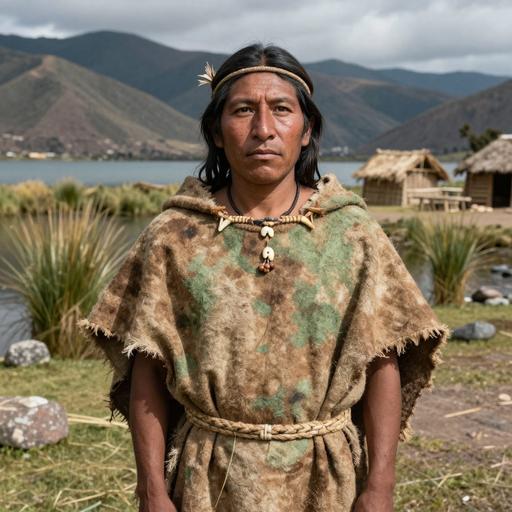
AI portrait reconstruction for A man buried in Peru in the Ancient South America era
AI-generated artistic reconstruction, not a photograph of the individual.
Record

Sample details

Recorded details and available lineage markers.

Individual

Andean Civilizations individual, Peru

Sample ID: SMP5

Date Range

4987 BCE - 4794 BCE

Cultural Period

Soro Mikaya Patjxa, Peru 6,800 Years Ago

Biological Sex

Male

mtDNA Haplogroup

C1c

Y-DNA Haplogroup

Q-B48

Social Role

Hunter (AI estimate, era-typical)

Geography

Location

Where this individual was discovered

Country Peru
Locality Rio Ilave Basin. Soro Mik’aya Patjxa
Chronology

Date range

When this individual lived in the broader context of human history

Andean Civilizations individual, Peru 4987 BCE - 4794 BCE
Context

Historical context

Background information associated with the reference record.

Overview

The Soro Mikaya Patjxa phase represents an early, pre-ceramic way of life in the Andes of Peru, dated to roughly the late 5th millennium BCE. It is understood through archaeological traces of settlement activities and the technologies used before pottery became widespread.

Region & Environment

Peru’s highland environments combine steep terrain, diverse ecological zones, and strong seasonality in water and plant growth. Mountain valleys and slopes offered varied resources—wild foods in appropriate seasons, and places to camp or build near reliable routes and procurement areas.

Historical Context

This period belongs to the broader Archaic sequence in the Andes, when people relied on hunting, gathering, and increasingly structured landscape use. Rather than a single “state” framework, regional lifeways developed over time with local adaptations to highland ecology.

Populations & Lifeways

Communities were likely small and mobile to semi-sedentary, organizing daily labor around food procurement and seasonal movement. Daily life would have included tool maintenance, processing of plant and animal foods, and repeated visits to favored resource areas.

Archaeology & Material Culture

Because this is pre-ceramic, the material record emphasizes stone technologies and organic remains where preservation allows. Archaeological deposits typically reflect cutting, scraping, and other processing tasks, along with durable hearth-related features (where present) and patterned discard from repeated activities.

Culture & Society

In the absence of pottery and written records, social organization is inferred cautiously from settlement organization, repeated activity areas, and the consistency of artifact styles or tool-making traditions. Shared approaches to stone tool production suggest communication of technical knowledge across groups.

Legacy & Transition

Later Andean developments introduced new subsistence strategies and, crucially, ceramic technologies. The pre-ceramic highland phases like this one form part of the long background that enabled subsequent increases in investment in settlements, storage, and wider interaction networks.

Analysis

Genetic comparisons

These comparisons show genetic similarity, not identity or origin. The populations listed are those whose genomes show statistical alignment to this ancient individual.

Similarity reflects shared history, not shared identity. These are analytical comparisons, not claims about who this person was.

Modern Genetic Admixture

This analysis compares the DNA profile with present-day reference populations, showing statistical similarity to modern reference populations from different regions. The excavation site records where this individual was found, not a fixed modern genetic identity.

America 68.8%
America 68.8%
Native American 68.8%
Asia 30.1%
Northern Asian 19.5%
Mongolian 10.2%
Siberian 9.3%
Chinese & Southeast Asian 9.1%
Tibetan 8.4%
Indonesian Khmer Thai Myanma 0.8%
Japanese & Korean 1.1%
Japanese 1.1%
Africa 1.1%
West African 1.1%
Ghanaian, Liberian, Sierra Leonean 1.1%

Closest Modern Populations

These are the modern populations showing the closest statistical alignment to A man buried in Peru in the Ancient South America era, ranked by genetic distance. Lower distance values indicate closer statistical similarity. Cross-region similarity can reflect shared ancestry, population movement, continuity, or later admixture.

1
Mixtec
5.6437
2
Zapotec
5.7559
3
Nahua
5.8878
4
Pima
6.1738
5
Huichol
6.5317
6
Mayan
6.5961
7
Bolivian Pando
7.1511
8
Bolivian Cochabamba
7.2958
9
Mixe
7.3482
10
Quechua
7.4172
Context

Related Samples

This individual exists within a broader network of ancient samples. No ancient genome stands alone.

Individual Culture/Period Date Location Action
Andean Civilizations individual, Peru Rio Uncallane, Peru 1,800 Years Ago 100 CE Rio Ilave Basin. Rio Uncallane, Peru View
Andean Civilizations individual, Peru Rio Uncallane, Peru 1,600 Years Ago 140 CE Rio Ilave Basin. Rio Uncallane, Peru View
Andean Civilizations individual, Peru Rio Uncallane, Peru 1,600 Years Ago 120 CE Rio Ilave Basin. Rio Uncallane, Peru View
Andean Civilizations individual, Peru Rio Uncallane, Peru 1,600 Years Ago 225 CE Rio Ilave Basin. Rio Uncallane, Peru View
Andean Civilizations individual, Peru Rio Uncallane, Peru 1,600 Years Ago 417 CE Rio Ilave Basin. Rio Uncallane, Peru View
Andean Civilizations individual, Peru Soro Mikaya Patjxa, Peru 6,800 Years Ago 4987 BCE Rio Ilave Basin. Soro Mik’aya Patjxa, Peru View
America South Pre Columbian individual, Peru 100 CE Rio Ilave Basin. Rio Uncallane, Peru View
America South Pre Columbian individual, Peru 140 CE Rio Ilave Basin. Rio Uncallane, Peru View
America South Pre Columbian individual, Peru 417 CE Rio Ilave Basin. Rio Uncallane, Peru View
America South Pre Columbian individual, Peru 225 CE Rio Ilave Basin. Rio Uncallane, Peru View
America South Pre Columbian individual, Peru 120 CE Rio Ilave Basin. Rio Uncallane, Peru View
America South Ancient individual, Peru 4987 BCE Rio Ilave Basin. Soro Mik’aya Patjxa, Peru View
Page 1
Individual Culture/Period Date Location Action
Andean Civilizations individual, Peru Soro Mikaya Patjxa, Peru 6,800 Years Ago 4987 BCE Rio Ilave Basin. Soro Mik’aya Patjxa, Peru View
Page 1
Sources

References

Scientific publications and genetic data that inform this profile.

G25 Coordinates

These coordinates represent a position in genetic space, a tool for comparison, not a conclusion. You can use these to perform custom admixture analysis in G25 Studio.

SMP5,0.05625812,-0.31163388,0.10363174,0.07408624,-0.09694394,-0.01387018,-0.2404349,-0.28198926,-0.00920382,-0.00914136,-0.0025663,-0.00027696,-0.00156732,0.01977998,-0.006124,-0.00182766,0.002873,0.00343354,0.0032199,0.0002459,0.00270754,0.00339494,-0.00288134,-0.004303,-0.00267499
Continue in G25 Studio
Use code for 30% off • Expires Nov 16