A man buried in Peru in the Pre-Columbian South America era

Download PDF creates a visual, rasterized copy. Use Print for selectable text and better assistive-technology support.

Loading Report

Preparing your ancestry journey

Preparing the available report content...

Your report will open automatically.

Skip to main content
Reference library / Sample profile

A man buried in Peru in the Pre-Columbian South America era

Explore the recorded context, genetic comparisons and research behind this reference sample.

PeruRio Uncallane, Peru 1,600 Years Ago

A reference profile describes this sample. It does not establish a personal or family relationship.

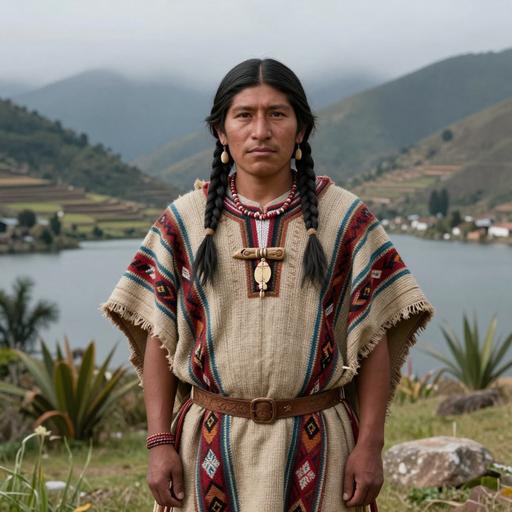
AI portrait reconstruction for A man buried in Peru in the Pre-Columbian South America era
AI-generated artistic reconstruction, not a photograph of the individual.
Record

Sample details

Recorded details and available lineage markers.

Individual

Andean Civilizations individual, Peru

Sample ID: IL4

Date Range

417 CE - 533 CE

Cultural Period

Rio Uncallane, Peru 1,600 Years Ago

Biological Sex

Male

mtDNA Haplogroup

C1b

Y-DNA Haplogroup

Q-M3

Social Role

Farmer (AI estimate, era-typical)

Geography

Location

Where this individual was discovered

Country Peru
Locality Rio Ilave Basin. Rio Uncallane
Chronology

Date range

When this individual lived in the broader context of human history

Andean Civilizations individual, Peru 417 CE - 533 CE
Context

Historical context

Background information associated with the reference record.

Overview

The Rio Uncallane phase is used to describe an early period of activity (roughly 300–550 CE) on Peru’s coastal region, associated in archaeology with Tiwanaku-related cultural influence. It represents an era when long-distance connections were expressed in local material culture while valley-based economies remained central.

Region & Environment

This sequence is tied to Peru’s southern coastal and valley environments, where farming depended on irrigation from river systems and where marine resources could complement agriculture. The arid coastal setting made water control and proximity to productive zones essential for sustaining settlements.

Historical Context

During Late Antiquity, the broader Tiwanaku world is archaeologically recognized across parts of the Andes and nearby regions. The Rio Uncallane record is placed within this context, suggesting that coastal communities experienced or adopted aspects of Tiwanaku-related practices during the early centuries of the common era.

Populations & Lifeways

Populations were likely organized around irrigated agriculture in valley settings, with fishing and gathering contributing to diets. Household economies would have included farming, food processing, and routine craft production, while participation in exchange networks provided access to goods and materials with wider affiliations.

Archaeology & Material Culture

Material culture evidence for Rio Uncallane typically relies on ceramic and other durable artifacts that can be compared to Tiwanaku-associated stylistic traits. In many such contexts, archaeology highlights both local continuity and the presence of non-local or shared technological and stylistic elements.

Culture & Society

Social life in valley settings required coordinated labor for irrigation and maintenance of settlement areas. Tiwanaku-related influence—when present—would have been mediated through networks of trade, artisanship, and shared cultural practices, shaping local identities without eliminating local lifeways.

Legacy & Transition

The Rio Uncallane sequence provides an early baseline for understanding later developments in the region’s cultural landscape. Over subsequent centuries, shifting political and economic connections helped set the stage for later coastal Late Intermediate patterns.

Analysis

Genetic comparisons

These comparisons show genetic similarity, not identity or origin. The populations listed are those whose genomes show statistical alignment to this ancient individual.

Similarity reflects shared history, not shared identity. These are analytical comparisons, not claims about who this person was.

Modern Genetic Admixture

This analysis compares the DNA profile with present-day reference populations, showing statistical similarity to modern reference populations from different regions. The excavation site records where this individual was found, not a fixed modern genetic identity.

America 88.4%
America 88.4%
Native American 88.4%
Asia 11.1%
Northern Asian 6.1%
Siberian 6.0%
Central Asian, Northern Indian & Pakistani 2.6%
Central Asian 1.3%
Pakistan 0.7%
Indian 0.6%
Chinese & Southeast Asian 2.1%
Tibetan 2.1%

Closest Modern Populations

These are the modern populations showing the closest statistical alignment to A man buried in Peru in the Pre-Columbian South America era, ranked by genetic distance. Lower distance values indicate closer statistical similarity. Cross-region similarity can reflect shared ancestry, population movement, continuity, or later admixture.

1
Bolivian Lapaz
2.2436
2
Aymara
2.4279
3
Colla
2.6486
4
Cachi
2.6519
5
Mixe
2.8939
6
Yukpa
3.1086
7
Piapoco
3.1162
8
Mayan
3.2972
9
Pima
3.4635
10
Huichol
3.5225
Context

Related Samples

This individual exists within a broader network of ancient samples. No ancient genome stands alone.

Individual Culture/Period Date Location Action
Andean Civilizations individual, Peru Rio Uncallane, Peru 1,800 Years Ago 100 CE Rio Ilave Basin. Rio Uncallane, Peru View
Andean Civilizations individual, Peru Rio Uncallane, Peru 1,600 Years Ago 140 CE Rio Ilave Basin. Rio Uncallane, Peru View
Andean Civilizations individual, Peru Rio Uncallane, Peru 1,600 Years Ago 120 CE Rio Ilave Basin. Rio Uncallane, Peru View
Andean Civilizations individual, Peru Rio Uncallane, Peru 1,600 Years Ago 225 CE Rio Ilave Basin. Rio Uncallane, Peru View
Andean Civilizations individual, Peru Rio Uncallane, Peru 1,600 Years Ago 417 CE Rio Ilave Basin. Rio Uncallane, Peru View
Andean Civilizations individual, Peru Soro Mikaya Patjxa, Peru 6,800 Years Ago 4987 BCE Rio Ilave Basin. Soro Mik’aya Patjxa, Peru View
America South Pre Columbian individual, Peru 100 CE Rio Ilave Basin. Rio Uncallane, Peru View
America South Pre Columbian individual, Peru 140 CE Rio Ilave Basin. Rio Uncallane, Peru View
America South Pre Columbian individual, Peru 417 CE Rio Ilave Basin. Rio Uncallane, Peru View
America South Pre Columbian individual, Peru 225 CE Rio Ilave Basin. Rio Uncallane, Peru View
America South Pre Columbian individual, Peru 120 CE Rio Ilave Basin. Rio Uncallane, Peru View
America South Ancient individual, Peru 4987 BCE Rio Ilave Basin. Soro Mik’aya Patjxa, Peru View
Page 1
Individual Culture/Period Date Location Action
Andean Civilizations individual, Peru Rio Uncallane, Peru 1,600 Years Ago 140 CE Rio Ilave Basin. Rio Uncallane, Peru View
Andean Civilizations individual, Peru Rio Uncallane, Peru 1,600 Years Ago 120 CE Rio Ilave Basin. Rio Uncallane, Peru View
Andean Civilizations individual, Peru Rio Uncallane, Peru 1,600 Years Ago 225 CE Rio Ilave Basin. Rio Uncallane, Peru View
Andean Civilizations individual, Peru Rio Uncallane, Peru 1,600 Years Ago 417 CE Rio Ilave Basin. Rio Uncallane, Peru View
Page 1
Sources

References

Scientific publications and genetic data that inform this profile.

G25 Coordinates

These coordinates represent a position in genetic space, a tool for comparison, not a conclusion. You can use these to perform custom admixture analysis in G25 Studio.

IL4,0.05699312,-0.31231318,0.11101848,0.09710144,-0.11397574,-0.01231768,-0.29239064,-0.34484664,-0.01371504,-0.01618014,0.00181494,-0.00038134,-0.00069448,0.02255984,-0.0072783,0.00148838,0.00645682,0.00446554,0.00221514,-0.00132148,-0.00117302,0.00546678,-0.00323668,-0.0016342,-0.00263487
Continue in G25 Studio
Use code for 30% off • Expires Nov 16