A woman buried in Taiwan in the Late Paleolithic era

Download PDF creates a visual, rasterized copy. Use Print for selectable text and better assistive-technology support.

Loading Report

Preparing your ancestry journey

Preparing the available report content...

Your report will open automatically.

Skip to main content
Reference library / Sample profile

A woman buried in Taiwan in the Late Paleolithic era

Explore the recorded context, genetic comparisons and research behind this reference sample.

TaiwanLate Paleolithic Taiwan

A reference profile describes this sample. It does not establish a personal or family relationship.

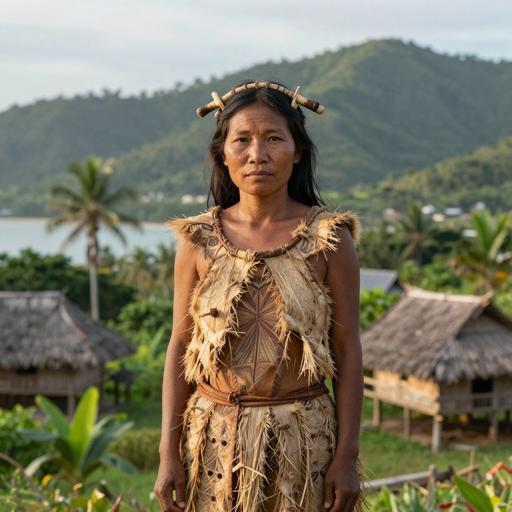
AI portrait reconstruction for A woman buried in Taiwan in the Late Paleolithic era
AI-generated artistic reconstruction, not a photograph of the individual.
Record

Sample details

Recorded details and available lineage markers.

Individual

Austronesian individual, Taiwan

Sample ID: tai002

Date Range

5640 BCE - 5560 BCE

Cultural Period

Late Paleolithic Taiwan

Biological Sex

Female

mtDNA Haplogroup

Not available

Y-DNA Haplogroup

Not available

Social Role

Gatherer (AI estimate, era-typical)

Geography

Location

Where this individual was discovered

Country Taiwan
Locality Liangdao
Chronology

Date range

When this individual lived in the broader context of human history

Austronesian individual, Taiwan 5640 BCE - 5560 BCE
Context

Historical context

Background information associated with the reference record.

Region & Environment

Taiwan’s Late Paleolithic landscapes included coastal and inland areas affected by climatic shifts during the late Pleistocene. Mountainous terrain and variable coastline would have influenced the availability of animal resources, freshwater, and travel routes, while shoreline settings supported access to marine foods where preserved.

Historical Context

This era (c. 50,000–10,000 BCE) predates most agricultural lifeways on the island by many millennia. Human activities are inferred from archaeological deposits and lithic industries, with periodization based on artifact typology and stratigraphic relationships rather than historical narratives.

Populations & Lifeways

Populations were likely mobile hunter-gatherers. Their subsistence would have depended on hunting terrestrial animals, collecting plant foods, and exploiting coastal resources where conditions allowed. Seasonal movement patterns—though hard to reconstruct precisely—would have helped communities track changing resource availability.

Archaeology & Material Culture

Material culture in Late Paleolithic contexts is dominated by stone tools and debitage. Toolmaking strategies reflect adaptation to local raw material sources and working needs, such as cutting, scraping, and processing tasks. Preservation can be uneven due to later landscape changes, so archaeologists rely on what survives in dated stratigraphic sequences.

Culture & Society

Society would have been organized around small groups and shared technical knowledge passed between individuals. Similarities and differences in lithic production can indicate interaction between groups or independent adaptation to local ecological conditions.

Legacy & Transition

The Late Paleolithic record forms the deep baseline for later prehistoric developments on Taiwan. Over time, technological and subsistence strategies changed, culminating in later Neolithic transformations; the transition is tracked archaeologically through shifts from mainly lithic industries toward more varied toolkits and eventually farming-related evidence.

Analysis

Genetic comparisons

These comparisons show genetic similarity, not identity or origin. The populations listed are those whose genomes show statistical alignment to this ancient individual.

Similarity reflects shared history, not shared identity. These are analytical comparisons, not claims about who this person was.

Modern Genetic Admixture

This analysis compares the DNA profile with present-day reference populations, showing statistical similarity to modern reference populations from different regions. The excavation site records where this individual was found, not a fixed modern genetic identity.

Asia 84.0%
Chinese & Southeast Asian 76.3%
Chinese 38.7%
Vietnamese 33.0%
Tibetan 4.7%
Central Asian, Northern Indian & Pakistani 3.4%
Indian 2.2%
Pakistan 1.2%
Japanese & Korean 2.6%
Japanese 2.6%
Northern Asian 1.6%
Siberian 1.6%
Europe 10.3%
Northwestern European 6.2%
Scandinavian 6.0%
Eastern European 3.0%
Southern European 1.1%
Iberian 1.1%
Africa 3.4%
West African 3.4%
Senegambian & Guinean 2.4%
Nigerian 1.0%
Oceania 2.3%
Melanesian 2.3%
Papuan 2.3%

Closest Modern Populations

These are the modern populations showing the closest statistical alignment to A woman buried in Taiwan in the Late Paleolithic era, ranked by genetic distance. Lower distance values indicate closer statistical similarity. Cross-region similarity can reflect shared ancestry, population movement, continuity, or later admixture.

1
Thai
3.2223
2
Cambodian
4.9961
3
Mon
5.1825
4
Malay
5.6999
5
Nyah Kur
6.1053
6
Lao
6.8189
7
Wa
7.2591
8
Blang
7.3479
9
Lawa
7.4928
10
Kuy Suay
7.5290
Context

Related Samples

This individual exists within a broader network of ancient samples. No ancient genome stands alone.
Individual Culture/Period Date Location Action
Austronesian individual, Taiwan Late Paleolithic Taiwan 6378 BCE Liangdao, Taiwan View
Austronesian individual, Taiwan Late Paleolithic Taiwan 5640 BCE Liangdao, Taiwan View
Late Paleolithic individual, Taiwan 6378 BCE Liangdao, Taiwan View
Late Paleolithic individual, Taiwan 5640 BCE Liangdao, Taiwan View
Page 1
Individual Culture/Period Date Location Action
Austronesian individual, Taiwan Late Paleolithic Taiwan 6378 BCE Liangdao, Taiwan View
Austronesian individual, Taiwan Late Paleolithic Taiwan 5640 BCE Liangdao, Taiwan View
Page 1
Sources

References

Scientific publications and genetic data that inform this profile.

G25 Coordinates

These coordinates represent a position in genetic space, a tool for comparison, not a conclusion. You can use these to perform custom admixture analysis in G25 Studio.

tai002,0.01237236,-0.36086956,-0.04574242,-0.03433678,0.11005334,0.0475259,-0.00022714,-0.00632896,-0.00780074,-0.0121264,0.0256159,0.00250506,-0.00179792,-0.00110326,0.00315166,0.00047554,-0.0001061,0.0002502,-0.00180234,-0.00142382,0.00227426,0.00412866,0.00077686,-0.00032002,0.01219729
Continue in G25 Studio
Use code for 30% off • Expires Nov 16