A man buried in Austria in the era

Download PDF creates a visual, rasterized copy. Use Print for selectable text and better assistive-technology support.

Loading Report

Preparing your ancestry journey

Preparing the available report content...

Your report will open automatically.

Skip to main content
Reference library / Sample profile

A man buried in Austria in the era

Explore the recorded context, genetic comparisons and research behind this reference sample.

AustriaGravettian Paleolithic

A reference profile describes this sample. It does not establish a personal or family relationship.

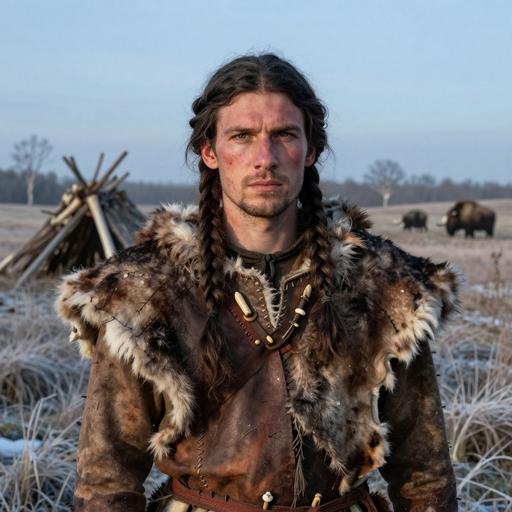
AI portrait reconstruction for A man buried in Austria in the  era
AI-generated artistic reconstruction, not a photograph of the individual.
Record

Sample details

Recorded details and available lineage markers.

Individual

Palaeolithic Gravettian individual, Austria

Sample ID: I2484

Date Range

29200 BCE - 28600 BCE

Cultural Period

Gravettian Paleolithic

Biological Sex

Male

mtDNA Haplogroup

U5*

Y-DNA Haplogroup

I-L758

Social Role

Hunter (AI estimate, era-typical)

Geography

Location

Where this individual was discovered

Country Austria
Locality Krems-Wachtberg
Coordinates 48.4100, 15.5900
Chronology

Date range

When this individual lived in the broader context of human history

Palaeolithic Gravettian individual, Austria 29200 BCE - 28600 BCE
Context

Historical context

Background information associated with the reference record.

Overview

The Gravettian is a recognized Paleolithic technological tradition within Upper Paleolithic frameworks in Eurasia, especially in parts of Europe. It is best characterized archaeologically by its distinctive chipped-stone toolkits and by patterns of site use that track changes in climate and subsistence.

Region & Environment

Gravettian occupations are linked to late Pleistocene conditions, which included cold phases and rapid environmental shifts. Landscapes such as open steppe-like areas, river corridors, and upland zones could be important for hunting and for access to raw materials. Seasonal variation in animal movements and plant availability likely structured mobility.

Historical Context

Within the broader story of Upper Paleolithic development, the Gravettian follows earlier Paleolithic traditions and is distinguished by changes in how stone tools were produced and organized in assemblages. These differences imply evolving preferences and adaptations rather than a uniform “culture” across all regions.

Populations & Lifeways

People associated with the Gravettian were hunter-gatherers. Their lifeways would have combined planned hunting with foraging, with movement patterns shaped by seasons and by the productivity of particular places. Repeated occupation indicators at some sites suggest that groups returned to familiar landscapes.

Archaeology & Material Culture

The Gravettian record is dominated by flaked-stone tools made through controlled knapping strategies. Assemblages often include characteristic projectile- and cutting-related components, reflecting the practical needs of mobile hunting. Archaeological contexts may also preserve hearth features and occupation surfaces, which help document site activities such as food processing and tool maintenance.

Culture & Society

Cultural identification in this period relies on recurring technological traditions and the organization of lithic production. Similarities among sites indicate shared learning and communication within networks of people. In some Gravettian contexts across Europe, archaeologists also recover evidence commonly interpreted as symbolic or decorative behavior, though specific meanings cannot be proven from artifacts alone.

Legacy & Transition

The Gravettian is followed in many regional sequences by later Upper Paleolithic traditions as climates and ecosystems continued to change. These transitions are visible through shifts in artifact styles and how people used landscapes for hunting and related activities.

Analysis

Genetic comparisons

These comparisons show genetic similarity, not identity or origin. The populations listed are those whose genomes show statistical alignment to this ancient individual.

Similarity reflects shared history, not shared identity. These are analytical comparisons, not claims about who this person was.

Modern Genetic Admixture

This analysis compares the DNA profile with present-day reference populations, showing statistical similarity to modern reference populations from different regions. The excavation site records where this individual was found, not a fixed modern genetic identity.

Europe 67.2%
Northwestern European 35.1%
Northwestern European 11.4%
Finnish 10.6%
English 7.9%
Scandinavian 5.1%
Southern European 22.4%
Iberian 18.7%
Sardinian 3.7%
Eastern European 9.8%
Asia 18.4%
Central Asian, Northern Indian & Pakistani 13.7%
Indian 13.7%
Chinese & Southeast Asian 4.7%
Tibetan 4.6%
Africa 6.8%
African Hunter-Gatherer 4.3%
North African 2.5%
Egyptian 2.5%
Oceania 6.1%
Melanesian 6.1%
Papuan 6.1%
America 1.6%
America 1.6%
Native American 1.6%

Closest Modern Populations

These are the modern populations showing the closest statistical alignment to A man buried in Austria in the era, ranked by genetic distance. Lower distance values indicate closer statistical similarity. Cross-region similarity can reflect shared ancestry, population movement, continuity, or later admixture.

1
Roma Bilbao
9.1457
2
Roma Barcelona
9.1775
3
Roma Madrid
9.2875
4
Roma Granada
9.5148
5
Tatar Mishar
9.5695
6
Roma Porto
9.7394
7
Tatar Kazan
9.9542
8
Turkish Rumeli
10.4911
9
Turkish Deliorman
10.6173
10
Roma Balkans
10.6995
Context

Related Samples

This individual exists within a broader network of ancient samples. No ancient genome stands alone.

Individual Culture/Period Date Location Action
European Paleolithic individual, Austria Krems-Wachtberg 1 Site, Austria 29200 BCE Krems-Wachtberg, Austria View
Palaeolithic Gravettian individual, Austria 29200 BCE Krems-Wachtberg, Austria View
Page 1
Individual Culture/Period Date Location Action
Palaeolithic Gravettian individual, Italy 26700 BCE Apulia. Paglicci, Italy View
Palaeolithic Gravettian individual, Belgium 26440 BCE Troisieme caverne of Goyet cave, Belgium View
Palaeolithic Gravettian individual, Belgium 24847 BCE Troisieme caverne of Goyet cave, Belgium View
Palaeolithic Gravettian individual, Belgium 33678 BCE Troisieme caverne of Goyet cave, Belgium View
Palaeolithic Gravettian individual, Romania 31343 BCE Cioclovina, Romania View
Palaeolithic Gravettian individual, Belgium 25771 BCE Troisieme caverne of Goyet cave, Belgium View
Palaeolithic Gravettian individual, Belgium 33678 BCE Troisieme caverne of Goyet cave, Belgium View
Palaeolithic Gravettian individual, Austria 29200 BCE Krems-Wachtberg, Austria View
Page 1
Sources

References

Scientific publications and genetic data that inform this profile.

G25 Coordinates

These coordinates represent a position in genetic space, a tool for comparison, not a conclusion. You can use these to perform custom admixture analysis in G25 Studio.

I2484,0.06340254,0.04100988,0.01471156,0.0523462,0.0282834,-0.00684384,-0.00682026,-0.00030946,0.0201157,0.00622502,-0.00986888,0.00236966,-0.00850534,-0.00216802,0.00788454,-0.00439168,-0.0115146,0.00037694,-0.00111536,-0.00279858,0.00330984,0.0053535,-0.00387144,0.00340516,0.00392681
Continue in G25 Studio
Use code for 30% off • Expires Nov 16