A man buried in Austria in the Pleistocene era

Download PDF creates a visual, rasterized copy. Use Print for selectable text and better assistive-technology support.

Loading Report

Preparing your ancestry journey

Preparing the available report content...

Your report will open automatically.

Skip to main content
Reference library / Sample profile

A man buried in Austria in the Pleistocene era

Explore the recorded context, genetic comparisons and research behind this reference sample.

AustriaKrems-Wachtberg 1 Site, Austria

A reference profile describes this sample. It does not establish a personal or family relationship.

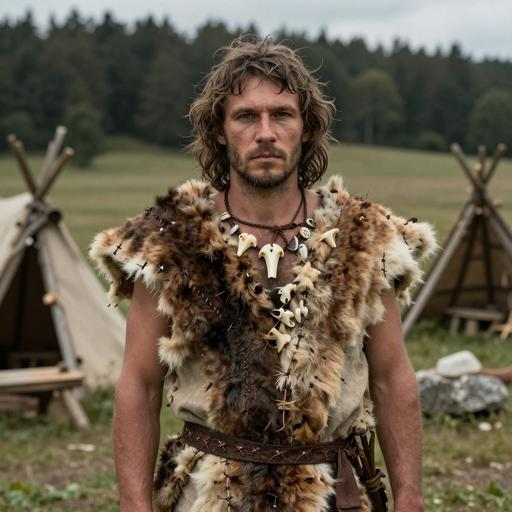
AI portrait reconstruction for A man buried in Austria in the Pleistocene era
AI-generated artistic reconstruction, not a photograph of the individual.
Record

Sample details

Recorded details and available lineage markers.

Individual

European Paleolithic individual, Austria

Sample ID: I2483

Date Range

29200 BCE - 28600 BCE

Cultural Period

Krems-Wachtberg 1 Site, Austria

Biological Sex

Male

mtDNA Haplogroup

U5*

Y-DNA Haplogroup

I-L758

Social Role

Hunter (AI estimate, era-typical)

Geography

Location

Where this individual was discovered

Country Austria
Locality Krems-Wachtberg
Coordinates 48.4100, 15.5900
Chronology

Date range

When this individual lived in the broader context of human history

European Paleolithic individual, Austria 29200 BCE - 28600 BCE
Context

Historical context

Background information associated with the reference record.

Region & Environment

Austria lies within Central Europe’s temperate-to-montane environments, where Upper Paleolithic populations faced climatic variability during the late Pleistocene. River valleys and open landscapes could support animal herds and provide raw materials such as stone for toolmaking. Seasonal movement would have been shaped by temperature fluctuations and changing vegetation.

Historical Context

The interval around 27,000–23,000 BCE falls in the European Upper Paleolithic, a period marked by regional traditions in lithic technology. The Krems-Wachtberg tradition is commonly discussed within broader Gravettian-era developments, reflecting shared tendencies in stone tool production while allowing for local variation. No written sources apply; archaeological patterns provide the main historical evidence.

Populations & Lifeways

The people associated with this horizon are best understood as mobile hunter-gatherers. Their lifeways likely included hunting and scavenging strategies coordinated with seasonal availability of prey, along with movements that followed suitable hunting grounds and resource patches. Toolkits were repeatedly maintained and replaced as groups relocated.

Archaeology & Material Culture

Krems-Wachtberg sites are identified through characteristic lithic assemblages—especially patterned stone-tool production that implies planning and technical knowledge. Durable artifacts indicate cutting and working tasks tied to hunting, hide processing, and butchering, as well as the preparation of other materials. Although organic components may have existed, Central European preservation varies, so the stone assemblage is typically central to cultural attribution.

Culture & Society

Technological traditions such as Krems-Wachtberg reflect learned practices transmitted within social networks. The presence of consistent tool production strategies suggests repeated behaviors and potentially shared norms across wider regions during the Upper Paleolithic. Interpretations of social complexity remain cautious, but the technological coherence points to structured teaching and practice among hunter-gatherer groups.

Legacy & Transition

As the Upper Paleolithic progressed toward later phases of the Pleistocene, regional lithic traditions continued to evolve. Krems-Wachtberg sites are part of the broader evidence used to understand how Central European foragers adapted through changing climates and shifting technological preferences, contributing to the long transition toward subsequent postglacial developments.

Analysis

Genetic comparisons

These comparisons show genetic similarity, not identity or origin. The populations listed are those whose genomes show statistical alignment to this ancient individual.

Similarity reflects shared history, not shared identity. These are analytical comparisons, not claims about who this person was.

Modern Genetic Admixture

This analysis compares the DNA profile with present-day reference populations, showing statistical similarity to modern reference populations from different regions. The excavation site records where this individual was found, not a fixed modern genetic identity.
Europe 70.6%
Northwestern European 34.8%
Finnish 12.4%
Northwestern European 11.1%
English 7.8%
Scandinavian 3.6%
Southern European 22.1%
Iberian 21.0%
Sardinian 1.1%
Eastern European 13.8%
Asia 13.6%
Central Asian, Northern Indian & Pakistani 9.0%
Indian 9.0%
Northern Asian 2.0%
Siberian 2.0%
Chinese & Southeast Asian 1.6%
Chinese 1.6%
Japanese & Korean 1.0%
Japanese 1.0%
Africa 8.4%
Congolese & Southern East African 3.2%
South East African 3.2%
African Hunter-Gatherer 2.8%
Northern East African 1.6%
Ethiopian 1.6%
North African 0.8%
Egyptian 0.8%
Oceania 4.6%
Melanesian 4.6%
Papuan 4.6%
America 2.7%
America 2.7%
Native American 2.7%

Closest Modern Populations

These are the modern populations showing the closest statistical alignment to A man buried in Austria in the Pleistocene era, ranked by genetic distance. Lower distance values indicate closer statistical similarity. Cross-region similarity can reflect shared ancestry, population movement, continuity, or later admixture.

1
Roma Barcelona
8.6167
2
Roma Madrid
9.0924
3
Roma Bilbao
9.1246
4
Tatar Mishar
9.1988
5
Roma Granada
9.5551
6
Roma Porto
9.7443
7
Turkish Deliorman
9.8189
8
Turkish Rumeli
9.9272
9
Tatar Kazan
9.9661
10
Afrikaner
10.6363
Context

Related Samples

This individual exists within a broader network of ancient samples. No ancient genome stands alone.

Individual Culture/Period Date Location Action
European Paleolithic individual, Austria Krems-Wachtberg 1 Site, Austria 29200 BCE Krems-Wachtberg, Austria View
Palaeolithic Gravettian individual, Austria 29200 BCE Krems-Wachtberg, Austria View
Page 1
Individual Culture/Period Date Location Action
European Paleolithic individual, Austria Krems-Wachtberg 1 Site, Austria 29200 BCE Krems-Wachtberg, Austria View
Page 1
Sources

References

Scientific publications and genetic data that inform this profile.

G25 Coordinates

These coordinates represent a position in genetic space, a tool for comparison, not a conclusion. You can use these to perform custom admixture analysis in G25 Studio.

I2483,0.06143512,0.05230432,0.02145542,0.04977034,0.03144174,-0.00324606,-0.0058549,-0.00336578,0.02167276,0.00195476,-0.00254996,0.00261134,-0.00683498,0.00070126,0.00287822,-0.00744672,-0.00827906,0.00116008,-0.00107714,-0.0016054,0.00231424,0.00344426,-0.00408364,-0.00173116,0.00196679
Continue in G25 Studio
Use code for 30% off • Expires Nov 16