A woman buried in Chile in the era

Download PDF creates a visual, rasterized copy. Use Print for selectable text and better assistive-technology support.

Loading Report

Preparing your ancestry journey

Preparing the available report content...

Your report will open automatically.

Skip to main content
Reference library / Sample profile

A woman buried in Chile in the era

Explore the recorded context, genetic comparisons and research behind this reference sample.

ChilePre-Columbian South America

A reference profile describes this sample. It does not establish a personal or family relationship.

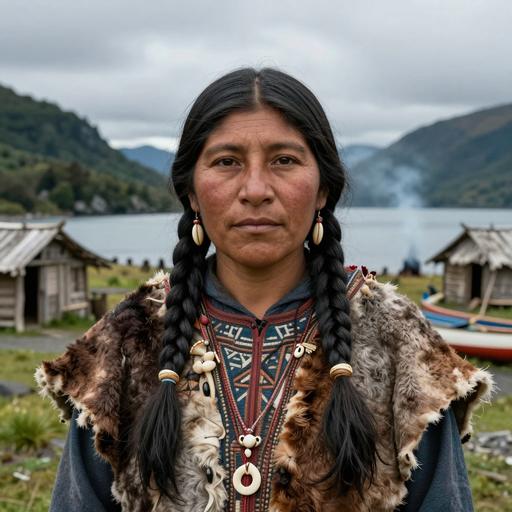
AI portrait reconstruction for A woman buried in Chile in the  era
AI-generated artistic reconstruction, not a photograph of the individual.
Record

Sample details

Recorded details and available lineage markers.

Individual

America South Pre Columbian individual, Chile

Sample ID: IPK12

Date Range

1024 CE - 1155 CE

Cultural Period

Pre-Columbian South America

Biological Sex

Female

mtDNA Haplogroup

C1b

Y-DNA Haplogroup

Not available

Social Role

Farmer (AI estimate, era-typical)

Geography

Location

Where this individual was discovered

Country Chile
Locality Strait of Magellan. Punta Santa María

A location map is not available for this record.

Chronology

Date range

When this individual lived in the broader context of human history

America South Pre Columbian individual, Chile 1024 CE - 1155 CE
Context

Historical context

Background information associated with the reference record.

Region & Environment

Pre-Columbian South America included the Andes, coastal deserts, river valleys, and tropical lowlands. These environments provided different opportunities for farming, fishing, and hunting, influencing settlement choices and the organization of subsistence. Over time, communities adapted to local water availability, soils, and seasonality.

Historical Context

This era is an archaeological framing for millennia of development prior to sustained European contact. Across the continent, records show periods of increasing complexity in some regions—such as larger centers, specialized crafts, and extensive building—alongside areas where lifeways remained comparatively local.

Populations & Lifeways

Many populations practiced agriculture in ways suited to specific ecologies, including terrace farming in mountainous regions and diversified production in other landscapes. Coastal and lowland communities often depended heavily on fishing and gathering, with cultivation also contributing where conditions allowed. Lifeways typically combined food production, craft making, and seasonal planning informed by local geography.

Archaeology & Material Culture

Material culture includes ceramics, textiles (where preserved), metal objects in some contexts, and extensive stone or earthen architecture in areas where monumental building developed. Archaeological evidence from domestic sites, storage features, burial practices, and craft-production areas provides insight into diet, social differentiation, and regional interaction.

Culture & Society

Complex ceremonial and political organization is visible in some regions through monument construction, iconography, and patterned burial practices. Yet South America’s cultural landscape was varied, and different societies followed different trajectories rather than a single uniform system.

Legacy & Transition

The transition toward the post-1492 world involved intensified external pressures and new economic and political dynamics. Even where European influence increased rapidly in some areas, earlier agricultural knowledge and cultural practices continued to shape local societies for generations.

Analysis

Genetic comparisons

These comparisons show genetic similarity, not identity or origin. The populations listed are those whose genomes show statistical alignment to this ancient individual.

Similarity reflects shared history, not shared identity. These are analytical comparisons, not claims about who this person was.

Modern Genetic Admixture

This analysis compares the DNA profile with present-day reference populations, showing statistical similarity to modern reference populations from different regions. The excavation site records where this individual was found, not a fixed modern genetic identity.

America 90.9%
America 90.9%
Native American 90.9%
Asia 8.0%
Japanese & Korean 5.0%
Japanese 5.0%
Northern Asian 3.0%
Siberian 3.0%
Africa 0.9%
African Hunter-Gatherer 0.7%

Closest Modern Populations

These are the modern populations showing the closest statistical alignment to A woman buried in Chile in the era, ranked by genetic distance. Lower distance values indicate closer statistical similarity. Cross-region similarity can reflect shared ancestry, population movement, continuity, or later admixture.

1
Aymara
2.2880
2
Bolivian Lapaz
2.5197
3
Piapoco
2.6747
4
Yukpa
2.8081
5
Colla
2.9968
6
Mixe
3.0831
7
Cachi
3.1400
8
Wichi
3.2370
9
Mayan
3.8495
10
Pima
3.9005
Context

Related Samples

This individual exists within a broader network of ancient samples. No ancient genome stands alone.

Individual Culture/Period Date Location Action
Indigenous Cultures of Southern South America individual, Chile Yamana Culture Beagle Channel, Chile 800 Years Ago 1048 CE Beagle Channel. Puerto Williams, Chile View
Indigenous Cultures of South America individual, Chile Western Archipelago Kaweskar Culture, Chile 800 Years Ago 1024 CE Strait of Magellan. Punta Santa María, Chile View
Indigenous Cultures of South America individual, Chile Western Archipelago Kaweskar Culture, Chile 1,200 Years Ago 669 CE Yekchal. Patagonia, Chile View
Indigenous Cultures of Southern South America individual, Chile Yamana Culture Beagle Channel, Chile 800 Years Ago 600 CE Beagle Channel. Hoste Island, Chile View
America South Pre Columbian individual, Chile 669 CE Yekchal. Patagonia, Chile View
America South Pre Columbian individual, Chile 600 CE Beagle Channel. Hoste Island, Chile View
America South Pre Columbian individual, Chile 1024 CE Strait of Magellan. Punta Santa María, Chile View
America South Pre Columbian individual, Chile 1048 CE Beagle Channel. Puerto Williams, Chile View
Page 1
Individual Culture/Period Date Location Action
America South Pre Columbian individual, Chile 669 CE Yekchal. Patagonia, Chile View
America South Pre Columbian individual, Chile 600 CE Beagle Channel. Hoste Island, Chile View
America South Pre Columbian individual, Brazil 1681 BCE Toca do Enoque Cave. Serra da Capivara. Piaui, Brazil View
America South Pre Columbian individual, Chile 1024 CE Strait of Magellan. Punta Santa María, Chile View
America South Pre Columbian individual, Peru 100 CE Rio Ilave Basin. Rio Uncallane, Peru View
America South Pre Columbian individual, Peru 140 CE Rio Ilave Basin. Rio Uncallane, Peru View
America South Pre Columbian individual, Peru 417 CE Rio Ilave Basin. Rio Uncallane, Peru View
America South Pre Columbian individual, Peru 225 CE Rio Ilave Basin. Rio Uncallane, Peru View
America South Pre Columbian individual, Peru 120 CE Rio Ilave Basin. Rio Uncallane, Peru View
America South Pre Columbian individual, Argentina 1400 CE Cerro Aconcagua. Mendoza Province, Argentina View
America South Pre Columbian individual, Chile 1048 CE Beagle Channel. Puerto Williams, Chile View
Page 1
Sources

References

Scientific publications and genetic data that inform this profile.

G25 Coordinates

These coordinates represent a position in genetic space, a tool for comparison, not a conclusion. You can use these to perform custom admixture analysis in G25 Studio.

IPK12,0.05617604,-0.31690202,0.110494,0.09681242,-0.1128233,-0.0111456,-0.2950306,-0.34780042,-0.0145148,-0.01640172,0.00053346,-0.0004109,-0.00098952,0.0246943,-0.00604532,0.00122828,0.0062682,0.0038462,0.0010371,-0.00203568,-0.0014123,0.00747418,-0.00309232,-0.00352884,-0.00455283
Continue in G25 Studio
Use code for 30% off • Expires Nov 16