A woman buried in Kazakhstan in the Eneolithic era

Download PDF creates a visual, rasterized copy. Use Print for selectable text and better assistive-technology support.

Loading Report

Preparing your ancestry journey

Preparing the available report content...

Your report will open automatically.

Skip to main content
Reference library / Sample profile

A woman buried in Kazakhstan in the Eneolithic era

Explore the recorded context, genetic comparisons and research behind this reference sample.

KazakhstanKazakhstan Botai Eneolithic

A reference profile describes this sample. It does not establish a personal or family relationship.

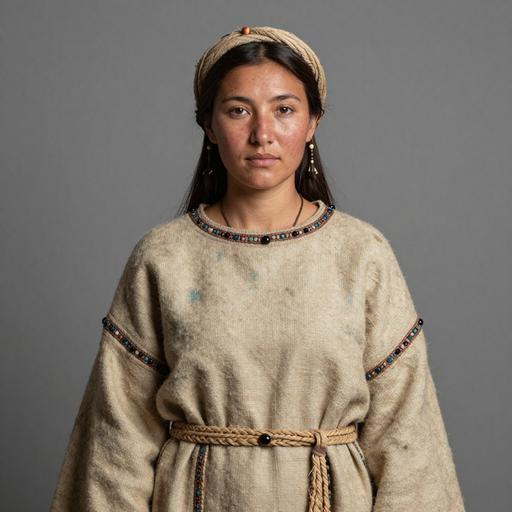
AI portrait reconstruction for A woman buried in Kazakhstan in the Eneolithic era
AI-generated artistic reconstruction, not a photograph of the individual.
Record

Sample details

Recorded details and available lineage markers.

Individual

Eurasian Steppe individual, Kazakhstan

Sample ID: BOT2016

Date Range

3516 BCE - 3371 BCE

Cultural Period

Kazakhstan Botai Eneolithic

Biological Sex

Female

mtDNA Haplogroup

Z1*

Y-DNA Haplogroup

Not available

Social Role

Pastoralist (AI estimate, era-typical)

Geography

Location

Where this individual was discovered

Country Kazakhstan
Locality Botai
Coordinates 53.1667, 67.6667
Chronology

Date range

When this individual lived in the broader context of human history

Eurasian Steppe individual, Kazakhstan 3516 BCE - 3371 BCE
Context

Historical context

Background information associated with the reference record.

The Botai Complex in Kazakhstan provides important evidence for how Eneolithic communities lived on the steppe, including key aspects of animal economies.

Region & Environment

Botai-era sites are situated in Kazakhstan’s steppe and forest-steppe environments, where grasslands and seasonal water availability supported herding. River systems and open steppe corridors facilitated movement between pastures and supported predictable access to resources.

Historical Context

During the third millennium BCE, steppe societies developed increasingly complex pastoral strategies, while surrounding regions saw ongoing changes in agriculture and metallurgy. In Kazakhstan, the Botai horizon is defined archaeologically by recurring settlement and artifact patterns rather than by named polities.

Populations & Lifeways

Botai communities are best described as herders with a mobile or semi-mobile rhythm tied to seasonal pasture. Daily life would have included livestock management, the production and repair of leather and wooden goods, and household-based craft work. The material record also reflects a distinctive relationship to horses, documented through site evidence that bears on early horse exploitation.

Archaeology & Material Culture

Archaeological remains include settlement features and artifact assemblages such as stone tools, ceramic vessels, and organic-material indicators preserved under favorable conditions at some sites. The Botai Complex is particularly noted in scholarship for evidence connected to horse use at certain locations, alongside typical pastoral material culture.

Culture & Society

Recurring patterns in settlement organization and material choices suggest shared learning and practical traditions within the Botai horizon. Differences between sites point to local adaptations—such as varying degrees of permanence or herd-management strategies—within a broader cultural framework.

Legacy & Transition

As the Eneolithic period progressed and later Bronze Age developments unfolded, steppe pastoralism continued, while technologies and exchange networks changed. The Botai horizon’s importance lies in how it illuminates early pastoral strategies that precede later steppe cultural phases across Kazakhstan and neighboring regions.

Analysis

Genetic comparisons

These comparisons show genetic similarity, not identity or origin. The populations listed are those whose genomes show statistical alignment to this ancient individual.

Similarity reflects shared history, not shared identity. These are analytical comparisons, not claims about who this person was.

Modern Genetic Admixture

This analysis compares the DNA profile with present-day reference populations, showing statistical similarity to modern reference populations from different regions. The excavation site records where this individual was found, not a fixed modern genetic identity.

Europe 52.5%
Eastern European 44.6%
Northwestern European 7.9%
Finnish 7.5%
Asia 27.6%
Northern Asian 15.7%
Siberian 15.7%
Central Asian, Northern Indian & Pakistani 12.0%
Indian 8.3%
Pakistan 3.7%
America 19.9%
America 19.9%
Native American 19.9%

Closest Modern Populations

These are the modern populations showing the closest statistical alignment to A woman buried in Kazakhstan in the Eneolithic era, ranked by genetic distance. Lower distance values indicate closer statistical similarity. Cross-region similarity can reflect shared ancestry, population movement, continuity, or later admixture.

1
Tlingit
9.1199
2
Mari
10.7445
3
Khanty O1
11.0673
4
Bashkir
11.6970
5
Tatar Siberian
12.4203
6
Udmurt
12.7265
7
Tatar Siberian Zabolotniye
12.9009
8
Chuvash
13.0559
9
Komi B
13.3101
10
Saami
13.4816
Context

Related Samples

This individual exists within a broader network of ancient samples. No ancient genome stands alone.
Individual Culture/Period Date Location Action
Eurasian Steppe individual, Kazakhstan Eneolithic Kazakhstan 3516 BCE Botai, Kazakhstan View
Botai individual, Kazakhstan 3517 BCE Botai, Kazakhstan View
Page 1
Individual Culture/Period Date Location Action
Eurasian Steppe individual, Kazakhstan Eneolithic Kazakhstan 3516 BCE Botai, Kazakhstan View
Eurasian Steppe individual, Kazakhstan Eneolithic Kazakhstan 3517 BCE Botai, Kazakhstan View
Eurasian Steppe individual, Kazakhstan Eneolithic Kazakhstan 3345 BCE Botai, Kazakhstan View
Page 1
Sources

References

Scientific publications and genetic data that inform this profile.

G25 Coordinates

These coordinates represent a position in genetic space, a tool for comparison, not a conclusion. You can use these to perform custom admixture analysis in G25 Studio.

BOT2016,0.09694162,-0.10155238,0.09277442,0.06851716,-0.04440014,-8.424E-05,-0.04418388,-0.04967626,-0.00817444,-0.03456684,0.02476682,-0.01125778,0.02603094,-0.0266568,-0.02541756,-0.02351204,-0.00936818,-0.00731912,-0.03188182,-0.02639758,0.01119732,0.0057986,-0.03510534,0.0056463,-0.00562995
Continue in G25 Studio
Use code for 30% off • Expires Nov 16