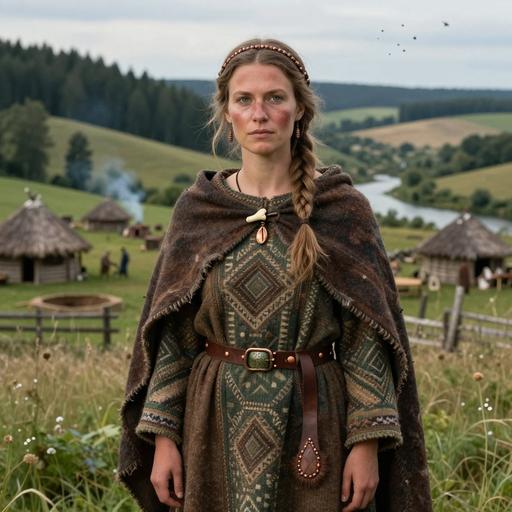
A woman buried in Poland in the Late Neolithic to Early Bronze Age era

Download PDF creates a visual, rasterized copy. Use Print for selectable text and better assistive-technology support.

Loading Report

Preparing your ancestry journey

Preparing the available report content...

Your report will open automatically.

Skip to main content
Reference library / Sample profile

A woman buried in Poland in the Late Neolithic to Early Bronze Age era

Explore the recorded context, genetic comparisons and research behind this reference sample.

PolandBell Beaker Culture Southeast Poland

A reference profile describes this sample. It does not establish a personal or family relationship.

AI portrait reconstruction for A woman buried in Poland in the Late Neolithic to Early Bronze Age era
AI-generated artistic reconstruction, not a photograph of the individual.
Record

Sample details

Recorded details and available lineage markers.

Individual

Indo-European individual, Poland

Sample ID: pcw270

Date Range

2500 BCE - 2100 BCE

Cultural Period

Bell Beaker Culture Southeast Poland

Biological Sex

Female

mtDNA Haplogroup

H

Y-DNA Haplogroup

Not available

Social Role

Farmer (AI estimate, era-typical)

Geography

Location

Where this individual was discovered

Country Poland
Locality Southeastern Poland. Pełczyska
Coordinates 50.3561, 20.5714
Chronology

Date range

When this individual lived in the broader context of human history

Indo-European individual, Poland 2500 BCE - 2100 BCE
Context

Historical context

Background information associated with the reference record.

Overview

Bell Beaker Culture in southeast Poland is dated to roughly 2900–2300 BCE and is associated with recognizable material patterns linked to the wider Bell Beaker phenomenon across Europe. Archaeology emphasizes distinctive ceramics, grave contexts, and artifacts that mark participation in broader social networks.

Region & Environment

Southeast Poland includes varied topography and river-linked travel corridors that would have supported both settlement and exchange. Productive agricultural zones and accessible resources from surrounding landscapes provided the basis for food production while facilitating movement and contact.

Historical Context

Bell Beaker horizons belong to the late 3rd millennium BCE, a period when interaction across large regions increased. In many parts of Europe, Bell Beaker material culture appears in contexts that reflect both local continuity and adoption of shared styles, especially in mortuary practice.

Populations & Lifeways

Communities were primarily rural and based on mixed farming and herding, with households maintaining everyday production of tools and domestic goods. Participation in long-distance exchange is suggested indirectly by the presence of distinctive “Beaker” items and other non-local-looking materials.

Archaeology & Material Culture

The Bell Beaker ceramic tradition is among the most diagnostic elements. Assemblages also include grave-linked objects and recurring artifact patterns that help distinguish Bell Beaker contexts from neighboring horizons in the region.

Culture & Society

Bell Beaker graves often display distinctive placements and inventories, implying that mortuary customs served as a key marker of identity. Such practices suggest shared expectations about commemoration and the social meaning of particular objects.

Legacy & Transition

After the Bell Beaker phase, subsequent regional Bronze Age developments replaced many of the earlier ceramic and burial conventions. In southeastern Poland, the transition is visible through changing assemblage characteristics and the reorganization of material signatures over time.

Analysis

Genetic comparisons

These comparisons show genetic similarity, not identity or origin. The populations listed are those whose genomes show statistical alignment to this ancient individual.

Similarity reflects shared history, not shared identity. These are analytical comparisons, not claims about who this person was.

Modern Genetic Admixture

This analysis compares the DNA profile with present-day reference populations, showing statistical similarity to modern reference populations from different regions. The excavation site records where this individual was found, not a fixed modern genetic identity.

Europe 91.8%
Northwestern European 60.5%
English 43.0%
Finnish 10.8%
Northwestern European 6.7%
Southern European 24.9%
Sardinian 10.5%
Balkan 9.7%
Iberian 4.8%
Eastern European 6.4%
Asia 7.8%
Northern West Asian 7.4%
Caucasian 7.4%

Closest Modern Populations

These are the modern populations showing the closest statistical alignment to A woman buried in Poland in the Late Neolithic to Early Bronze Age era, ranked by genetic distance. Lower distance values indicate closer statistical similarity. Cross-region similarity can reflect shared ancestry, population movement, continuity, or later admixture.

1
French Alsace
2.3754
2
French Nord
2.4765
3
Swiss German
2.6213
4
Belgianb
2.6800
5
French Seine Maritime
2.7211
6
Belgianc
2.7613
7
French Paris
2.9061
8
French Pas De Calais
2.9431
9
Afrikaner
2.9798
10
Belgiana
3.0272
Context

Related Samples

This individual exists within a broader network of ancient samples. No ancient genome stands alone.

Individual Culture/Period Date Location Action
Indo-European individual, Poland Corded Ware Culture Southeast Poland 2465 BCE Southeastern Poland. Łubcze, Poland View
Indo-European individual, Poland Corded Ware Culture Southeast Poland 2500 BCE Southeastern Poland. Łubcze, Poland View
Indo-European individual, Poland Corded Ware Culture Southeast Poland 2571 BCE Southeastern Poland. Święte, Poland View
Indo-European individual, Poland Bell Beaker Culture Southeast Poland 2455 BCE Southeastern Poland. Pełczyska, Poland View
Indo-European individual, Poland Corded Ware Culture Southeast Poland 2469 BCE Southeastern Poland. Święte, Poland View
Indo-European individual, Poland Corded Ware Culture Southeast Poland 2500 BCE Southeastern Poland. Chłopice, Poland View
Indo-European individual, Poland Bell Beaker Culture Southeast Poland 2500 BCE Southeastern Poland. Pełczyska, Poland View
Indo-European individual, Poland Corded Ware Culture Southeast Poland 2469 BCE Southeastern Poland. Święte, Poland View
Indo-European individual, Poland Corded Ware Culture Southeast Poland 2571 BCE Southeastern Poland. Święte, Poland View
Indo-European individual, Poland Corded Ware Culture Southeast Poland 2462 BCE Southeastern Poland. Łubcze, Poland View
Indo-European individual, Poland Corded Ware Culture Southeast Poland 2455 BCE Southeastern Poland. Skołoszów, Poland View
Indo-European individual, Poland Corded Ware Culture Southeast Poland 2500 BCE Southeastern Poland. Bosutów, Poland View
Indo-European individual, Poland Bell Beaker Culture Southeast Poland 2500 BCE Southeastern Poland. Pełczyska, Poland View
Indo-European individual, Poland Corded Ware Culture Southeast Poland 2500 BCE Southeastern Poland. Mistrzejowice, Poland View
Indo-European individual, Poland Corded Ware Culture Southeast Poland 2617 BCE Southeastern Poland. Chłopice, Poland View
Indo-European individual, Poland Corded Ware Culture Southeast Poland 2500 BCE Southeastern Poland. Szczytna, Poland View
Indo-European individual, Poland Corded Ware Culture Southeast Poland 2500 BCE Southeastern Poland. Proszowice, Poland View
Indo-European individual, Poland Corded Ware Culture Southeast Poland 2463 BCE Southeastern Poland. Mirocin, Poland View
Indo-European individual, Poland Corded Ware Culture Southeast Poland 2500 BCE Southeastern Poland. Święte, Poland View
Niche Graves individual, Poland 2571 BCE Southeastern Poland. Święte, Poland View
Niche Graves individual, Poland 2469 BCE Southeastern Poland. Święte, Poland View
Niche Graves individual, Poland 2500 BCE Southeastern Poland. Święte, Poland View
Niche Graves individual, Poland 2469 BCE Southeastern Poland. Święte, Poland View
Niche Graves individual, Poland 2500 BCE Southeastern Poland. Szczytna, Poland View
Niche Graves individual, Poland 2463 BCE Southeastern Poland. Mirocin, Poland View
Niche Graves individual, Poland 2455 BCE Southeastern Poland. Skołoszów, Poland View
Niche Graves individual, Poland 2500 BCE Southeastern Poland. Chłopice, Poland View
Niche Graves individual, Poland 2617 BCE Southeastern Poland. Chłopice, Poland View
Niche Graves individual, Poland 2500 BCE Southeastern Poland. Mistrzejowice, Poland View
Bell Beaker individual, Poland 2455 BCE Southeastern Poland. Pełczyska, Poland View
Bell Beaker individual, Poland 2500 BCE Southeastern Poland. Pełczyska, Poland View
Niche Graves individual, Poland 2462 BCE Southeastern Poland. Łubcze, Poland View
Niche Graves individual, Poland 2500 BCE Southeastern Poland. Łubcze, Poland View
Niche Graves individual, Poland 2465 BCE Southeastern Poland. Łubcze, Poland View
Niche Graves individual, Poland 2500 BCE Southeastern Poland. Proszowice, Poland View
Niche Graves individual, Poland 2500 BCE Southeastern Poland. Bosutów, Poland View
Page 1
Individual Culture/Period Date Location Action
Indo-European individual, Poland Bell Beaker Culture Southeast Poland 2455 BCE Southeastern Poland. Pełczyska, Poland View
Indo-European individual, Poland Bell Beaker Culture Southeast Poland 2500 BCE Southeastern Poland. Pełczyska, Poland View
Page 1
Sources

References

Scientific publications and genetic data that inform this profile.

G25 Coordinates

These coordinates represent a position in genetic space, a tool for comparison, not a conclusion. You can use these to perform custom admixture analysis in G25 Studio.

pcw270,0.12356824,0.12694212,0.04082822,0.02255782,0.0358958,0.01034224,-0.00509576,-0.0009177,0.01284936,0.00877312,-0.0057702,0.00660286,-0.00155532,-0.00726994,0.007018,0.00259842,-0.00514268,0.00117236,-0.0007462,-0.00112046,0.00504278,0.00445636,-0.00096918,0.0033234,-0.00014595
Continue in G25 Studio
Use code for 30% off • Expires Nov 16