A woman buried in Spain in the era

Download PDF creates a visual, rasterized copy. Use Print for selectable text and better assistive-technology support.

Loading Report

Preparing your ancestry journey

Preparing the available report content...

Your report will open automatically.

Skip to main content
Reference library / Sample profile

A woman buried in Spain in the era

Explore the recorded context, genetic comparisons and research behind this reference sample.

SpainEarly Neolithic Iberia

A reference profile describes this sample. It does not establish a personal or family relationship.

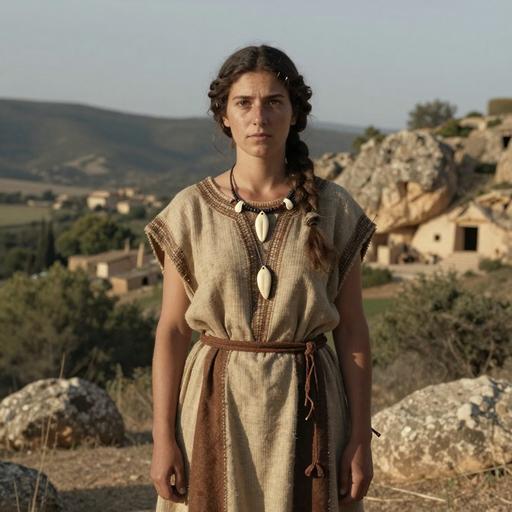
AI portrait reconstruction for A woman buried in Spain in the  era
AI-generated artistic reconstruction, not a photograph of the individual.
Record

Sample details

Recorded details and available lineage markers.

Individual

Iberia En individual, Spain

Sample ID: CB13

Date Range

5474 BCE - 5318 BCE

Cultural Period

Early Neolithic Iberia

Biological Sex

Female

mtDNA Haplogroup

K1a2a

Y-DNA Haplogroup

Not available

Social Role

Farmer (AI estimate, era-typical)

Geography

Location

Where this individual was discovered

Country Spain
Locality Cova Bonica. Vallirana. Barcelona
Coordinates 41.3700, 1.8900
Chronology

Date range

When this individual lived in the broader context of human history

Iberia En individual, Spain 5474 BCE - 5318 BCE
Context

Historical context

Background information associated with the reference record.

Overview

Early Neolithic Iberia corresponds to the earliest phases of Neolithic lifeways in the peninsula, when domesticated agriculture and herding became established in local contexts. These communities maintained varying regional traditions while sharing broad technological and subsistence strategies associated with early farming.

Region & Environment

Iberia’s environmental diversity—coastal zones, river valleys, plains, and uplands—provided multiple settings for early farming. Fertile soils near water sources supported cultivation, while surrounding landscapes could be used for grazing and foraging, helping stabilize village-based life.

Historical Context

The Early Neolithic is defined archaeologically by the appearance of domesticated economies and associated technologies. In many areas, this period involved the formation of farming networks and gradually expanding settlement, though the pace and character of adoption differed by region.

Populations & Lifeways

Populations were organized around village life with domesticated animals and crops forming the core of subsistence. Household labor included tending fields, processing plant foods, and managing herds. Communities likely also continued using wild resources as supplements, but the central feature was dependence on cultivation and herding.

Archaeology & Material Culture

Archaeology for Early Neolithic Iberia frequently emphasizes:

  • Pottery vessels and other ceramic technologies associated with storage and cooking
  • Ground-stone tools for grinding and food processing
  • Lithic toolkits suited to daily work, often still including flaked stone components Where preserved, architecture and pits or other features can indicate sedentary or semi-sedentary settlement.

Culture & Society

Social identity in early farming communities can be approached through style and practice in ceramics, house layouts, and burial patterns. These choices demonstrate communal norms and shared technical traditions, even as regional differences reflect local histories.

Legacy & Transition

Early Neolithic settlements and material traditions formed a foundation for later Chalcolithic and Bronze Age developments. Transitions are traced archaeologically through changing pottery styles, new toolmaking preferences, and shifts in settlement scale and organization.

Analysis

Genetic comparisons

These comparisons show genetic similarity, not identity or origin. The populations listed are those whose genomes show statistical alignment to this ancient individual.

Similarity reflects shared history, not shared identity. These are analytical comparisons, not claims about who this person was.

Modern Genetic Admixture

This analysis compares the DNA profile with present-day reference populations, showing statistical similarity to modern reference populations from different regions. The excavation site records where this individual was found, not a fixed modern genetic identity.

Europe 100.0%
Southern European 100.0%
Italian 37.7%
Sardinian 32.9%
Iberian 29.4%

Closest Modern Populations

These are the modern populations showing the closest statistical alignment to A woman buried in Spain in the era, ranked by genetic distance. Lower distance values indicate closer statistical similarity. Cross-region similarity can reflect shared ancestry, population movement, continuity, or later admixture.

1
Sardinian
2.0446
Context

Related Samples

This individual exists within a broader network of ancient samples. No ancient genome stands alone.

Individual Culture/Period Date Location Action
Western European Neolithic individual, Spain Early Neolithic Spain 5474 BCE Cova Bonica. Vallirana. Barcelona, Spain View
Iberia En individual, Spain 5474 BCE Cova Bonica. Vallirana. Barcelona, Spain View
Page 1
Individual Culture/Period Date Location Action
Iberia En individual, Spain 5474 BCE Cova Bonica. Vallirana. Barcelona, Spain View
Iberia En individual, Spain 5214 BCE Atapuerca. El Portalón, Spain View
Iberia En individual, Spain 5036 BCE El Toro, Spain View
Iberia En individual, Spain 5100 BCE El Toro, Spain View
Page 1
Sources

References

Scientific publications and genetic data that inform this profile.

G25 Coordinates

These coordinates represent a position in genetic space, a tool for comparison, not a conclusion. You can use these to perform custom admixture analysis in G25 Studio.
CB13,0.11593874,0.16124658,0.0222075,-0.0463201,0.05749548,-0.02296556,-0.00289354,0.00560682,0.04045722,0.0718656,-0.00357322,0.01445804,-0.02563624,-0.01464754,-0.01154962,0.00481162,0.014242,-0.00043004,-0.0013309,-0.00392454,-0.00088006,0.00351708,-0.01167152,-0.01957444,0.00449034
Continue in G25 Studio
Use code for 30% off • Expires Nov 16