
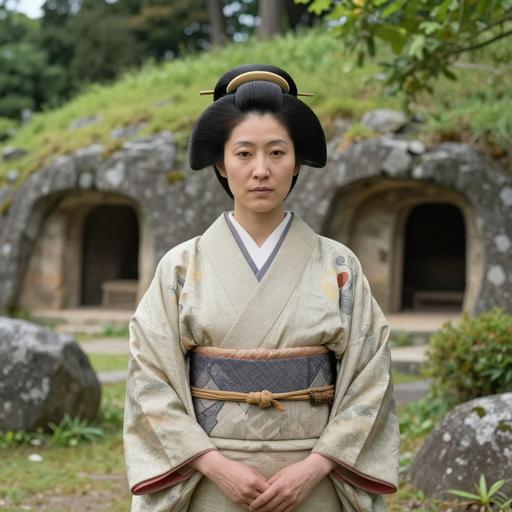
A woman buried in Japan in the Kofun Period era

Download PDF creates a visual, rasterized copy. Use Print for selectable text and better assistive-technology support.

Loading Report

Preparing your ancestry journey

Preparing the available report content...

Your report will open automatically.

Skip to main content
Reference library / Sample profile

A woman buried in Japan in the Kofun Period era

Explore the recorded context, genetic comparisons and research behind this reference sample.

JapanKofun Period Japan

A reference profile describes this sample. It does not establish a personal or family relationship.

AI portrait reconstruction for A woman buried in Japan in the Kofun Period era
AI-generated artistic reconstruction, not a photograph of the individual.
Record

Sample details

Recorded details and available lineage markers.

Individual

Kofun Period individual, Japan

Sample ID: JpIw31

Date Range

573 CE - 647 CE

Cultural Period

Kofun Period Japan

Biological Sex

Female

mtDNA Haplogroup

D5c1a

Y-DNA Haplogroup

Not available

Social Role

Farmer (AI estimate, era-typical)

Geography

Location

Where this individual was discovered

Country Japan
Locality Honshu. Ishikawa Prefecture. Kanazawa. Iwade horizontal cave tombs
Chronology

Date range

When this individual lived in the broader context of human history

Kofun Period individual, Japan 573 CE - 647 CE
Context

Historical context

Background information associated with the reference record.

The Kofun period, lasting from approximately the mid-3rd century to the early 7th century, is a pivotal era in Japanese history, marking significant political, social, and cultural transformations. It is named after the large tumulus mounds, called \kofun," that were constructed as burial sites for the ruling elite during this time. The period witnessed the emergence of a more centralized state structure and the establishment of key cultural practices that would persist throughout Japanese history.

Political Structure and Society

  1. Emergence of Powerful Clans:

    • The Kofun period is characterized by the dominance of powerful regional clans known as "uji," each led by a chieftain. The Yamato clan eventually emerged as the most influential, coming to dominate much of the archipelago.
    • These clans were integral to the formation of a more centralized authority, with the Yamato leaders leveraging alliances and military might to assert control over surrounding regions.
  2. Centralization and State Formation:

    • The consolidation of political power under the Yamato court laid the groundwork for a more unified Japanese state.
    • Influences from the Korean Peninsula and China, including bureaucratic and administrative techniques, played a significant role in this centralization process.
  3. Social Hierarchy:

    • Society was hierarchically structured, with a clear division between the elite ruling class and commoners.
    • The elite were distinguished by their political power, wealth, and access to prestigious goods obtained through trade and tribute.

Culture and Religion

  1. Shinto Practices:

    • Indigenous religious beliefs, which would later be codified as Shinto, were prevalent. These involved the worship of kami (spirits or gods) associated with natural phenomena, ancestors, and important clan deities.
    • Ritual practices and ceremonies were important in both political and social contexts, serving as a means to legitimize the power of the ruling elite.
  2. Burial Mounds (Kofun):

    • The kofun themselves are key cultural artifacts from this period. These earthen mounds, often shaped like keyholes, served as tombs for the elite and symbolize the hierarchical nature of Kofun society.
    • The tombs were accompanied by grave goods, including bronze mirrors, iron weapons, and clay haniwa figures, which provide insights into the material culture and beliefs of the time.
  3. Art and Artifacts:

    • Haniwa figures, made of terracotta, are among the most distinctive artifacts of this era. They served both decorative and ritual purposes, often being placed around the kofun.
    • The period also saw the production of sophisticated metalwork and pottery, indicating advanced craftsmanship and trade links with neighboring cultures.

Economic and Technological Developments

  1. Agriculture and Land Management:

    • Advances in agricultural techniques led to increased productivity, which supported population growth and the development of larger settlements.
    • Rice cultivation continued to be the backbone of the economy, with agricultural surplus allowing for the support of a warrior and artisan class.
  2. Trade and External Relations:

    • The Kofun period was marked by active trade and cultural exchanges with the Korean Peninsula and China. This led to the introduction of new technologies, such as ironworking and advanced pottery techniques.
    • External influences also extended to military practices, architecture, and the adaptation of Chinese writing, which would lay the groundwork for the development of the Japanese script.

In conclusion, the Kofun period is critical to understanding the transition of Japan from fragmented tribal societies to a more unified state with a rich cultural identity. It set the stage for the subsequent Asuka period, during which Japan would further embrace continental influences and continue its transformation into a more sophisticated and centralized state. The legacy of the Kofun period is still visible today in Japan's cultural and historical landscape, particularly through its burial mounds and the enduring influence of early clan cultures."

Analysis

Genetic comparisons

These comparisons show genetic similarity, not identity or origin. The populations listed are those whose genomes show statistical alignment to this ancient individual.

Similarity reflects shared history, not shared identity. These are analytical comparisons, not claims about who this person was.

Modern Genetic Admixture

This analysis compares the DNA profile with present-day reference populations, showing statistical similarity to modern reference populations from different regions. The excavation site records where this individual was found, not a fixed modern genetic identity.

Asia 98.8%
Japanese & Korean 66.2%
Japanese 66.2%
Chinese & Southeast Asian 27.1%
Chinese 27.1%
Northern Asian 5.5%
Mongolian 3.4%
Siberian 2.1%
Africa 1.2%
West African 1.2%
Senegambian & Guinean 1.2%

Closest Modern Populations

These are the modern populations showing the closest statistical alignment to A woman buried in Japan in the Kofun Period era, ranked by genetic distance. Lower distance values indicate closer statistical similarity. Cross-region similarity can reflect shared ancestry, population movement, continuity, or later admixture.

1
Korean
2.5233
2
Korean Antu
2.5462
3
Japanese
3.5226
4
Manchu
3.5912
5
Manchu Jinzhou
3.8545
6
Han Shandong
4.0980
7
Manchu Liaoning
4.1949
8
Han Henan
4.2088
9
Han Shanxi
4.2309
10
Mongola
4.5766
Context

Related Samples

This individual exists within a broader network of ancient samples. No ancient genome stands alone.

Individual Culture/Period Date Location Action
Honshu Early Jomon individual, Japan Early Jomon Period Japan 3,640-3,528 BCE Honshu. Kurashiki. Funagura Shell Midden, Japan View
Honshu Early Jomon individual, Japan Early Jomon Period Japan 3,967-3,801 BCE Honshu. Toyama. Kureha Hills. Odake Shell Midden, Japan View
Honshu Early Jomon individual, Japan Early Jomon Period Japan 4,339-4,169 BCE Honshu. Toyama. Kureha Hills. Odake Shell Midden, Japan View
Honshu Early Jomon individual, Japan Early Jomon Period Japan 3,952-3,787 BCE Honshu. Toyama. Kureha Hills. Odake Shell Midden, Japan View
Honshu Early Jomon individual, Japan Early Jomon Period Japan 4,229-3,984 BCE Honshu. Toyama. Kureha Hills. Odake Shell Midden, Japan View
Kofun Period individual, Japan Kofun Period Japan 573-647 CE Honshu. Ishikawa Prefecture. Kanazawa. Iwade horizontal cave tombs, Japan View
Kofun Period individual, Japan Kofun Period Japan 541-603 CE Honshu. Ishikawa Prefecture. Kanazawa. Iwade horizontal cave tombs, Japan View
Kofun Period individual, Japan Kofun Period Japan 595-655 CE Honshu. Ishikawa Prefecture. Kanazawa. Iwade horizontal cave tombs, Japan View
Honshu Mid Late Jomon individual, Japan The Jomon Period in Japan 2,028-1,897 BCE Honshu. Funabashi. Kosaku Shell Midden, Japan View
Honshu Mid Late Jomon individual, Japan The Jomon Period in Japan 2,564-2,344 BCE Honshu. Funabashi. Kosaku Shell Midden, Japan View
Shikoku Initial Jomon individual, Japan The Initial Jomon Period in Japan 7,041-6,696 BCE Shikoku. Ehime Prefecture. Kamiukena District. Kamikuroiwa Rock Shelter, Japan View
Shikoku Late Joman individual, Japan The Jomon Period in Japan 1,900-1,735 BCE Shikoku. Ainan. Hijaro Shell Midden, Japan View
Page 1
Individual Culture/Period Date Location Action
Kofun Period individual, Japan Kofun Period Japan 573-647 CE Honshu. Ishikawa Prefecture. Kanazawa. Iwade horizontal cave tombs, Japan View
Kofun Period individual, Japan Kofun Period Japan 541-603 CE Honshu. Ishikawa Prefecture. Kanazawa. Iwade horizontal cave tombs, Japan View
Kofun Period individual, Japan Kofun Period Japan 595-655 CE Honshu. Ishikawa Prefecture. Kanazawa. Iwade horizontal cave tombs, Japan View
Page 1
Sources

References

Scientific publications and genetic data that inform this profile.

G25 Coordinates

These coordinates represent a position in genetic space, a tool for comparison, not a conclusion. You can use these to perform custom admixture analysis in G25 Studio.

JpIw31,0.02467062,-0.44927158,0.01572176,-0.05816908,0.03552922,0.00856816,0.00696824,0.00484116,-0.00424582,0.00721398,-0.0550572,-0.00560326,0.00809076,-0.00958442,-0.00874166,-0.00391104,-0.00036856,0.00051582,0.00306958,-0.00344614,0.01645476,-0.00998776,0.00565384,0.00341588,-0.01793728
Continue in G25 Studio

Our analyses use reference samples for comparison. A sample’s place, period and source help explain how to interpret a match.

Use code for 35% off • Expires Nov 30