
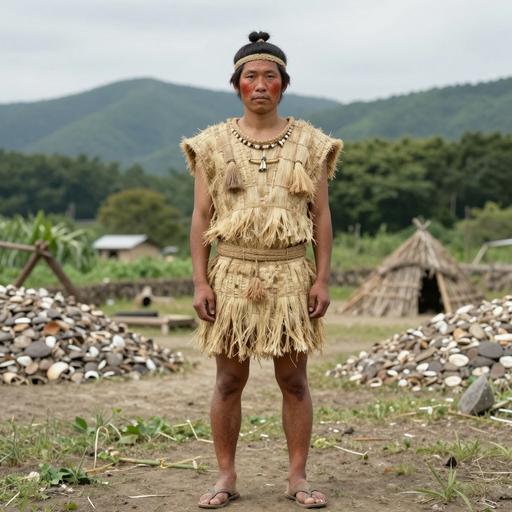
A man buried in Japan in the Copper Age era

Download PDF creates a visual, rasterized copy. Use Print for selectable text and better assistive-technology support.

Loading Report

Preparing your ancestry journey

Preparing the available report content...

Your report will open automatically.

Skip to main content
Reference library / Sample profile

A man buried in Japan in the Copper Age era

Explore the recorded context, genetic comparisons and research behind this reference sample.

JapanJapan Honshu EarlyJomon

A reference profile describes this sample. It does not establish a personal or family relationship.

AI portrait reconstruction for A man buried in Japan in the Copper Age era
AI-generated artistic reconstruction, not a photograph of the individual.
Record

Sample details

Recorded details and available lineage markers.

Individual

Honshu Early Jomon individual, Japan

Sample ID: JpOd282

Date Range

3952 BCE - 3787 BCE

Cultural Period

Japan Honshu EarlyJomon

Biological Sex

Male

mtDNA Haplogroup

M7a1

Y-DNA Haplogroup

D-Y11739

Social Role

Gatherer (AI estimate, era-typical)

Geography

Location

Where this individual was discovered

Country Japan
Locality Honshu. Toyama. Kureha Hills. Odake Shell Midden
Chronology

Date range

When this individual lived in the broader context of human history

Honshu Early Jomon individual, Japan 3952 BCE - 3787 BCE
Context

Historical context

Background information associated with the reference record.

Region & Environment

Early Jōmon sites on Honshū were distributed across varied environments, including coastlines, river valleys, and forested uplands. Stable marine and terrestrial food resources supported seasonal rounds, while changing climates and local ecologies influenced where groups camped and how they exploited particular habitats.

Historical Context

The Early Jōmon period falls in the early Holocene, when foraging societies across the Japanese archipelago expanded and diversified in their subsistence strategies. Rather than being defined by states or writing, the era is best understood through regional continuity in settlement and technology. Over time, differences in pottery styles and settlement practices helped archaeologists distinguish subphases within the broader Jōmon tradition.

Populations & Lifeways

Jōmon populations were hunter-gatherers who relied on fishing, hunting, and gathering, with diets shaped by local availability of resources. Communities organized their movement around seasonal opportunities, and archaeological evidence for repeated use of places suggests that many areas were used for long-term returns. Social life likely involved cooperation within extended household or community networks, reflected indirectly in shared ceramic and craft traditions.

Archaeology & Material Culture

The most distinctive marker of Early Jōmon archaeology is pottery, including early phases of Jōmon-style wares characterized by patterned decoration. Settlements often include semi-permanent or repeatedly used sites, where refuse deposits and hearth-related features can preserve evidence of food processing. Lithic tools used for cutting, scraping, and woodworking, along with bone and shell items where present, indicate broad exploitation of both plant and animal resources.

Culture & Society

Jōmon society is typically reconstructed from household-scale remains rather than from monumental architecture or written records. Pottery styles and manufacturing choices suggest shared cultural knowledge transmitted within and among communities. Decorative traditions, craft production, and the repeated use of sites imply social routines that supported identity and coordination, even without centralized political institutions.

Legacy & Transition

Early Jōmon lifeways and ceramic traditions formed a foundation for later Jōmon developments on Honshū. As the Jōmon sequence continued, archaeologists observe changes in pottery styles, settlement organization, and regional patterns that indicate shifts in cultural practices over time. The period’s material legacy—especially distinctive ceramics—remains essential for tracing how foraging societies changed yet retained recognizable continuity.

Analysis

Genetic comparisons

These comparisons show genetic similarity, not identity or origin. The populations listed are those whose genomes show statistical alignment to this ancient individual.

Similarity reflects shared history, not shared identity. These are analytical comparisons, not claims about who this person was.

Modern Genetic Admixture

This analysis compares the DNA profile with present-day reference populations, showing statistical similarity to modern reference populations from different regions. The excavation site records where this individual was found, not a fixed modern genetic identity.

Asia 95.2%
Japanese & Korean 82.5%
Japanese 82.5%
Central Asian, Northern Indian & Pakistani 12.7%
Indian 12.7%
Oceania 3.7%
Melanesian 3.7%
Papuan 3.7%
Europe 1.1%
Northwestern European 1.1%

Closest Modern Populations

These are the modern populations showing the closest statistical alignment to A man buried in Japan in the Copper Age era, ranked by genetic distance. Lower distance values indicate closer statistical similarity. Cross-region similarity can reflect shared ancestry, population movement, continuity, or later admixture.

1
Tamang
4.0623
2
Nepali Tamang Simigaon
4.1337
3
Magar
4.1509
4
Gurung
5.0593
5
Nepali Tamang Tashinam
6.1839
6
Yuku
6.6296
7
Nepali Sherpa Rolwaling
7.0555
8
Tibetan Xunhua
7.0571
9
Dongxiang
7.1337
10
Salar
7.1851
Context

Related Samples

This individual exists within a broader network of ancient samples. No ancient genome stands alone.

Individual Culture/Period Date Location Action
Honshu Early Jomon individual, Japan Early Jomon Period Japan 3,640-3,528 BCE Honshu. Kurashiki. Funagura Shell Midden, Japan View
Honshu Early Jomon individual, Japan Early Jomon Period Japan 3,967-3,801 BCE Honshu. Toyama. Kureha Hills. Odake Shell Midden, Japan View
Honshu Early Jomon individual, Japan Early Jomon Period Japan 4,339-4,169 BCE Honshu. Toyama. Kureha Hills. Odake Shell Midden, Japan View
Honshu Early Jomon individual, Japan Early Jomon Period Japan 3,952-3,787 BCE Honshu. Toyama. Kureha Hills. Odake Shell Midden, Japan View
Honshu Early Jomon individual, Japan Early Jomon Period Japan 4,229-3,984 BCE Honshu. Toyama. Kureha Hills. Odake Shell Midden, Japan View
Kofun Period individual, Japan Kofun Period Japan 573-647 CE Honshu. Ishikawa Prefecture. Kanazawa. Iwade horizontal cave tombs, Japan View
Kofun Period individual, Japan Kofun Period Japan 541-603 CE Honshu. Ishikawa Prefecture. Kanazawa. Iwade horizontal cave tombs, Japan View
Kofun Period individual, Japan Kofun Period Japan 595-655 CE Honshu. Ishikawa Prefecture. Kanazawa. Iwade horizontal cave tombs, Japan View
Honshu Mid Late Jomon individual, Japan The Jomon Period in Japan 2,028-1,897 BCE Honshu. Funabashi. Kosaku Shell Midden, Japan View
Honshu Mid Late Jomon individual, Japan The Jomon Period in Japan 2,564-2,344 BCE Honshu. Funabashi. Kosaku Shell Midden, Japan View
Shikoku Initial Jomon individual, Japan The Initial Jomon Period in Japan 7,041-6,696 BCE Shikoku. Ehime Prefecture. Kamiukena District. Kamikuroiwa Rock Shelter, Japan View
Shikoku Late Joman individual, Japan The Jomon Period in Japan 1,900-1,735 BCE Shikoku. Ainan. Hijaro Shell Midden, Japan View
Page 1
Individual Culture/Period Date Location Action
Honshu Early Jomon individual, Japan Early Jomon Period Japan 3,640-3,528 BCE Honshu. Kurashiki. Funagura Shell Midden, Japan View
Honshu Early Jomon individual, Japan Early Jomon Period Japan 3,967-3,801 BCE Honshu. Toyama. Kureha Hills. Odake Shell Midden, Japan View
Honshu Early Jomon individual, Japan Early Jomon Period Japan 4,339-4,169 BCE Honshu. Toyama. Kureha Hills. Odake Shell Midden, Japan View
Honshu Early Jomon individual, Japan Early Jomon Period Japan 3,952-3,787 BCE Honshu. Toyama. Kureha Hills. Odake Shell Midden, Japan View
Honshu Early Jomon individual, Japan Early Jomon Period Japan 4,229-3,984 BCE Honshu. Toyama. Kureha Hills. Odake Shell Midden, Japan View
Page 1
Sources

References

Scientific publications and genetic data that inform this profile.

G25 Coordinates

These coordinates represent a position in genetic space, a tool for comparison, not a conclusion. You can use these to perform custom admixture analysis in G25 Studio.

JpOd282,0.01096972,-0.35703278,-0.0174777,-0.00468638,0.0026599,-0.00764384,0.0085616,0.00729614,0.01194946,0.01122996,-0.05442022,-0.00438192,0.00616734,0.00131254,-0.0062657,-0.00608294,0.00360962,-0.00100672,-0.00332566,0.00080278,0.0023756,0.01450018,0.00423032,0.00355118,0.0232325
Continue in G25 Studio

Our analyses use reference samples for comparison. A sample’s place, period and source help explain how to interpret a match.

Use code for 35% off • Expires Nov 30