A man buried in Taiwan in the Late Iron Age era

Download PDF creates a visual, rasterized copy. Use Print for selectable text and better assistive-technology support.

Loading Report

Preparing your ancestry journey

Preparing the available report content...

Your report will open automatically.

Skip to main content
Reference library / Sample profile

A man buried in Taiwan in the Late Iron Age era

Explore the recorded context, genetic comparisons and research behind this reference sample.

TaiwanTaiwan Gongguan

A reference profile describes this sample. It does not establish a personal or family relationship.

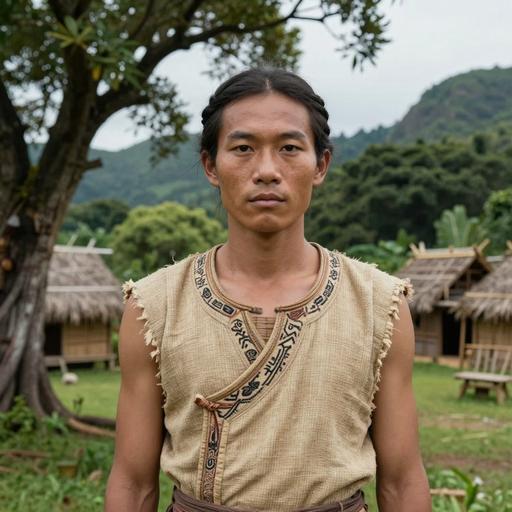
AI portrait reconstruction for A man buried in Taiwan in the Late Iron Age era
AI-generated artistic reconstruction, not a photograph of the individual.
Record

Sample details

Recorded details and available lineage markers.

Individual

Gongguan individual, Taiwan

Sample ID: I13722

Date Range

250 CE - 650 CE

Cultural Period

Taiwan Gongguan

Biological Sex

Male

mtDNA Haplogroup

Y2a1

Y-DNA Haplogroup

Not available

Social Role

Farmer (AI estimate, era-typical)

Geography

Location

Where this individual was discovered

Country Taiwan
Locality Green Island. Gongguan site
Chronology

Date range

When this individual lived in the broader context of human history

Gongguan individual, Taiwan 250 CE - 650 CE
Context

Historical context

Background information associated with the reference record.

Late Neolithic communities at Gongguan (in Taiwan) lived through farming and fishing economies shaped by coastal and riverine landscapes. Archaeological patterns from this period highlight changing settlement organization and distinctive ceramic traditions. These communities form a key backdrop for later developments in Taiwanese prehistory.

Region & Environment

Taiwan’s Late Neolithic is generally associated with the island’s varied environments, especially lowland settings near coasts and river valleys where cultivation and fishing were practical. The monsoon-influenced climate supported abundant plant and animal resources, while upland zones offered additional foraging opportunities and raw materials.

Historical Context

During the later Neolithic on Taiwan (as commonly periodized by regional archaeological schemes), communities were increasingly engaged in settled or semi-settled lifeways supported by plant cultivation, with fishing and hunting continuing to contribute to subsistence. This period precedes the widespread adoption of iron-working technologies that are characteristic of later Taiwanese Iron Age sequences.

Populations & Lifeways

People in this timeframe likely lived in small village clusters and practiced mixed subsistence. Agricultural work would have focused on locally available crops, complemented by seafood (coastal and estuarine resources) and terrestrial hunting/foraging. Daily life would have included food processing, vessel use for storage and cooking, and maintaining household tools.

Archaeology & Material Culture

Gongguan is chiefly discussed through its distinctive archaeological signatures, especially ceramics and associated stone tool industries typical of Taiwanese Neolithic horizons. Pottery styles and production choices provide a primary means of comparing sites within the period. Grinding and cutting stone tools, along with refuse deposits and settlement features, are key evidence for food processing and household activities.

Culture & Society

Material culture suggests organized household production and shared technological traditions across communities, reflected in recurring patterns of ceramic manufacture and tool forms. While the scale of social differentiation is difficult to quantify conservatively, village life implies cooperation in daily tasks such as cultivation cycles, fishing, and craft production. Regional variation in pottery and site organization may indicate multiple interacting local groups.

Legacy & Transition

The Late Neolithic horizon represented by Gongguan sets conditions for later transitions in Taiwanese prehistory—especially changes in settlement patterns, craft traditions, and subsistence organization. Subsequent periods (including later Iron Age developments) build on these earlier agricultural and ceramic traditions while introducing new technological and cultural markers.

Analysis

Genetic comparisons

These comparisons show genetic similarity, not identity or origin. The populations listed are those whose genomes show statistical alignment to this ancient individual.

Similarity reflects shared history, not shared identity. These are analytical comparisons, not claims about who this person was.

Modern Genetic Admixture

This analysis compares the DNA profile with present-day reference populations, showing statistical similarity to modern reference populations from different regions. The excavation site records where this individual was found, not a fixed modern genetic identity.
Asia 98.8%
Chinese & Southeast Asian 82.7%
Chinese 68.4%
Indonesian Khmer Thai Myanma 14.2%
Japanese & Korean 16.1%
Japanese 16.1%
Africa 1.3%
Congolese & Southern East African 1.3%
South East African 1.3%

Closest Modern Populations

These are the modern populations showing the closest statistical alignment to A man buried in Taiwan in the Late Iron Age era, ranked by genetic distance. Lower distance values indicate closer statistical similarity. Cross-region similarity can reflect shared ancestry, population movement, continuity, or later admixture.

1
Dai
2.7305
2
Kinh Vietnam
2.7485
3
Tai Lue
3.0301
4
Gelao
3.5350
5
Zhuang
3.9438
6
Maonan
4.1628
7
Mulam
4.1992
8
Lao
4.2620
9
Li
4.2947
10
Lahu
4.3923
Context

Related Samples

This individual exists within a broader network of ancient samples. No ancient genome stands alone.

Individual Culture/Period Date Location Action
EIA Slab Grave-1 individual, Mongolia Early Iron Age Slab Grave Culture 1, Mongolia 782-567 BCE Khentii. Delgerkhaan sum. Khanan Tomb 1a, Mongolia View
Gongguan individual, Taiwan Gongguan Culture 250-650 CE Green Island. Gongguan site, Taiwan View
IA individual, Taiwan Iron Age Taiwan 1-800 CE Hanben. Blihun site, Taiwan View
Page 1
Individual Culture/Period Date Location Action
Gongguan individual, Taiwan Gongguan Culture 1,366-1,126 BCE Green Island. Gongguan site, Taiwan View
Gongguan individual, Taiwan Gongguan Culture 250-650 CE Green Island. Gongguan site, Taiwan View
Page 1
Sources

References

Scientific publications and genetic data that inform this profile.

G25 Coordinates

These coordinates represent a position in genetic space, a tool for comparison, not a conclusion. You can use these to perform custom admixture analysis in G25 Studio.

I13722,0.01421396,-0.42807672,-0.05492272,-0.04797024,0.1179174,0.04439032,-0.00087936,-0.00483216,-0.0190938,-0.01145392,0.00927012,0.0015498,0.00430816,-0.00785488,0.00219832,0.00202376,0.00789592,-0.00378376,-0.00254824,-0.01100096,0.01177116,0.01084348,0.01591724,0.00465108,0.00593004
Continue in G25 Studio

Our analyses use reference samples for comparison. A sample’s place, period and source help explain how to interpret a match.

Use code for 35% off • Expires Nov 30