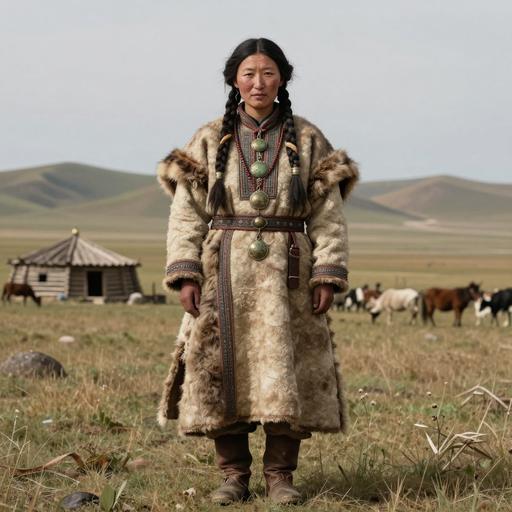
A woman buried in Mongolia in the Early Iron Age era

Download PDF creates a visual, rasterized copy. Use Print for selectable text and better assistive-technology support.

Loading Report

Preparing your ancestry journey

Preparing the available report content...

Your report will open automatically.

Skip to main content
Reference library / Sample profile

A woman buried in Mongolia in the Early Iron Age era

Explore the recorded context, genetic comparisons and research behind this reference sample.

MongoliaMongolia EIA SlabGrave 1

A reference profile describes this sample. It does not establish a personal or family relationship.

AI portrait reconstruction for A woman buried in Mongolia in the Early Iron Age era
AI-generated artistic reconstruction, not a photograph of the individual.
Record

Sample details

Recorded details and available lineage markers.

Individual

EIA Slab Grave-1 individual, Mongolia

Sample ID: I6368

Date Range

782 BCE - 567 BCE

Cultural Period

Mongolia EIA SlabGrave 1

Biological Sex

Female

mtDNA Haplogroup

L3

Y-DNA Haplogroup

Not available

Social Role

Pastoralist (AI estimate, era-typical)

Geography

Location

Where this individual was discovered

Country Mongolia
Locality Khentii. Delgerkhaan sum. Khanan Tomb 1a
Chronology

Date range

When this individual lived in the broader context of human history

EIA Slab Grave-1 individual, Mongolia 782 BCE - 567 BCE
Context

Historical context

Background information associated with the reference record.

Region & Environment

This phase is associated with Mongolia’s open steppe environments, including upland and valley settings suited to grazing and movement. Cemeteries and finds are typically distributed across landscapes where seasonal access to pasture and water would have been feasible.

Historical Context

During 1000–300 BCE, the Mongolian steppe experienced ongoing Iron Age developments that formed part of wider Eurasian steppe change. Communities in this timeframe were not static: patterns of movement and interaction connected local groups to broader steppe networks, even as regional burial customs retained distinct local character.

Populations & Lifeways

The most plausible economic base is pastoralism, supported by mobility across seasonal grazing lands. Lifeways would have emphasized herd management and the use of horses, while household activities produced a mobile material record dominated by durable, transportable objects rather than permanent urban infrastructure.

Archaeology & Material Culture

The defining archaeological feature is the slab grave tradition: graves where large stone slabs are arranged as part of burial construction. Assemblages often include metal objects and everyday items that accompanied the deceased, though the exact composition varies by site and grave. Together, construction methods and associated artifacts help establish chronological and cultural distinctions within the wider Mongolian steppe sequence.

Culture & Society

Slab grave practices suggest strong norms around community identity and ritual treatment of the dead. Regularities in grave construction and offerings imply shared social expectations, while differences between graves may reflect variable status, family affiliations, or the resources available to different groups.

Legacy & Transition

Slab Grave 1 contributes to a longer transition in Mongolia from earlier Bronze Age traditions toward later Iron Age horizons that include increasingly prominent steppe-wide systems. Archaeological comparisons show how burial architecture and artifact traditions could persist for generations and then change as new cultural influences and social configurations emerged.

Analysis

Genetic comparisons

These comparisons show genetic similarity, not identity or origin. The populations listed are those whose genomes show statistical alignment to this ancient individual.

Similarity reflects shared history, not shared identity. These are analytical comparisons, not claims about who this person was.

Modern Genetic Admixture

This analysis compares the DNA profile with present-day reference populations, showing statistical similarity to modern reference populations from different regions. The excavation site records where this individual was found, not a fixed modern genetic identity.

Asia 91.7%
Northern Asian 62.3%
Siberian 40.8%
Mongolian 21.5%
Japanese & Korean 13.5%
Japanese 13.5%
Chinese & Southeast Asian 11.6%
Tibetan 6.2%
Chinese 5.4%
Central Asian, Northern Indian & Pakistani 4.3%
Central Asian 4.3%
America 6.5%
America 6.5%
Native American 6.5%
Oceania 1.2%
Melanesian 1.2%
Papuan 1.2%
Africa 0.6%
African Hunter-Gatherer 0.6%

Closest Modern Populations

These are the modern populations showing the closest statistical alignment to A woman buried in Mongolia in the Early Iron Age era, ranked by genetic distance. Lower distance values indicate closer statistical similarity. Cross-region similarity can reflect shared ancestry, population movement, continuity, or later admixture.

1
Mogush
5.1072
2
Tuvinian
5.1225
3
Khamnegan
5.8908
4
Evenk O
6.5226
5
Buryat
7.1639
6
Kalmyk
7.3561
7
Mongolian
7.6134
8
Todzin
7.6228
9
Mongol Xinjiang
7.6528
10
Mongol
7.7232
Context

Related Samples

This individual exists within a broader network of ancient samples. No ancient genome stands alone.

Individual Culture/Period Date Location Action
EIA Slab Grave-1 individual, Mongolia Early Iron Age Slab Grave Culture 1, Mongolia 782-567 BCE Khentii. Delgerkhaan sum. Khanan Tomb 1a, Mongolia View
Gongguan individual, Taiwan Gongguan Culture 250-650 CE Green Island. Gongguan site, Taiwan View
IA individual, Taiwan Iron Age Taiwan 1-800 CE Hanben. Blihun site, Taiwan View
Page 1
Individual Culture/Period Date Location Action
EIA Slab Grave-1 individual, Mongolia Early Iron Age Slab Grave Culture 1, Mongolia 898-800 BCE Sükhbaatar aimag. Dariganga sum. Baaran-Khavtsal, Mongolia View
EIA Slab Grave-1 individual, Mongolia Early Iron Age Slab Grave Culture 1, Mongolia 1,107-924 BCE Uvurkhangai. Khujirt sum. Shunkhlai Uul. Grave #1, Mongolia View
Nomadic Steppe Cultures individual, Mongolia Early Iron Age Slab Grave Culture 1, Mongolia 1,010-901 BCE Uvurkhangai. Khujirt sum. Shunkhlai Uul. Tomb 9, Mongolia View
Nomadic Steppe Cultures individual, Mongolia Early Iron Age Slab Grave Culture 1, Mongolia 1,100-400 BCE Tuv aimag. Altanbulag sum. Tariat Brigad Tomb 5, Mongolia View
EIA Slab Grave-1 individual, Mongolia Early Iron Age Slab Grave Culture 1, Mongolia 1,100-400 BCE Khuvsgul aimag. Alag-Erdene sum. Erhel nuur. Ulaan tolgoi, Mongolia View
EIA Slab Grave-1 individual, Mongolia Early Iron Age Slab Grave Culture 1, Mongolia 981-832 BCE Khentii. Batshireet sum. Tugsiin uvdug Tomb 1, Mongolia View
EIA Slab Grave-1 individual, Mongolia Early Iron Age Slab Grave Culture 1, Mongolia 809-779 BCE Khuvsgul aimag. Burentogtoh sum. Uushigiin uvur. Slab Burial 1, Mongolia View
EIA Slab Grave-1 individual, Mongolia Early Iron Age Slab Grave Culture 1, Mongolia 752-417 BCE Khentii. Murun sum. Bus khairkhan Tomb 2, Mongolia View
EIA Slab Grave-1 individual, Mongolia Early Iron Age Slab Grave Culture 1, Mongolia 1,124-939 BCE Khentii. Delgerkhaan sum. Khanan 3, Mongolia View
EIA Slab Grave-1 individual, Mongolia Early Iron Age Slab Grave Culture 1, Mongolia 1,441-1,304 BCE Uvurkhangai. Khujirt sum. Shunkhlai Uul. Tomb 2, Mongolia View
EIA Slab Grave-1 individual, Mongolia Early Iron Age Slab Grave Culture 1, Mongolia 981-832 BCE Dornod aimag. Gurvanzagal sum. Khadan khuv Tomb 1, Mongolia View
EIA Slab Grave-1 individual, Mongolia Early Iron Age Slab Grave Culture 1, Mongolia 1,046-914 BCE Khentii. Bayan-Adraga sum. Shuusyn boom Tomb 6, Mongolia View
EIA Slab Grave-1 individual, Mongolia Early Iron Age Slab Grave Culture 1, Mongolia 967-827 BCE Khentii. Delgerkhaan sum. Rashaant tolgoi. tomb 6, Mongolia View
EIA Slab Grave-1 individual, Mongolia Early Iron Age Slab Grave Culture 1, Mongolia 782-567 BCE Khentii. Delgerkhaan sum. Khanan Tomb 1a, Mongolia View
Page 1
Sources

References

Scientific publications and genetic data that inform this profile.

G25 Coordinates

These coordinates represent a position in genetic space, a tool for comparison, not a conclusion. You can use these to perform custom admixture analysis in G25 Studio.

I6368,0.04912146,-0.34125262,0.09349756,-0.01363276,-0.0621481,-0.04064456,0.01791784,0.02409404,0.00944828,0.00962362,0.0083305,-0.00021074,0.0022891,-0.00837822,-0.0112361,-0.01294944,-0.00703292,0.00918942,0.0144441,0.00676942,0.01169482,-0.01130232,0.00543432,-0.00104332,0.00546999
Continue in G25 Studio

Our analyses use reference samples for comparison. A sample’s place, period and source help explain how to interpret a match.

Use code for 35% off • Expires Nov 30