A man buried in Greece in the Late Neolithic era

Download PDF creates a visual, rasterized copy. Use Print for selectable text and better assistive-technology support.

Loading Report

Preparing your ancestry journey

Preparing the available report content...

Your report will open automatically.

Skip to main content
Reference library / Sample profile

A man buried in Greece in the Late Neolithic era

Explore the recorded context, genetic comparisons and research behind this reference sample.

GreeceLate Neolithic 2 Greece

A reference profile describes this sample. It does not establish a personal or family relationship.

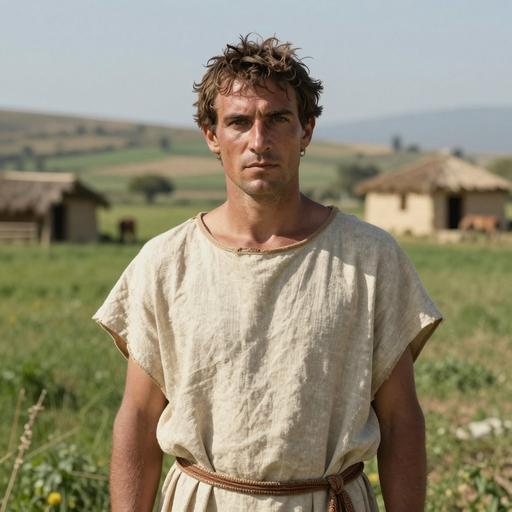
AI portrait reconstruction for A man buried in Greece in the Late Neolithic era
AI-generated artistic reconstruction, not a photograph of the individual.
Record

Sample details

Recorded details and available lineage markers.

Individual

Aegean Civilization individual, Greece

Sample ID: Klei10

Date Range

4446 BCE - 4351 BCE

Cultural Period

Late Neolithic 2 Greece

Biological Sex

Male

mtDNA Haplogroup

K1a2

Y-DNA Haplogroup

G-Z42562

Social Role

Laborer (AI estimate, era-typical)

Geography

Location

Where this individual was discovered

Country Greece
Locality Kleitos
Coordinates 40.4317, 21.8588
Chronology

Date range

When this individual lived in the broader context of human history

Aegean Civilization individual, Greece 4446 BCE - 4351 BCE
Context

Historical context

Background information associated with the reference record.

Overview

Late Neolithic 2 in Greece represents a phase of continued Neolithic life in the Greek mainland and surrounding regions, ending before the establishment of fully developed Bronze Age systems. While local traditions varied, pottery styles and settlement patterns provide the main basis for distinguishing this late Neolithic horizon.

Region & Environment

The Greek mainland and nearby islands offered diverse environments—from coastal plains to mountainous interiors. Farming depended on access to cultivable land and reliable water sources, while coastal areas supported fishing and exchange opportunities. Regional differences in rainfall and terrain would have encouraged varied settlement choices and subsistence strategies.

Historical Context

In the centuries leading to the Bronze Age, Greek Neolithic communities sustained agricultural economies and engaged in long-distance contacts within the wider Aegean world. This era is commonly placed within the transition toward more complex Aegean societies, though it remains Neolithic in technology and social organization. The “Late Neolithic 2” label emphasizes chronological position within Neolithic sequences rather than a single uniform culture.

Populations & Lifeways

People lived in villages organized around agriculture and animal husbandry. Daily lifeways included crop production, herding, food processing, and routine craft tasks. Increasingly dense settlement and diversified craft activity in some areas suggest growing community specialization, even if communities remained largely non-urban.

Archaeology & Material Culture

Archaeological remains of Late Neolithic 2 are dominated by ceramics, including regionally recognizable wares and vessel forms that help define chronological subdivisions. Lithic industries, grinding equipment, and domestic construction features (as preserved) support reconstructions of food processing and household activity. The material culture record often shows continuity with earlier Neolithic practices, combined with gradual changes in styles and production techniques.

Culture & Society

Neolithic communities in this period likely shared broad cultural habits while expressing local identities through pottery style and household practices. Social life would have involved cooperative agricultural work, seasonal movement or management of resources, and exchange with neighboring groups. Evidence for craft activity suggests that household and community production played key roles in daily economies.

Legacy & Transition

Late Neolithic 2 forms part of the backdrop for later Early Bronze Age developments in Greece and the Aegean. Changes in pottery traditions and settlement organization contribute to understanding how Neolithic lifeways evolved—eventually giving rise to new Bronze Age cultural systems with different architectural forms and technologies.

Analysis

Genetic comparisons

These comparisons show genetic similarity, not identity or origin. The populations listed are those whose genomes show statistical alignment to this ancient individual.

Similarity reflects shared history, not shared identity. These are analytical comparisons, not claims about who this person was.

Modern Genetic Admixture

This analysis compares the DNA profile with present-day reference populations, showing statistical similarity to modern reference populations from different regions. The excavation site records where this individual was found, not a fixed modern genetic identity.

Europe 74.0%
Southern European 74.0%
Sardinian 32.1%
Italian 29.3%
Iberian 6.9%
Balkan 5.7%
Asia 23.8%
Arab, Egyptian & Levantine 21.2%
Levantine 19.0%
Arabian 2.2%
Northern West Asian 2.6%
Cypriot 2.6%
Africa 2.2%
North African 2.2%
Egyptian 1.3%
North African 0.9%

Closest Modern Populations

These are the modern populations showing the closest statistical alignment to A man buried in Greece in the Late Neolithic era, ranked by genetic distance. Lower distance values indicate closer statistical similarity. Cross-region similarity can reflect shared ancestry, population movement, continuity, or later admixture.

1
Belmonte Jew
6.0330
2
Sardinian
6.1494
3
Italian Jew
6.8887
4
Turkish Sabbatean
6.9227
5
Sicilian West
7.0103
6
Maltese
7.0994
7
Italian Calabria
7.1493
8
Sicilian East
7.1541
9
Italian Campania
7.1561
10
Italian Lazio
7.1594
Context

Related Samples

This individual exists within a broader network of ancient samples. No ancient genome stands alone.
Individual Culture/Period Date Location Action
Aegean Civilization individual, Greece Late Neolithic 2 Greece 4446 BCE Kleitos, Greece View
Aegean Civilization individual, Greece Late Neolithic 2 Greece 4449 BCE Paliambela, Greece View
Aegean Civilization individual, Greece Neolithic Greece 6434 BCE Revenia, Greece View
Anatolian Neolithic individual, Turkey Neolithic Turkey 6221 BCE Northwest Anatolia. Marmara. Barcın, Turkey View
Anatolian Neolithic individual, Turkey Neolithic Turkey 6417 BCE Northwest Anatolia. Marmara. Barcın, Turkey View
Anatolia N individual, Turkey 6417 BCE Northwest Anatolia. Marmara. Barcın, Turkey View
Iberia Ca individual, Turkey 6221 BCE Northwest Anatolia. Marmara. Barcın, Turkey View
Greece N individual, Greece 4446 BCE Kleitos, Greece View
Greece N individual, Greece 4449 BCE Paliambela, Greece View
Greece N individual, Greece 6434 BCE Revenia, Greece View
Page 1
Individual Culture/Period Date Location Action
Aegean Civilization individual, Greece Late Neolithic 2 Greece 4446 BCE Kleitos, Greece View
Aegean Civilization individual, Greece Late Neolithic 2 Greece 4449 BCE Paliambela, Greece View
Page 1
Sources

References

Scientific publications and genetic data that inform this profile.

G25 Coordinates

These coordinates represent a position in genetic space, a tool for comparison, not a conclusion. You can use these to perform custom admixture analysis in G25 Studio.

Klei10,0.10157344,0.15727224,-0.00132472,-0.06775648,0.039942,-0.03256128,-0.00370176,0.00197864,0.0428886,0.05501972,0.00100056,0.005446,-0.00798804,-0.01025732,-0.01189244,0.00873048,0.0060912,0.0014186,0.00252168,0.00043768,0.00395988,0.00804804,-0.01207452,-0.01585332,0.00209061
Continue in G25 Studio
Use code for 30% off • Expires Nov 16