
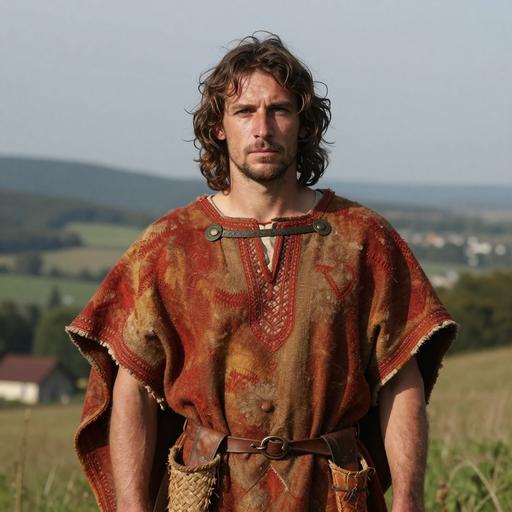
A man buried in Slovenia in the Early Iron Age era

Download PDF creates a visual, rasterized copy. Use Print for selectable text and better assistive-technology support.

Loading Report

Preparing your ancestry journey

Preparing the available report content...

Your report will open automatically.

Skip to main content
Reference library / Sample profile

A man buried in Slovenia in the Early Iron Age era

Explore the recorded context, genetic comparisons and research behind this reference sample.

SloveniaSlovenia EIA

A reference profile describes this sample. It does not establish a personal or family relationship.

AI portrait reconstruction for A man buried in Slovenia in the Early Iron Age era
AI-generated artistic reconstruction, not a photograph of the individual.
Record

Sample details

Recorded details and available lineage markers.

Individual

EIA individual, Slovenia

Sample ID: I22934

Date Range

796 BCE - 547 BCE

Cultural Period

Slovenia EIA

Biological Sex

Male

mtDNA Haplogroup

H

Y-DNA Haplogroup

R-M269

Social Role

Farmer (AI estimate, era-typical)

Geography

Location

Where this individual was discovered

Country Slovenia
Locality Dolge njive (Smarjepke Toplice)
Coordinates 45.8674, 15.2798
Chronology

Date range

When this individual lived in the broader context of human history

EIA individual, Slovenia 796 BCE - 547 BCE
Context

Historical context

Background information associated with the reference record.

Region & Environment

Early Iron Age Slovenia lay at the interface of alpine and subalpine zones, where navigable river corridors and passes connected inland areas with wider Central European networks. The uplands supported seasonal herding and woodlands, while valleys and basins offered arable land and travel routes that structured settlement.

Historical Context

Between roughly the 8th and mid-5th centuries BCE, Iron Age lifeways in the region developed within broader Hallstatt cultural horizons across much of Central Europe. Rather than a single political state, the landscape reflects multiple local communities interacting through trade and shared styles of prestige goods and technology.

Populations & Lifeways

Populations were organized in small-scale settlements and social groupings that relied on mixed farming and animal husbandry, with periodic emphasis on pasture-based activities in upland areas. Household production and craft work—especially around metal and woodworking—were central to everyday life. Local leaders or wealthy families are suggested indirectly by burials and the distribution of valuable objects.

Archaeology & Material Culture

Archaeological visibility comes largely from settlements, cemeteries, and metalwork. Finds associated with Hallstatt traditions include iron tools and weapons, bronze vessels and ornaments, and ceramic forms that reflect regional stylistic affinities. Burial evidence (often with grave goods) helps indicate social differentiation, while weapon and personal items point to roles in protection, status, and exchange.

Culture & Society

Material patterns suggest societies where prestige was communicated through crafted objects, metalwork, and funerary practice. Connections across Central Europe are implied by recurring styles in ornaments and equipment and by the circulation of raw materials and finished goods. Community life likely combined agricultural routines with craft specialization and seasonal movement.

Legacy & Transition

By the later 6th and 5th centuries BCE, cultural change toward later Iron Age horizons is reflected in shifting artifact styles and mortuary patterns across the broader region. These transitions set the stage for subsequent developments in eastern Alpine areas, including the later emergence of Roman-era urban centers.

Analysis

Genetic comparisons

These comparisons show genetic similarity, not identity or origin. The populations listed are those whose genomes show statistical alignment to this ancient individual.

Similarity reflects shared history, not shared identity. These are analytical comparisons, not claims about who this person was.

Modern Genetic Admixture

This analysis compares the DNA profile with present-day reference populations, showing statistical similarity to modern reference populations from different regions. The excavation site records where this individual was found, not a fixed modern genetic identity.

Europe 87.3%
Southern European 63.4%
Iberian 35.0%
Balkan 15.0%
Italian 9.5%
Sardinian 3.9%
Northwestern European 23.9%
Northwestern European 13.6%
English 10.3%
Asia 10.9%
Arab, Egyptian & Levantine 6.4%
Levantine 6.4%
Northern West Asian 4.4%
Cypriot 4.4%
Africa 1.7%
North African 1.7%
Egyptian 1.7%

Closest Modern Populations

These are the modern populations showing the closest statistical alignment to A man buried in Slovenia in the Early Iron Age era, ranked by genetic distance. Lower distance values indicate closer statistical similarity. Cross-region similarity can reflect shared ancestry, population movement, continuity, or later admixture.

1
Spanish Eivissa
2.2619
2
Spanish Barcelones
2.3126
3
Spanish Terres De L'ebre
2.3295
4
Spanish Mallorca
2.3490
5
French Provence
2.4153
6
Spanish Penedes
2.4860
7
Spanish Alacant
2.5026
8
Spanish Valencia
2.5111
9
Spanish Camp De Tarragona
2.5320
10
Spanish Castilla La Mancha
2.5518
Context

Related Samples

This individual exists within a broader network of ancient samples. No ancient genome stands alone.

Individual Culture/Period Date Location Action
EIA individual, Slovenia Early Iron Age Slovenia 808 BCE Dolge njive (Smarjepke Toplice), Slovenia View
EIA individual, Slovenia Early Iron Age Slovenia 794 BCE Dolge njive (Smarjepke Toplice), Slovenia View
EIA individual, Slovenia Early Iron Age Slovenia 780 BCE Dolge njive (Smarjepke Toplice), Slovenia View
Celtic individual, Slovenia Early Iron Age Slovenia 791 BCE Dolge njive (Smarjepke Toplice), Slovenia View
EIA individual, Slovenia Early Iron Age Slovenia 850 BCE Dolge njive (Smarjepke Toplice), Slovenia View
EIA individual, Slovenia Early Iron Age Slovenia 796 BCE Dolge njive (Smarjepke Toplice), Slovenia View
EIA individual, Slovenia Early Iron Age Slovenia 850 BCE Dolge njive (Smarjepke Toplice), Slovenia View
EIA individual, Slovenia Early Iron Age Slovenia 798 BCE Dolge njive (Smarjepke Toplice), Slovenia View
Page 1
Individual Culture/Period Date Location Action
EIA individual, Slovenia Early Iron Age Slovenia 729 BCE Grofove njive, Slovenia View
EIA individual, Slovenia Early Iron Age Slovenia 600 BCE Zagorje ob Savi, Slovenia View
EIA individual, Slovenia Early Iron Age Slovenia 742 BCE Zagorje ob Savi, Slovenia View
EIA individual, Slovenia Early Iron Age Slovenia 750 BCE Grofove njive, Slovenia View
EIA individual, Slovenia Early Iron Age Slovenia 763 BCE Grofove njive, Slovenia View
EIA individual, Slovenia Early Iron Age Slovenia 787 BCE Novo mesto. Kapiteljska njive, Slovenia View
EIA individual, Slovenia Early Iron Age Slovenia 795 BCE Ljubljana. Kongresni trg, Slovenia View
EIA individual, Slovenia Early Iron Age Slovenia 796 BCE Ljubljana. Kongresni trg, Slovenia View
EIA individual, Slovenia Early Iron Age Slovenia 776 BCE Zagorje ob Savi, Slovenia View
EIA individual, Slovenia Early Iron Age Slovenia 808 BCE Dolge njive (Smarjepke Toplice), Slovenia View
EIA individual, Slovenia Early Iron Age Slovenia 794 BCE Dolge njive (Smarjepke Toplice), Slovenia View
EIA individual, Slovenia Early Iron Age Slovenia 780 BCE Dolge njive (Smarjepke Toplice), Slovenia View
Celtic individual, Slovenia Early Iron Age Slovenia 791 BCE Dolge njive (Smarjepke Toplice), Slovenia View
EIA individual, Slovenia Early Iron Age Slovenia 850 BCE Dolge njive (Smarjepke Toplice), Slovenia View
EIA individual, Slovenia Early Iron Age Slovenia 796 BCE Dolge njive (Smarjepke Toplice), Slovenia View
EIA individual, Slovenia Early Iron Age Slovenia 850 BCE Dolge njive (Smarjepke Toplice), Slovenia View
EIA individual, Slovenia Early Iron Age Slovenia 798 BCE Dolge njive (Smarjepke Toplice), Slovenia View
Page 1
Sources

References

Scientific publications and genetic data that inform this profile.

G25 Coordinates

These coordinates represent a position in genetic space, a tool for comparison, not a conclusion. You can use these to perform custom admixture analysis in G25 Studio.

I22934,0.11608428,0.14229048,0.03629994,0.00432902,0.03748564,0.0018783,-0.00100404,-0.00121866,0.01325396,0.02224924,-0.0072423,0.009698,-0.01582826,-0.00735544,0.0101523,-0.00548994,-0.01381458,-0.00103082,0.00086314,-0.00243972,0.00510206,0.00390596,-0.00797898,-0.00071584,-0.00010477
Continue in G25 Studio
Use code for 30% off • Expires Nov 16