
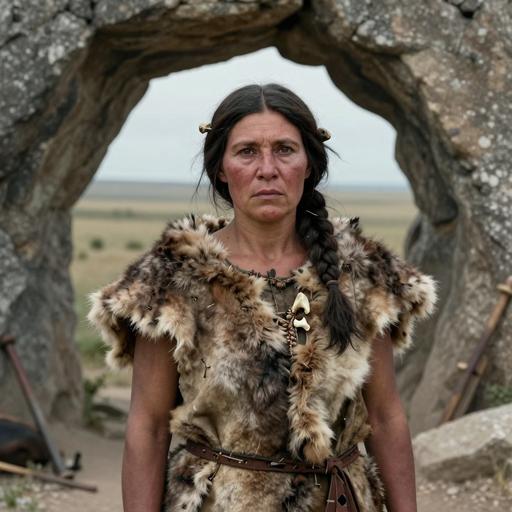
An individual buried in Russia in the Pleistocene era

Download PDF creates a visual, rasterized copy. Use Print for selectable text and better assistive-technology support.

Loading Report

Preparing your ancestry journey

Preparing the available report content...

Your report will open automatically.

Skip to main content
Reference library / Sample profile

An individual buried in Russia in the Pleistocene era

Explore the recorded context, genetic comparisons and research behind this reference sample.

RussiaChagyrskaya Cave Neanderthal, Russia

A reference profile describes this sample. It does not establish a personal or family relationship.

AI portrait reconstruction for An individual buried in Russia in the Pleistocene era
AI-generated artistic reconstruction, not a photograph of the individual.
Record

Sample details

Recorded details and available lineage markers.

Individual

Neanderthal individual, Russia

Sample ID: Chagyrskaya8

Date Range

98050 BCE - 58050 BCE

Cultural Period

Chagyrskaya Cave Neanderthal, Russia

Biological Sex

Not known

mtDNA Haplogroup

Not available

Y-DNA Haplogroup

Not available

Social Role

Hunter (AI estimate, era-typical)

Geography

Location

Where this individual was discovered

Country Russia
Locality Chagyrskaya-Cave (Altai Krai, Krasnoshchyokovsky District)
Coordinates 51.4425, 83.1545
Chronology

Date range

When this individual lived in the broader context of human history

Neanderthal individual, Russia 98050 BCE - 58050 BCE
Context

Historical context

Background information associated with the reference record.

Overview

Chagyrskaya Cave is an important Middle Paleolithic site in Siberia associated with Neanderthal activity and dated to approximately 60,000–50,000 BCE. Its significance lies in how the stone-tool assemblage and cave use help document Neanderthal presence and technological behavior in high-latitude environments.

Region & Environment

Siberia’s Pleistocene environments included cold climates and fluctuating habitats shaped by glacial cycles. Caves such as Chagyrskaya offered more stable conditions for shelter and for organizing hunting-related or maintenance tasks in harsh weather.

Historical Context

During 60,000–50,000 BCE, Neanderthal groups occupied parts of Eurasia under changing climate pressures. In Siberia, archaeologists interpret Middle Paleolithic occupations through evidence of tool production and activity areas, placing Chagyrskaya within the broader Mousterian tradition.

Populations & Lifeways

Human groups at this time were hunter-gatherers, with mobility and site use shaped by prey availability and seasonal conditions. Cave sites could function as bases for short-term activities, including tool making, maintenance, and processing of animal products.

Archaeology & Material Culture

The key evidence at Chagyrskaya includes Middle Paleolithic stone tools crafted using flaking methods characteristic of Mousterian technological traditions. Such assemblages typically contain scrapers and other retouched implements, and they preserve patterns that inform archaeologists about how tools were made and used within the cave.

Culture & Society

At this scale, “culture” is primarily expressed through technology: consistent approaches to core reduction and retouch. Toolkits suggest planning in procurement and manufacture, and repeated cave use implies organization of tasks and adaptation to the surrounding environment.

Legacy & Transition

Chagyrskaya contributes to broader reconstructions of Neanderthal technological diversity across Eurasia. Over the late Pleistocene, different human groups and technological traditions appear in subsequent archaeological layers, reflecting changing populations and environmental pressures after the Middle Paleolithic.

Analysis

Genetic comparisons

These comparisons show genetic similarity, not identity or origin. The populations listed are those whose genomes show statistical alignment to this ancient individual.

Similarity reflects shared history, not shared identity. These are analytical comparisons, not claims about who this person was.

Modern Genetic Admixture

This analysis compares the DNA profile with present-day reference populations, showing statistical similarity to modern reference populations from different regions. The excavation site records where this individual was found, not a fixed modern genetic identity.

Africa 91.7%
African Hunter-Gatherer 90.5%
West African 1.3%
Ghanaian, Liberian, Sierra Leonean 1.3%
Europe 4.7%
Northwestern European 2.7%
English 1.5%
Scandinavian 1.0%
Eastern European 1.2%
Southern European 0.9%
Balkan 0.9%
Asia 2.3%
Northern Asian 1.7%
Mongolian 1.5%
Chinese & Southeast Asian 0.6%
Chinese 0.6%
Oceania 1.0%
Melanesian 1.0%
Papuan 1.0%

Closest Modern Populations

These are the modern populations showing the closest statistical alignment to An individual buried in Russia in the Pleistocene era, ranked by genetic distance. Lower distance values indicate closer statistical similarity. Cross-region similarity can reflect shared ancestry, population movement, continuity, or later admixture.

1
Khomani San
5.5793
2
Ju Hoan North
21.1986
3
Bakola
26.7476
4
Bedzan
28.4971
5
Baka
29.8407
6
Biaka
30.9646
7
Bantu S.E.
33.6568
8
Hadza
34.7628
9
Sandawe
38.6256
10
Bantu S.W.
38.7599
Context

Related Samples

This individual exists within a broader network of ancient samples. No ancient genome stands alone.

Individual Culture/Period Date Location Action
Neanderthal individual, Russia Chagyrskaya Cave Neanderthal, Russia 98050 BCE Chagyrskaya Cave, Russia View
Neanderthal individual, Russia Chagyrskaya Cave Neanderthal, Russia 98050 BCE Chagyrskaya-Cave (Altai Krai, Krasnoshchyokovsky District), Russia View
Neanderthal individual, Russia Chagyrskaya Cave Neanderthal, Russia 54750 BCE Chagyrskaya-Cave (Altai Krai, Krasnoshchyokovsky District), Russia View
Neanderthal individual, Russia 98050 BCE Chagyrskaya Cave, Russia View
Page 1
Individual Culture/Period Date Location Action
Neanderthal individual, Russia Chagyrskaya Cave Neanderthal, Russia 98050 BCE Chagyrskaya Cave, Russia View
Neanderthal individual, Russia Chagyrskaya Cave Neanderthal, Russia 98050 BCE Chagyrskaya-Cave (Altai Krai, Krasnoshchyokovsky District), Russia View
Neanderthal individual, Russia Chagyrskaya Cave Neanderthal, Russia 54750 BCE Chagyrskaya-Cave (Altai Krai, Krasnoshchyokovsky District), Russia View
Page 1
Sources

References

Scientific publications and genetic data that inform this profile.

G25 Coordinates

These coordinates represent a position in genetic space, a tool for comparison, not a conclusion. You can use these to perform custom admixture analysis in G25 Studio.

Chagyrskaya8,-0.61852018,0.0628,0.02076298,0.03085984,0.0010594,0.0035322,0.24778826,-0.19401206,0.02170214,0.00951912,0.00021316,-0.03778814,-0.01233928,0.00486126,0.02044038,-0.01725804,0.02926876,0.21609308,-0.07241456,-0.00042144,-0.02549516,0.0004409,0.00320552,-0.0048322,0.00176342
Continue in G25 Studio
Use code for 30% off • Expires Nov 16