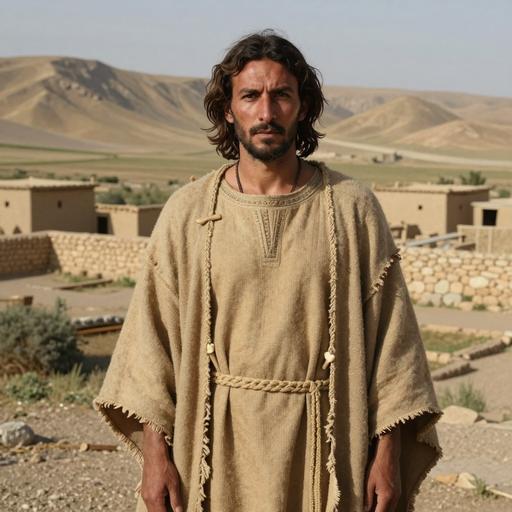
A man buried in Iran in the Copper Age era

Download PDF creates a visual, rasterized copy. Use Print for selectable text and better assistive-technology support.

Loading Report

Preparing your ancestry journey

Preparing the available report content...

Your report will open automatically.

Skip to main content
Reference library / Sample profile

A man buried in Iran in the Copper Age era

Explore the recorded context, genetic comparisons and research behind this reference sample.

IranChalcolithic Iran

A reference profile describes this sample. It does not establish a personal or family relationship.

AI portrait reconstruction for A man buried in Iran in the Copper Age era
AI-generated artistic reconstruction, not a photograph of the individual.
Record

Sample details

Recorded details and available lineage markers.

Individual

Seh Gabi individual, Iran

Sample ID: I1674

Date Range

3978 BCE - 3798 BCE

Cultural Period

Chalcolithic Iran

Biological Sex

Male

mtDNA Haplogroup

I1c

Y-DNA Haplogroup

G-CTS11562

Social Role

Farmer (AI estimate, era-typical)

Geography

Location

Where this individual was discovered

Country Iran
Locality Seh Gabi
Coordinates 34.5000, 47.9600
Chronology

Date range

When this individual lived in the broader context of human history

Seh Gabi individual, Iran 3978 BCE - 3798 BCE
Context

Historical context

Background information associated with the reference record.

The Chalcolithic era, also known as the Copper Age, represents a significant period in the history of Iran, falling between the Neolithic and the Bronze Age, approximately from 5500 to 3000 BCE. During this time, significant cultural, technological, and societal advancements took place which laid the groundwork for the complex civilizations that would later develop in the region.

Geography and Environment:

Chalcolithic Iran was characterized by a diverse range of environmental zones including mountains, plains, and river valleys which influenced the distribution and lifestyle of its inhabitants. The Zagros Mountains, the central plateau, and the coastal plains of the Persian Gulf and Caspian Sea all provided varied resources and challenges. This period saw human communities increasingly settled alongside permanent water sources, leading to the development of more stable agricultural societies.

Technological Developments:

A defining feature of the Chalcolithic era was the introduction and use of copper alongside traditional stone tools. This was the first time humans began experimenting with metallurgy, and in Iran, this led to the bolstering of craft specialization and technological innovation. Artisans learned to cold-hammer native copper and eventually developed techniques for smelting. While copper tools and ornaments were not widespread among common populations due to the complexities of production, their presence indicates the beginnings of social stratification.

Settlements and Architecture:

This era saw the growth of villages into more complex settlements. Archaeological sites such as Tepe Sialk, Tepe Hissar, and Tepe Yahya provide key insights into the architectural advancements of the time which included mud-brick homes, communal storage facilities, and religious or communal buildings. These settlements were often fortified, suggesting a need for defense and hinting at emerging socio-political complexities.

Economy and Agriculture:

Agriculture during the Chalcolithic period in Iran became more sophisticated. The domestication of plants such as wheat, barley, and legumes, alongside animals like cattle, sheep, and goats, allowed for more reliable food production. This in turn supported larger populations and more permanent settlements. There was also a notable rise in trade networks which facilitated the exchange of raw materials like obsidian, lapis lazuli, and, later, copper. This inter-regional trade indicates not only economic growth but also the movement of ideas and technologies.

Social Structure and Culture:

The Chalcolithic era in Iran is marked by increasing social stratification. This is evidenced by burials with grave goods indicating wealth differentiation and possibly the beginnings of a class system. Religious practices and rituals became more pronounced, as seen in the construction of temples and usage of symbolic artifacts which possibly indicates the presence of religious or ritual specialists. Artifacts such as pottery, figurines, and seals reflect the artistic expression and religious beliefs of the era, often depicting deities, animals, and abstract designs.

Challenges and Changes:

Populations during the Chalcolithic faced environmental challenges such as fluctuating climates and resource depletion, as well as potential conflicts caused by increasing population densities and competition for resources. These pressures may have driven technological and social innovations, leading to the more hierarchical and structured societies that characterized the later Bronze Age.

In conclusion, Chalcolithic Iran was a transformative period that laid crucial foundations for the development of more complex societies in the Ancient Near East. Its advancements in metallurgy, agriculture, social organization, and trade set the stage for the rise of memorable civilizations such as Elam, showcasing an era of significant transition and cultural flowering.

Analysis

Genetic comparisons

These comparisons show genetic similarity, not identity or origin. The populations listed are those whose genomes show statistical alignment to this ancient individual.

Similarity reflects shared history, not shared identity. These are analytical comparisons, not claims about who this person was.

Modern Genetic Admixture

This analysis compares the DNA profile with present-day reference populations, showing statistical similarity to modern reference populations from different regions. The excavation site records where this individual was found, not a fixed modern genetic identity.

Asia 100.0%
Northern West Asian 51.7%
Mesopotamian 37.3%
Anatolian 13.4%
Cypriot 0.9%
Central Asian, Northern Indian & Pakistani 26.7%
Pakistan 23.8%
Indian 2.9%
Arab, Egyptian & Levantine 21.6%
Levantine 20.8%
Arabian 0.8%

Closest Modern Populations

These are the modern populations showing the closest statistical alignment to A man buried in Iran in the Copper Age era, ranked by genetic distance. Lower distance values indicate closer statistical similarity. Cross-region similarity can reflect shared ancestry, population movement, continuity, or later admixture.

1
Turkish Erzurum
1.7382
2
Armenian Syunik
2.5157
3
Udi
2.5619
4
Armenian Hemsheni
2.6090
5
Armenian Artsakh
2.7309
6
Georgian Kakh
2.7315
7
Georgian Samtckhe
2.8174
8
Georgian Meskheti
2.8482
9
Armenian Parspatunik
2.9047
10
Armenian Ararat
2.9153
Context

Related Samples

This individual exists within a broader network of ancient samples. No ancient genome stands alone.

Individual Culture/Period Date Location Action
Seh Gabi individual, Iran Chalcolithic Iran 4700 BCE Seh Gabi, Iran View
Ancient Near Eastern Civilization individual, Armenia Chalcolithic Armenia 4330 BCE Areni 1, Armenia View
Ancient Near Eastern Civilization individual, Armenia Chalcolithic Armenia 4236 BCE Areni 1, Armenia View
Ancient Near Eastern Civilization individual, Armenia Chalcolithic Armenia 4311 BCE Areni 1, Armenia View
Kalavan EBA Kura Araxes individual, Armenia Early Bronze Age Armenia 2623 BCE Kalavan, Armenia View
Kalavan EBA Kura Araxes individual, Armenia Early Bronze Age Armenia 2621 BCE Kalavan, Armenia View
Talin EBA Kura Araxes individual, Armenia Early Bronze Age Armenia 3350 BCE Talin, Armenia View
Katnaghbiur1 MBA individual, Armenia Middle Bronze Age Armenia 1502 BCE Katnaghbiur 1, Armenia View
Ancient Near Eastern Civilization individual, Armenia Chalcolithic Armenia 4230 BCE Areni 1, Armenia View
Ancient Near Eastern Civilization individual, Armenia Chalcolithic Armenia 4350 BCE Areni 1, Armenia View
Ancient Near Eastern Civilization individual, Iran Neolithic Ganj Dareh 8170 BCE Ganj Dareh, Iran View
EBA individual, Jordan Early Bronze Age Jordan 2198 BCE 'Ain Ghazal, Jordan View
EBA individual, Jordan Early Bronze Age Jordan 2490 BCE 'Ain Ghazal, Jordan View
PPNB individual, Jordan Pre-Pottery Neolithic B Jordan 8300 BCE 'Ain Ghazal, Jordan View
Natufian/Levantine individual, Jordan Pre-Pottery Neolithic B Jordan 7741 BCE 'Ain Ghazal, Jordan View
Natufian/Levantine individual, Jordan Pre-Pottery Neolithic B Jordan 7732 BCE 'Ain Ghazal, Jordan View
Natufian/Levantine individual, Jordan Pre-Pottery Neolithic B Jordan 7451 BCE 'Ain Ghazal, Jordan View
Ancient Near Eastern Civilization individual, Jordan Early Bronze Age Jordan 2557 BCE 'Ain Ghazal, Jordan View
PPNC individual, Jordan Pre-Pottery Neolithic C Jordan 6800 BCE 'Ain Ghazal, Jordan View
Seh Gabi individual, Iran Chalcolithic Iran 4840 BCE Seh Gabi, Iran View
Seh Gabi individual, Iran Chalcolithic Iran 4836 BCE Seh Gabi, Iran View
Seh Gabi individual, Iran Chalcolithic Iran 3978 BCE Seh Gabi, Iran View
Seh Gabi individual, Iran Chalcolithic Iran 3957 BCE Seh Gabi, Iran View
Ancient Near Eastern Civilization individual, Iran Late Neolithic Iran 5840 BCE Seh Gabi, Iran View
Levantine Neolithic individual, Israel Pre-Pottery Neolithic B Israel 7300 BCE Motza, Israel View
Levantine individual, Israel Natufian Culture in Israel 12000 BCE Raqefet Cave, Israel View
Ancient Anatolian individual, Turkey Chalcolithic Turkey 3946 BCE Northwest Anatolia. Marmara. Barcın, Turkey View
Levantine individual, Israel Natufian Culture in Israel 12000 BCE Raqefet Cave, Israel View
Levantine individual, Israel Natufian Culture in Israel 11541 BCE Raqefet Cave, Israel View
Natufian/Levantine individual, Jordan Pre-Pottery Neolithic B Jordan 8300 BCE 'Ain Ghazal, Jordan View
Natufian/Levantine individual, Jordan Pre-Pottery Neolithic B Jordan 8176 BCE 'Ain Ghazal, Jordan View
Natufian/Levantine individual, Jordan Pre-Pottery Neolithic B Jordan 7752 BCE 'Ain Ghazal, Jordan View
Natufian/Levantine individual, Jordan Pre-Pottery Neolithic B Jordan 8300 BCE 'Ain Ghazal, Jordan View
Natufian/Levantine individual, Jordan Pre-Pottery Neolithic C Jordan 6900 BCE 'Ain Ghazal, Jordan View
Natufian/Levantine individual, Jordan Pre-Pottery Neolithic B Jordan 8300 BCE Ain Ghazal (Amman, Sahab), Jordan View
Levant Hg individual, Israel 12000 BCE Raqefet Cave, Israel View
Levant N individual, Jordan 6900 BCE 'Ain Ghazal, Jordan View
Levant N individual, Jordan 8300 BCE 'Ain Ghazal, Jordan View
Levant Hg individual, Israel 12000 BCE Raqefet Cave, Israel View
Levant N individual, Jordan 7752 BCE 'Ain Ghazal, Jordan View
Levant Hg individual, Israel 12000 BCE Raqefet Cave, Israel View
Levant N individual, Jordan 8300 BCE 'Ain Ghazal, Jordan View
Levant N individual, Jordan 8176 BCE 'Ain Ghazal, Jordan View
Levant Hg individual, Israel 12000 BCE Raqefet Cave, Israel View
Levant N individual, Jordan 8300 BCE 'Ain Ghazal, Jordan View
Levant Hg individual, Israel 11541 BCE Raqefet Cave, Israel View
Levant Hg individual, Israel 12000 BCE Raqefet Cave, Israel View
Anatolia Ca individual, Turkey 3946 BCE Northwest Anatolia. Marmara. Barcın, Turkey View
Levant Hg individual, Israel 12000 BCE Raqefet Cave, Israel View
Page 1
Individual Culture/Period Date Location Action
Seh Gabi individual, Iran Chalcolithic Iran 4700 BCE Seh Gabi, Iran View
Seh Gabi individual, Iran Chalcolithic Iran 4840 BCE Seh Gabi, Iran View
Seh Gabi individual, Iran Chalcolithic Iran 4836 BCE Seh Gabi, Iran View
Seh Gabi individual, Iran Chalcolithic Iran 3978 BCE Seh Gabi, Iran View
Seh Gabi individual, Iran Chalcolithic Iran 3957 BCE Seh Gabi, Iran View
Page 1
Sources

References

Scientific publications and genetic data that inform this profile.

G25 Coordinates

These coordinates represent a position in genetic space, a tool for comparison, not a conclusion. You can use these to perform custom admixture analysis in G25 Studio.

I1674,0.09692894,0.12395178,-0.0580023,-0.05409194,-0.03779434,-0.01305556,0.00629556,-0.00398338,-0.03491408,-0.01221314,0.00424862,0.0026562,-0.00501404,0.0020356,-0.00401346,-0.0073994,0.00509518,-0.00188554,-0.00369686,0.0047085,0.00570352,0.00226822,0.00011244,-0.00750446,-0.00452691
Continue in G25 Studio
Use code for 30% off • Expires Nov 16