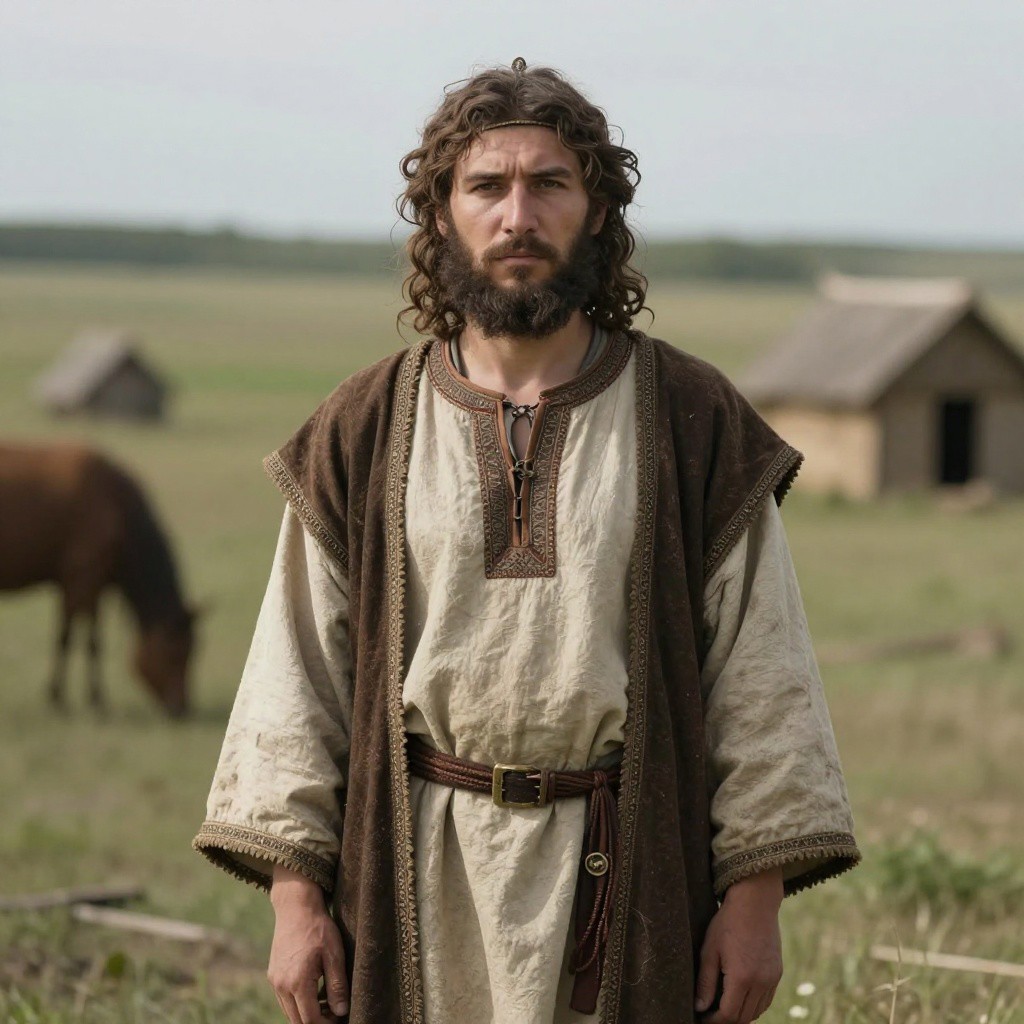
An individual buried in Russia in the era

Download PDF creates a visual, rasterized copy. Use Print for selectable text and better assistive-technology support.

Loading Report

Preparing your ancestry journey

Preparing the available report content...

Your report will open automatically.

Skip to main content
Reference library / Sample profile

An individual buried in Russia in the era

Explore the recorded context, genetic comparisons and research behind this reference sample.

RussiaRussia Rostovka EMBA Irtysh SeimaTurbino

A reference profile describes this sample. It does not establish a personal or family relationship.

AI portrait reconstruction for An individual buried in Russia in the  era
AI-generated artistic reconstruction, not a photograph of the individual.
Record

Sample details

Recorded details and available lineage markers.

Individual

Rostovka EMBA Irtysh Seima Turbino individual, Russia

Sample ID: ROT003

Date Range

2227 BCE - 1823 BCE

Cultural Period

Russia Rostovka EMBA Irtysh SeimaTurbino

Biological Sex

Not known

mtDNA Haplogroup

Not available

Y-DNA Haplogroup

Not available

Geography

Location

Where this individual was discovered

Country Russia
Locality Rostovka (Omsk Oblast, Omsk District, Rostovka Village)
Coordinates 55.0290, 73.5728
Chronology

Date range

When this individual lived in the broader context of human history

Rostovka EMBA Irtysh Seima Turbino individual, Russia 2227 BCE - 1823 BCE
Context

Historical context

Background information associated with the reference record.

Overview

The Rostovka–Emba–Irtysh–Seima–Turbino era refers to a Bronze Age pattern recognized across parts of northern Eurasia through shared technological and typological traits, especially in metalwork. It is best understood as an archaeological horizon: related practices and styles appear in multiple regions rather than a single unified political state.

Region & Environment

This horizon spans areas associated with steppe and forest-steppe landscapes, including river systems such as those in the Irtysh region and steppe-influenced zones nearer to the Emba basin. Such environments supported mobile pastoralism and movement between seasonal pastures and resource areas, as well as access to materials and trade routes. Environmental gradients likely shaped settlement choices and subsistence strategies.

Historical Context

In the Bronze Age, increasing specialization in metallurgy and long-distance movement of people and materials contributed to regional connectivity. The Seima–Turbino horizon is notable for its wide geographic distribution of certain artifact types and casting/metalworking approaches. The degree of direct contact or shared ancestry is difficult to demonstrate from artifacts alone; the safest interpretation emphasizes shared technological traditions and exchange.

Populations & Lifeways

Populations in these regions were likely organized in mobile or semi-mobile groups that could manage resources across broad territories. Daily lifeways would have included herding and hunting, supplemented by craft activities and the procurement of copper and tin or other alloying materials where available. Metalworkers and traveling groups may have played important roles in transmitting skills and object forms.

Archaeology & Material Culture

Archaeologically, the horizon is often recognized through distinctive bronze artifacts—particularly weapons and tools—whose styles and manufacturing traits recur across large areas. Casting technology and consistent object typologies help archaeologists group assemblages. Finds can include fragments and finished pieces, sometimes associated with burial contexts or settlements, but interpretations remain cautious about exact social roles.

Culture & Society

The horizon is frequently taken to reflect networks that connected groups over long distances, where craft knowledge and prestigious objects circulated. Such connections could cross linguistic or ethnic boundaries, which limits strong claims about shared identity. Social differentiation may be expressed through the possession of metal objects, while technological transmission implies some combination of local production and interaction.

Legacy & Transition

As the Bronze Age progressed, regional traditions diversified, and horizons like Seima–Turbino became part of longer-term trajectories of metallurgical practice. The value of this era in the archaeological record lies in how it documents connectivity and the spread of technological traditions across Eurasia.

Analysis

Genetic comparisons

These comparisons show genetic similarity, not identity or origin. The populations listed are those whose genomes show statistical alignment to this ancient individual.

Similarity reflects shared history, not shared identity. These are analytical comparisons, not claims about who this person was.

Modern Genetic Admixture

This analysis compares the DNA profile with present-day reference populations, showing statistical similarity to modern reference populations from different regions. The excavation site records where this individual was found, not a fixed modern genetic identity.

Europe 98.5%
Northwestern European 49.1%
Scandinavian 32.7%
Northwestern European 8.3%
English 6.6%
Finnish 1.6%
Eastern European 27.9%
Southern European 21.5%
Italian 21.5%
Asia 1.2%
Chinese & Southeast Asian 1.2%
Chinese 1.2%

Closest Modern Populations

These are the modern populations showing the closest statistical alignment to An individual buried in Russia in the era, ranked by genetic distance. Lower distance values indicate closer statistical similarity. Cross-region similarity can reflect shared ancestry, population movement, continuity, or later admixture.

1
Tatar Mishar
4.9810
2
Moksha
6.0791
3
Russian Krasnoborsky
6.1213
4
Mordovian
6.1231
5
Erzya
6.2430
6
Russian Kostroma
6.2440
7
Finnish Southwest
6.4068
8
Finnish North
6.4180
9
Finnish Central
6.5221
10
Russian Pinega
6.6967
Context

Related Samples

This individual exists within a broader network of ancient samples. No ancient genome stands alone.

Individual Culture/Period Date Location Action
Bolshoy Oleniy Ostrov MBA individual, Russia 2093 BCE Bolshoy-Oleniy-Ostrov (Murmansk Oblast, Alexandrovsk Municipality), Russia View
Bolshoy Oleniy Ostrov BA individual, Russia 991 BCE Bolshoy-Oleniy-Ostrov (Murmansk Oblast, Alexandrovsk Municipality), Russia View
Rostovka EMBA Irtysh Seima Turbino individual, Russia 1943 BCE Rostovka (Omsk Oblast, Omsk District, Rostovka Village), Russia View
Rostovka EMBA Irtysh Seima Turbino individual, Russia 2227 BCE Rostovka (Omsk Oblast, Omsk District, Rostovka Village), Russia View
Rostovka EMBA Irtysh Seima Turbino individual, Russia 2213 BCE Rostovka (Omsk Oblast, Omsk District, Rostovka Village), Russia View
Rostovka EMBA Irtysh Seima Turbino individual, Russia 2227 BCE Rostovka (Omsk Oblast, Omsk District, Rostovka Village), Russia View
Rostovka EMBA Irtysh Seima Turbino individual, Russia 2035 BCE Rostovka (Omsk Oblast, Omsk District, Rostovka Village), Russia View
Rostovka EMBA Irtysh Seima Turbino individual, Russia 2227 BCE Rostovka (Omsk Oblast, Omsk District, Rostovka Village), Russia View
Rostovka EMBA Irtysh Seima Turbino individual, Russia 2128 BCE Rostovka (Omsk Oblast, Omsk District, Rostovka Village), Russia View
Rostovka EMBA Irtysh Seima Turbino individual, Russia 2153 BCE Rostovka (Omsk Oblast, Omsk District, Rostovka Village), Russia View
Rostovka EMBA Irtysh Seima Turbino individual, Russia 2227 BCE Rostovka (Omsk Oblast, Omsk District, Rostovka Village), Russia View
Page 1
Individual Culture/Period Date Location Action
Rostovka EMBA Irtysh Seima Turbino individual, Russia 1943 BCE Rostovka (Omsk Oblast, Omsk District, Rostovka Village), Russia View
Rostovka EMBA Irtysh Seima Turbino individual, Russia 2227 BCE Rostovka (Omsk Oblast, Omsk District, Rostovka Village), Russia View
Rostovka EMBA Irtysh Seima Turbino individual, Russia 2213 BCE Rostovka (Omsk Oblast, Omsk District, Rostovka Village), Russia View
Rostovka EMBA Irtysh Seima Turbino individual, Russia 2227 BCE Rostovka (Omsk Oblast, Omsk District, Rostovka Village), Russia View
Rostovka EMBA Irtysh Seima Turbino individual, Russia 2035 BCE Rostovka (Omsk Oblast, Omsk District, Rostovka Village), Russia View
Rostovka EMBA Irtysh Seima Turbino individual, Russia 2227 BCE Rostovka (Omsk Oblast, Omsk District, Rostovka Village), Russia View
Rostovka EMBA Irtysh Seima Turbino individual, Russia 2128 BCE Rostovka (Omsk Oblast, Omsk District, Rostovka Village), Russia View
Rostovka EMBA Irtysh Seima Turbino individual, Russia 2153 BCE Rostovka (Omsk Oblast, Omsk District, Rostovka Village), Russia View
Rostovka EMBA Irtysh Seima Turbino individual, Russia 2227 BCE Rostovka (Omsk Oblast, Omsk District, Rostovka Village), Russia View
Page 1
Sources

References

Scientific publications and genetic data that inform this profile.

G25 Coordinates

These coordinates represent a position in genetic space, a tool for comparison, not a conclusion. You can use these to perform custom admixture analysis in G25 Studio.

ROT003,0.11970932,0.06861292,0.06902356,0.04698492,0.01580836,0.00595668,0.00997144,0.01392268,0.00277268,-0.009623,0.00647628,-0.00129692,0.0046034,-0.012326,-0.00246532,-0.01274784,-0.01701516,-0.00352444,-0.01006096,-0.01028544,0.00136508,0.00721276,-0.01863896,0.0003046,-0.00516102
Continue in G25 Studio
Use code for 30% off • Expires Nov 16